Kite Review (2026)
 By Daan Haket · Researched and written with an AI assistant · who does what
'Free to install' is doing a lot of work on this listing.
shopify stores that want the discount mechanics themselves — gift with purchase, buy X get Y, tiered and volume pricing, with progress bars pushing the cart toward the next reward — built on native Shopify Functions rather than theme edits.
your promotions are simple enough for Shopify's own discount engine, or you are on Advanced or Plus and unwilling to start at $49 — and if all you need is a pile of unique codes, a code generator does that for a third of the price.
Transparency: the “Visit” links on this page are affiliate links — we may earn a commission if you sign up, at no extra cost to you. No vendor can pay for a better review or verdict. How we make money →
Pricing (2026)
✓ Pricing re-verified 17 Sep 2026
Four plans, billed in USD every 30 days. The Free plan is free to install and covers the first 50 discount orders each month; the listing states that $29 a month is billed only if you go over 50 orders. Starter is $29 a month, or $299 a year at a stated 14% saving, and adds unlimited discount orders, combined offers, progress bars and up to 10K bulk codes.
Growth is $49 a month, or $499 a year at 15%, and raises bulk codes to 100K with multiple rules per offer and campaign links. Pro is $99 a month, or $999 a year at 16%, and adds custom discount functions, checkout gifts (Plus only) and segment targeting. The three paid tiers carry a 7-day free trial. Free and Starter both say 'Not for Shopify Advanced and Plus'. Plans change — always verify the live price on their site.
Category context: E-commerce. Across the 42 tools in this category that we researched with a public US-dollar price, the median entry price is $17 a month (lowest paid plan as listed, per seat where the vendor prices per seat). Kite’s entry price of $29 a month sits above that median. Compare pricing conditions in the Software Cost Atlas →
What the pricing page doesn’t say
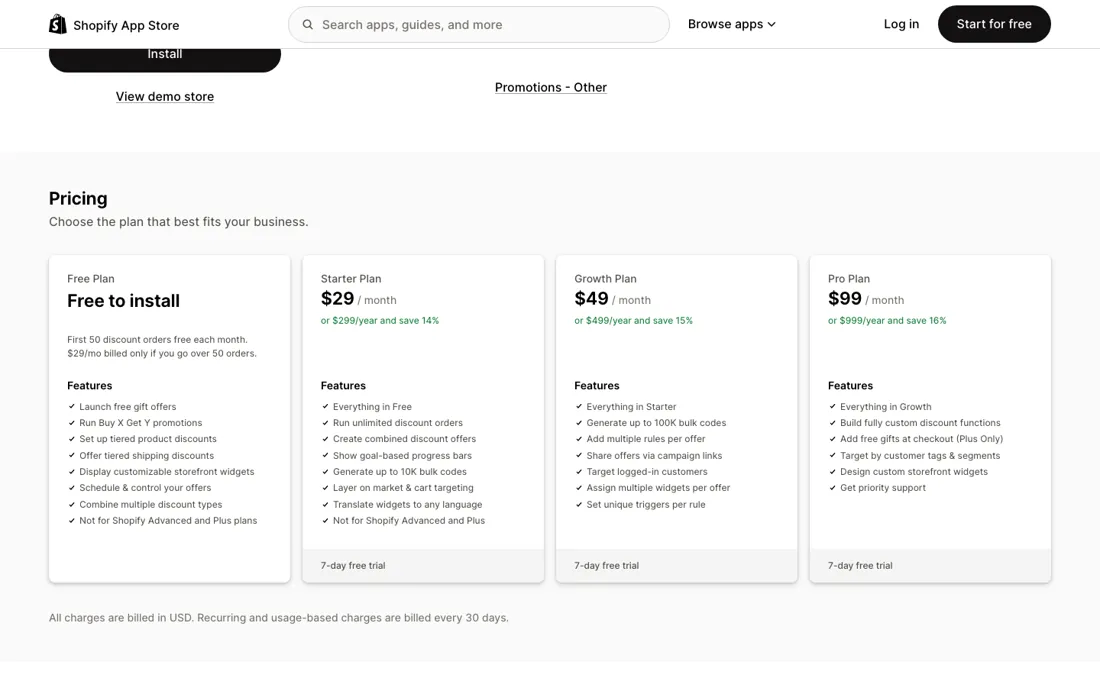
The free plan covers the first 50 discount orders a month, and the same panel says $29 a month is billed once you pass them — so it is a threshold with an invoice behind it, not a free tier you can settle on. A store running one decent promotion will cross 50 discounted orders in days and be on Starter money without choosing to upgrade. The second catch is written on the plans themselves: Free and Starter are both labelled 'Not for Shopify Advanced and Plus', so if you are on either of those Shopify plans your real entry price is the $49 Growth tier, not the $29 the listing leads with.
And the feature most likely to sell the app to a large merchant — free gifts added at checkout — is marked Plus only and sits in the $99 Pro tier, which means the Plus stores it is built for pay $1,188 a year to reach it.
Watch the video review
The video version of this review, from our YouTube channel.
What Kite does
Shopify discount toolkit (by Skai Lama) built on native Shopify Functions: free gift with purchase, buy X get Y, tiered and volume discounts, progress bars and bulk codes.
What buyers report about Kite
Hands-on: not tested by usReported by buyers: the Shopify App Store listing, read September 2026
Themes from the buyer-review sites listed at the foot of this page, read in September 2026. We have not run Kite ourselves, so this is other buyers' experience rather than ours. We summarise it here because the complaints are usually the part a vendor page leaves out.
- • Support, in almost every five-star review and by name — merchants describe replies within hours, agents who build a multi-discount offer with them, and fixes to theme-specific breakage.
- • The range of promotion types in one app: BOGO, buy X get Y, free gift, progress-bar thresholds and stacked codes, without needing a second app for each.
- • Being able to gate a free gift behind a URL, which several reviewers say they could not find anywhere else.
- • Scheduling: upcoming promotions, cut-off times and blocked delivery dates set ahead of a campaign rather than on the night.
- • The discount logic itself misfiring. A November 2025 reviewer reports progress-bar discounts awarding unlimited free products on every item added to the cart, confirmed on a call with the vendor, plus wrong strike-through prices in their USD, GBP, EUR and AUD markets; a January 2026 reviewer reports gifts still being charged for after the conditions were met.
- • Reliability under load: two reviewers say it stopped working during high-volume sales periods, one of them twice.
- • Side-cart and slider themes need a full page refresh before the discount shows.
- • Exclusions. Promotions can be built from inclusions only, so there is no way to exclude a vendor or a collection.
- • The interface was redesigned and two long-term merchants (almost two years and around two years on the app) say it became harder to navigate.
- • No Japanese in the admin, raised by a Japanese merchant a year into using it.
Where the ratings disagree. The score and the complaints describe different risks rather than disagreeing. Kite carries 4.9 across 1,202 ratings, of which 1,147 are five stars and ten are three stars or lower — so the crowd verdict is genuinely strong, and it is mostly a verdict on the support team. What the ten low reviews have in common is the other thing: the discount engine handing out more than it should, or charging for a gift it promised. That is the failure that costs money rather than time, and a 95% five-star rate does not tell you how likely it is on your theme and your markets. Test the exact promotion you plan to run, in your currencies, before a sales peak rather than during one.
Pages read (September 2026): Shopify App Store
Where the four tiers actually diverge
The ladder is not four sizes of the same thing. Free and Starter are the same product with the meter removed — Starter's $29 buys unlimited discount orders, combined offers, progress bars and 10K bulk codes — and both are closed to Advanced and Plus stores. Growth at $49 mostly widens limits: 100K bulk codes, multiple rules per offer, campaign links, targeting logged-in customers. Pro at $99 is where a different kind of feature appears — custom discount functions, checkout gifts, targeting by customer tag and segment.
That shape decides the sum for you. If you are on Basic or Grow, start on Free and let the 50-order threshold tell you whether the app earns $29; you will know within a campaign. If you are on Advanced or Plus, ignore the first two tiers entirely — $49 is your floor, and the only question is whether checkout gifts are worth the further $50 a month to Pro.
Work that one out as revenue per gifted order, because at $1,188 a year it is competing with dedicated upsell apps rather than with the rest of this ladder.
How to actually use Kite
Installation runs from the App Store, so setup starts inside your Shopify admin rather than at a separate signup, and the listing says the app works with Checkout and Shopify Admin alongside a list of cart and page builders — All Slide Carts, Checkout Wizard, Easy Bundles, GemPages, iCart and UpCart — which is worth checking against whatever is already on your storefront before you install. Use the step most merchants skip: the listing carries a View demo store link, so you can watch a gift appear at a cart threshold and a progress bar fill on a live storefront before handing the app access to your store.
Then check your Shopify plan first, because it decides where you can start — Advanced and Plus stores are excluded from Free and Starter. On Basic or Grow, install on the free plan and build one offer, then watch the 50-order threshold: crossing it is what moves you to $29, and it is better to see that happen on a promotion you chose than on one that ran away.
Distilled from The Kite listing on the Shopify App Store (apps.shopify.com/kite-free-gift), read 6 September 2026 — the four plans with their annual rates and stated savings, the free plan's 50-order threshold and the $29 that follows it, the 'Not for Shopify Advanced and Plus' label on the two cheapest tiers, the Plus-only note on checkout gifts, the works-with list, the demo store, the developer (Skai Lama, Indore, MP, IN), the launch date of 28 June 2023 and the 4.9 rating over 1,161 reviews.
Kite vs Stackable, side by side
Each column shows the vendor’s own published entry price, read on the date shown. Entry prices can cover different services or units, so check what each one buys. We do not average them into a score.
The Kite link above is an affiliate link — we may earn a commission if you sign up, at no extra cost to you — and the other column is a plain link. Neither changes what this table says.
The natural comparison is Stackable — Both sit on Shopify's native discount plumbing, and the split is between combining discounts and creating them. Stackable is about redemption: several discounts — order, collection, shipping — under a single code, plus a progress type, from $19.99 a month with no free plan. Kite is about the offers themselves: free gifts, BOGO, tiered and volume pricing, bulk codes and storefront widgets, opening at a metered free tier that turns into $29 past 50 discount orders. So if your promotions already exist and customers keep having to pick which code to use, that is Stackable's problem. If the promotion is the thing you cannot build — a gift that appears at a cart threshold, a tier that rewards the bigger basket — Kite is the one with those mechanics, and it has the far longer record: 1,161 reviews against Stackable's 54..
Frequently asked questions
What does Kite cost?
Four plans, billed in USD every 30 days, read on apps.shopify.com/kite-free-gift on 17 September 2026. Free to install covers the first 50 discount orders each month, and the same card states that $29 a month is billed only if you go over 50 orders. Starter is $29 a month, or $299 a year at a stated 14% saving. Growth is $49 a month, or $499 a year at 15%. Pro is $99 a month, or $999 a year at 16%. Every paid tier carries a 7-day free trial. The ladder buys volume and control rather than the discount types themselves: free gift with purchase, buy X get Y and tiered discounts are already on the free plan.
Is the free plan actually free?
Only up to 50 discount orders a month. The plan card says it in one line — first 50 discount orders free each month, $29 a month billed only if you go over 50 orders — so it is a threshold with an invoice behind it rather than a tier you can settle on. One promotion that works will cross 50 discounted orders in days, and you are on Starter money without having chosen to upgrade. Read 17 September 2026, and unchanged from our first reading on 6 September.
I run Shopify Advanced or Plus — which plan do I start on?
Growth, at $49 a month or $499 a year. Both the Free and the Starter card carry the line 'Not for Shopify Advanced and Plus plans', so the two cheapest options on the page are closed to the larger stores and the real entry price is $49 rather than nothing. One feature sits higher still: adding free gifts at checkout is marked Plus only and appears on the Pro plan at $99 a month. Read 17 September 2026.
Which plan do I need for bulk discount codes?
Bulk codes start on Starter, which lists up to 10,000 generated codes at $29 a month; Growth raises that to up to 100,000 at $49. The free plan lists none at all. If unique codes in bulk are the only reason you are looking, compare a dedicated code generator before you pay for a whole discount engine alongside them. Read 17 September 2026.
Is this a hands-on review of Kite?
This is a researched assessment, not a hands-on test — where we've used a tool ourselves, we say so explicitly. We name what each tool is good and bad at, and we earn a commission only if you sign up, at no cost to you.
- Buyer reviews on the Shopify App Store listing, read September 2026.
- Prices read 2026-09-06 on apps.shopify.com/kite-free-gift.
- A dated screenshot of that pricing page, kept on this site as the receipt.
Others in this category
Reviewed e-commerce tools that share ground with Kite — comparable in what they do, not drop-in swaps:
New reviews, price changes we recorded, and the cost conditions we found. No sponsored placements. Unsubscribe anytime.
This is our researched assessment — not a paid placement. The “Visit” links on this page are affiliate links: we may earn a commission if you sign up, at no extra cost to you, and it never changes our take. How we review →