Stackable Review (2026)
 By Daan Haket · Researched and written with an AI assistant · who does what
The two halves of the pitch are priced five times apart.
shopify stores running several promotions at once — an order discount, free shipping and a collection deal — that want shoppers to redeem them with one code instead of choosing, or that want the progress type which raises the discount as the cart fills.
you run one promotion at a time, because Shopify's own combined discounts already cover that at no cost — or the checkout upsells are the part you actually want, since those only exist in the $99.99 tier here.
Transparency: we earn nothing from Stackable; the links to it are plain links. How we make money →
Pricing (2026)
✓ Pricing re-verified 17 Sep 2026
| This tool | $19.99 | 38th cheapest of 54 |
| Cheapest | $2.99 | MX AI |
| Median | $14.50 | |
| Most expensive | $199 | Auware |
Lowest paid entry price per account a month, billed monthly, in USD, among the 54 e-commerce growth apps we have researched (read between 2026-08-19 and 2026-10-20). Only tools priced in the same unit and on the same billing are compared — not a market survey, and cheapest is not best.
Two paid tiers, billed in USD every 30 days, and no free plan. Growth is $19.99 a month, or $199.99 a year with the annual saving the listing puts at 17%, and covers unlimited combined discounts; that plan carries the label 'For Non-Plus'. Unlimited is $99.99 a month, or $999.99 a year on the same 17%, and adds unlimited checkout upsells and unlimited linked discounts on top of the same combined discounts.
Both tiers come with a 7-day free trial. The plan table lists no order caps, credit allowances or per-use charges, so what the tier costs is what the app costs. Plans change — always verify the live price on their site.
Category context: E-commerce. Across the 42 tools in this category that we researched with a public US-dollar price, the median entry price is $17 a month (lowest paid plan as listed, per seat where the vendor prices per seat). Compare pricing conditions in the Software Cost Atlas →
What the pricing page doesn’t say
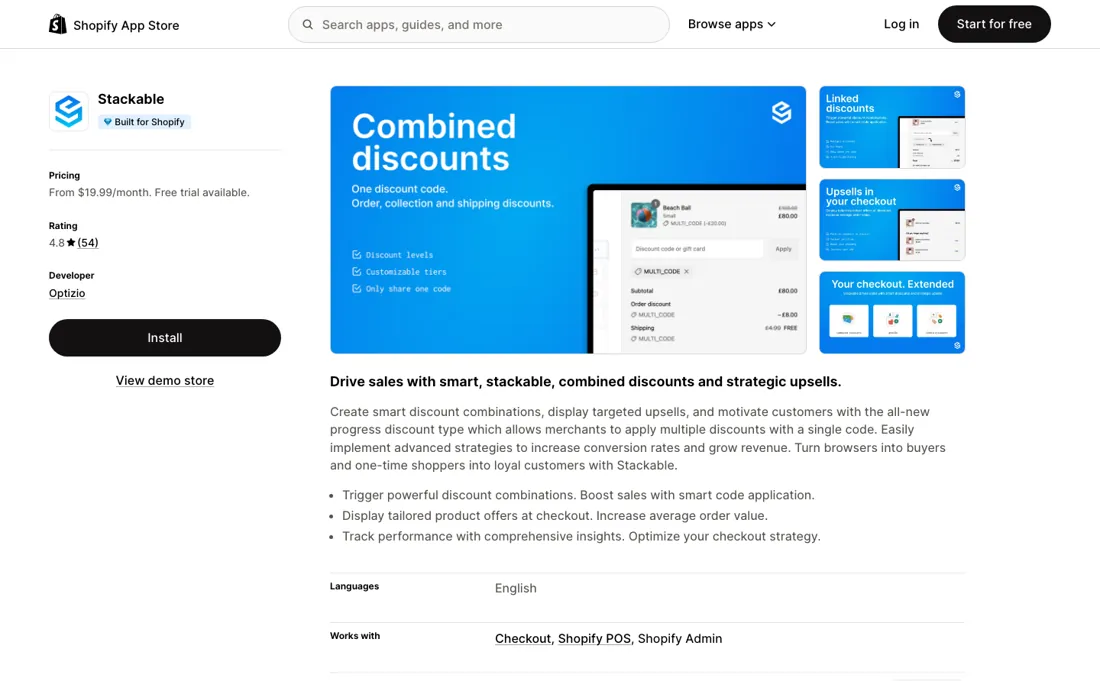
Discount stacking — order, collection and shipping discounts redeemed with a single code — is the $19.99 Growth plan, the one the listing labels 'For Non-Plus'. The checkout upsells and linked discounts the app leads with sit in the $99.99 Unlimited tier only, so a merchant who came for the upsells is reading $1,199.88 a year rather than $239.88. There is no free plan to settle whether the stacking alone lifts an order, so the seven-day trial is the entire evaluation.
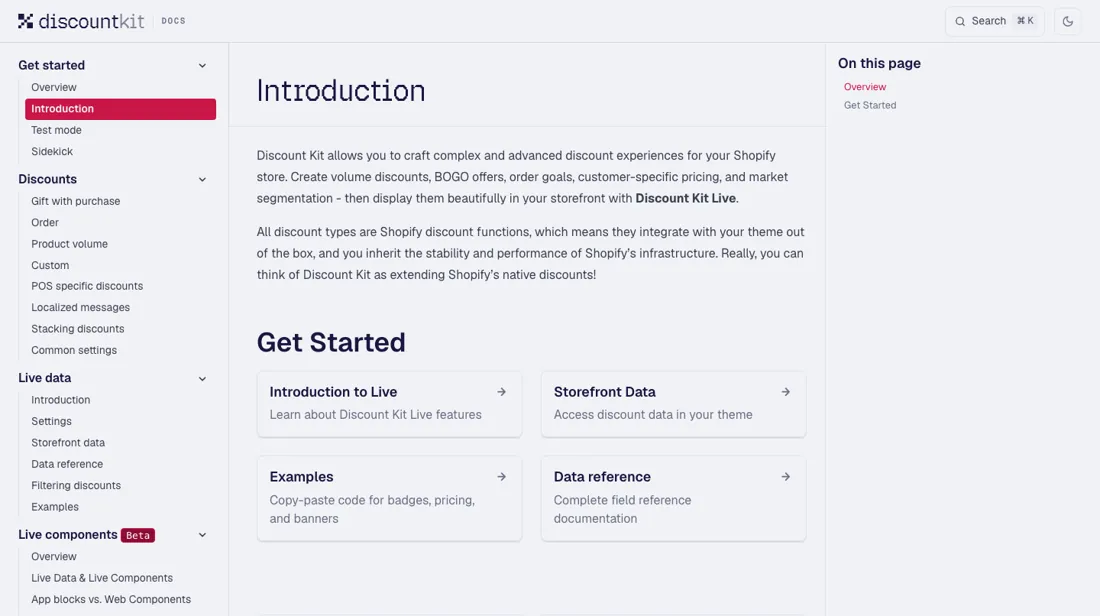
One more thing to check before you commit: the Website link on the listing, www.stkbl.app, now redirects to the documentation for Discount Kit — a different, pricier Optizio app — and that documentation does not mention Stackable anywhere (checked 6 September 2026). For an app that launched on 13 October 2020 and has collected 54 App Store reviews since, ask support where the current documentation lives before the trial clock starts.
Watch the video review
The video version of this review, from our YouTube channel.
What Stackable does
Shopify discount app (by Optizio) that folds several discounts into one code: order, collection and shipping discounts combined, a progress type that raises the discount as the cart grows, and checkout upsells on the top tier.
What buyers report about Stackable
Hands-on: not tested by usReported by buyers: the Shopify App Store listing, read September 2026
Themes from the buyer-review sites listed at the foot of this page, read in September 2026. We have not run Stackable ourselves, so this is other buyers' experience rather than ours. We summarise it here because the complaints are usually the part a vendor page leaves out.
- • The one thing it is bought for: linking discount codes so a percentage code and a free-shipping code apply together, which reviewers repeatedly say they could not find in another app or in Shopify's own automatic discounts.
- • Segmenting by collection, so a stacked promotion can exclude the products that should not be in it.
- • Gift cards keep working alongside the stacked codes.
- • Support that fixes theme-level problems quickly and by name, including after Shopify changed something on the back end.
- • It doubles as automatic bundling, and competing automatic and manual discounts can be set to resolve to the best price for the customer.
- • The vendor sunset older versions of the app at the end of June 2025. One merchant of about three years reports losing every discount and their header with it; the vendor replied publicly that it had emailed and messaged in-app for months beforehand and offered migration help. That is the single one-star review on the listing.
- • BOGO promotions do not let you choose the variant of the gift item.
- • One merchant reports discounts taking a while to load during heavy traffic, though the promotion still applied.
Where the ratings disagree. The 4.8 is real but thin and largely historical. It rests on 54 ratings, 52 of them five stars, and they have arrived slowly: reading the listing newest-first on 17 September 2026 gives two entries from 2026 — both a rating with no written text — five from 2025, and the rest going back through 2024, 2023, 2022 and 2020. So most of the score was earned by versions of the app that the vendor has since retired, and the one review describing that retirement is the one-star. Treat the rating as evidence that the stacking idea works, not as evidence about the version you would install today.
Pages read (September 2026): Shopify App Store
What the $99.99 tier actually adds
The step from Growth to Unlimited is $19.99 to $99.99, and the plan table names exactly two things you get for it: unlimited checkout upsells and unlimited linked discounts. Combined discounts are already unlimited on Growth, so the extra $80 a month does not buy more of the thing the app is named after — it buys a second product, offers placed at checkout, bolted onto the first. That makes the decision cleaner than most ladders.
Work out what a checkout upsell would have to earn to cover the gap — $960 a year on 30-day billing, or $800 on the annual plans ($999.99 against $199.99) — and judge that tier as upsell software rather than discount software, because at $99.99 it is competing with upsell apps. If the sum does not close, Growth carries the stacking on its own, and the listing marks it 'For Non-Plus' — the tier most stores reading this will land on anyway.
What neither tier buys is a way to try before the meter starts: with no free plan, the seven-day trial is the whole evaluation window.
How to actually use Stackable
Installation runs from the App Store, so setup starts inside your Shopify admin rather than at a separate signup, and the listing says the app works with Checkout, Shopify POS and Shopify Admin. Before you install, use the step most merchants skip: the listing carries a View demo store link, so you can watch stacked discounts and the progress type behave on a live storefront without first handing the app access to your products, orders, discounts and customer data — access it does ask for.
Then treat the seven-day trial as the entire evaluation, because there is no free tier to fall back on. Build the one combination you actually need — an order discount plus free shipping plus a collection deal, say — and test it the way a customer would: one cart that should qualify and one that should not, on the live storefront. Two practical notes. Growth is marked 'For Non-Plus', so if checkout upsells are on your list you would be testing a tier you do not intend to stay on.
And plan to ask support your setup questions: the listing's own Website link (www.stkbl.app) redirects to the documentation for Discount Kit, another Optizio app, and that documentation does not cover Stackable (checked 6 September 2026).
Distilled from The Stackable listing on the Shopify App Store (apps.shopify.com/stackable-discounts), read 6 September 2026 — the two plans and their annual rates, the 7-day trial, the 'For Non-Plus' label on Growth, the works-with list, the data the app asks for, the demo store, the launch date of 13 October 2020 and the review count — plus a check of the listing's own Website link (www.stkbl.app), which redirects to help.discountkit.app and on to discountkit.app/docs/documentation/, where Stackable is not mentioned.
Stackable vs Smarty Discounts, side by side
Each column shows the vendor’s own published entry price, read on the date shown. Entry prices can cover different services or units, so check what each one buys. We do not average them into a score.
The natural comparison is Smarty Discounts — Both extend Shopify's native discount engine, and the money separates them more than the feature lists do. Smarty Discounts has a free tier and tops out at $25.99 a month, and it aims at rules the native engine cannot express — capped and fixed-amount discounts that survive currency conversion, tiers by quantity and subtotal. Stackable aims at combination instead: several discounts under one code, a progress type that raises the discount as the cart grows, and checkout upsells in its top tier. So if the problem is 'this rule cannot be built', start with Smarty and pay nothing to find out. If the problem is 'my customers have to pick which code to use', that is Stackable's job — but there is no free tier here to test it on, only the seven-day trial..
Frequently asked questions
What does Stackable cost?
Two tiers and no free plan, both billed in USD every 30 days, read again on apps.shopify.com/stackable-discounts on 17 September 2026. The entry is Growth: $19.99 a month, or $199.99 if you pay for the year, which the listing prices as a 17% saving. Above it sits Unlimited, five times the money at $99.99 a month or $999.99 for the year at that same discount. Both open with a 7-day free trial. What separates the two is not how much you use the app but which half of it you get — see the next question.
Which plan has the checkout upsells?
Only Unlimited, at $99.99 a month. That gap is worth reading twice, because the app leads its own description with targeted upsells at checkout and with linked discount codes, and both sit five times above the entry price. If what you want is discount stacking — an order discount, a collection deal and free shipping redeemed with a single code — Growth at $19.99 covers it and your year costs $239.88. If you came for the upsells, your year is $1,199.88. Read 17 September 2026.
I'm on Shopify Plus — does the $19.99 plan apply to me?
The Growth card carries the label 'For Non-Plus' and the listing explains it nowhere else. What the page does not say is what a Plus store is meant to do instead: Unlimited at $99.99 carries no matching 'For Plus' label, it simply holds more. If you are on Plus and Growth is the plan you want, ask Optizio what that label means before you install rather than after. Read 17 September 2026.
How current is the 4.8 rating?
Less current than it looks. The score rests on 54 ratings, 52 of them five stars, with one three-star and one one-star. Sorted newest first, the two ratings that arrived in 2026 — 2 July and 14 July — carry no written text at all, and the most recent review with words behind it is from 16 September 2025. The app launched on 13 October 2020, so the number you are reading describes the app as merchants found it in 2025. Read 17 September 2026.
What happened to the older version of the app?
Optizio sunset older versions of Stackable at the end of June 2025 because of changes on the Shopify platform. It shows up in the only one-star review on the listing, left on 6 August 2025 by a merchant who had run the app for about three years and found their discounts and their header gone; the vendor replied on 25 August 2025 that the change had been communicated by email and in-app over the preceding months and that they were willing to help people migrate. Both sides of that are on the page. If you are going to build promotions on top of this app, ask support how the next version change will reach you.
Is this a hands-on review of Stackable?
This is a researched assessment, not a hands-on test — where we've used a tool ourselves, we say so explicitly. We name what each tool is good and bad at, and we have no affiliate relationship with Stackable — we earn nothing whether you sign up or not.
- Buyer reviews on the Shopify App Store listing, read September 2026.
- Prices read 2026-09-06 on apps.shopify.com/stackable-discounts.
- A dated screenshot of that pricing page, kept on this site as the receipt.
Others in this category
Reviewed e-commerce tools that share ground with Stackable — comparable in what they do, not drop-in swaps:
New reviews, price changes we recorded, and the cost conditions we found. No sponsored placements. Unsubscribe anytime.
This is our researched assessment — not a paid placement. How we review →