Atlas AI Store Builder Review (2026)
 By Daan Haket · Researched and written with an AI assistant · who does what
The meter runs on your success, not your usage.
sellers testing many product ideas quickly who want a full Shopify storefront from a single product link, and who will genuinely stay inside 10 pages and 250 orders a month or have priced the overage.
you run one established store with real order volume — the caps turn a $39 tool into a variable bill exactly when the store starts working — or you want a page builder you keep after you stop paying.
Transparency: the “Visit” links on this page are affiliate links — we may earn a commission if you sign up, at no extra cost to you. No vendor can pay for a better review or verdict. How we make money →
Pricing (2026)
✓ Pricing re-verified 9 Oct 2026
| This tool | $39 | 50th cheapest of 56 |
| Cheapest | $2.99 | MX AI |
| Median | $15 | |
| Most expensive | $199 | Auware |
Lowest paid entry price per account a month, billed monthly, in USD, among the 56 e-commerce growth apps we have researched (read between 2026-08-19 and 2026-10-21). Only tools priced in the same unit and on the same billing are compared — not a market survey, and cheapest is not best.
The listing says “Free to install”, but that is the development-store tier. A real store runs on the All-in-One plan at $39 a month, billed in USD with a 7-day free trial. What $39 buys is capped rather than unlimited. On 9 October 2026 the vendor's pricing section lists up to 10 published pages (it was 5 on 18 August), up to $1,000 of bundle revenue and up to 250 cart orders; AI photos, listed at 50 in August, no longer appear in that list.
Their pricing page states it plainly: “you’ll be charged the base plan fees and given access to features to a limit, any additional uses for those features can be purchased as shown in the per feature pricing”, but the rendered page showed no per-feature prices on 9 October. The App Store listing adds that “additional charges apply as your store generates revenue and impact”, and that recurring and usage-based charges are billed every 30 days. Plans change — always verify the live price on their site.
Category context: E-commerce. Across the 44 tools in this category that we researched with a public US-dollar price, the median entry price is $19 a month (lowest paid plan as listed, per seat where the vendor prices per seat). Atlas AI Store Builder’s entry price of $39 a month sits above that median. Compare pricing conditions in the Software Cost Atlas →
What the pricing page doesn’t say
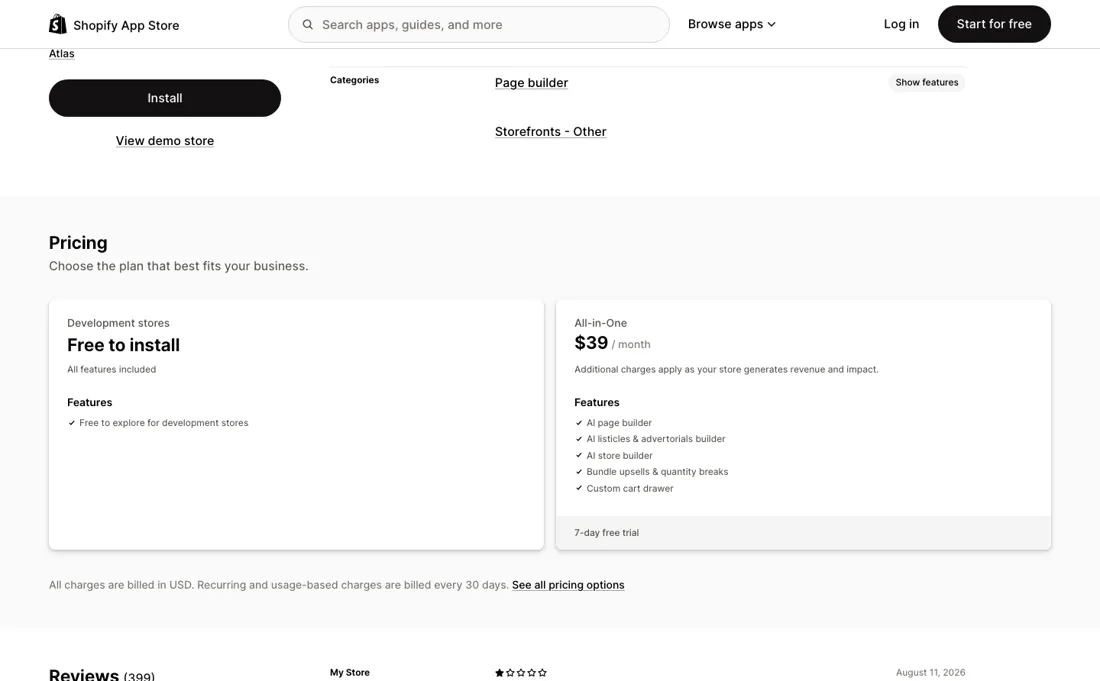
$1,000 of bundle revenue and 250 cart orders is a rounding error for a store that is actually working. So the $39 headline describes the bill of a store that has not started selling yet. Price the tier you expect to be on in month three, not the one you sign up on. Two other things worth knowing before you install. The rating is 4.6 from 374 reviews on 9 October 2026, but 25 of those are one star and the recent ones are about billing rather than the product: one seller writes “cancelled it, uninstalled it, but still getting charged” after two months.
And the listing carries a line Shopify does not require of most apps: “Atlas must not be used to copy, duplicate, or reproduce products, product listings, images, or store content from any website, or marketplace without the explicit permission of the rights holder”. That tells you what a paste-a-product-link builder gets used for.
Watch the video review
The video version of this review, from our YouTube channel.
What Atlas AI Store Builder does
Shopify app that builds a full store or product page from a single product link — layout, copy and images generated automatically, plus bundle and cart upsells.

What buyers report about Atlas AI Store Builder
Hands-on: not tested by usReported by buyers: Shopify App Store, read August 2026
Themes from the buyer-review sites listed at the foot of this page, read in August 2026. We have not run Atlas AI Store Builder ourselves, so this is other buyers' experience rather than ours. We summarise it here because the complaints are usually the part a vendor page leaves out.
- • Support is what the five-star reviews are actually about, and reviewers name the people: a May 2026 merchant describes reporting a cart-drawer bug late at night, getting a reply within minutes, and watching it fixed after granting collaborator access.
- • The bundle and offer pages are the feature merchants credit by name — tiered offers, custom badges and editable images and text — rather than the full-store generation the app leads with.
- • Billing continuing after uninstall is the single most repeated complaint, and it is recent: reviewers in June, July and August 2026 report charges after removing the app, including one merchant charged $39 despite cancelling and deleting before the free trial ended, and another who says the refund was issued once and then the charges resumed.
- • Uninstalling can leave the storefront broken. A May 2026 merchant did not realise the app also replaces the home page, and reports that after uninstalling, Atlas elements stayed behind and could not be deleted, taking the page down.
- • An August 2026 reviewer says no support phone number or email is listed and they had to go looking for one — which is the opposite of the same-day support the positive reviews describe.
Where the ratings disagree. The distribution matters more than the average here. The listing sits at 4.7 across 396 reviews with 87% at five stars, but 18 one-star reviews sit underneath it and the recent ones are almost entirely about billing rather than about the store builder. The praise is about what happens while you are paying; the criticism is about what happens when you try to stop. That pairs directly with the listing's own line that further charges apply as your store generates revenue, without publishing what those charges are.
Pages read (August 2026): Shopify App Store
When the paid plan is worth it
There is only one paid plan, so the real question is not which tier but what the tier leaves open. All-in-one is $39 a month and the listing adds that further charges apply as your store generates revenue and impact, without publishing what those charges are. That is an open end on the only price they do quote, and it is the number to ask about in writing before you install.
The free tier is for development stores only, so it is a sandbox rather than a trial; the actual trial is 7 days. On the App Store listing, read 9 October 2026, the rating is 4.6 from 374 reviews (it was 4.7 from 390 on 19 August). Note the shape of that average: 318 five-star ratings sit beside 25 one-star ones. The one-star reviews visible on the day we read them describe being charged after cancelling and uninstalling.
A high average with a heavy tail at the bottom is worth more attention than the average alone.
Our monthly capture read this vendor's pricing page every month from August 2026 to October 2026, and the amounts were the same all 3 times, including $39 and $1,000 from the pricing above. We keep watching — the registry records what moves.
Questions we are still checking
Facts about Atlas AI Store Builder that would change a buying decision, and where we stand on each. An unanswered question does not mean the feature is missing; it means we have not confirmed it yet.
- What does Atlas charge per extra published page, per $1,000 of bundle revenue and per cart order above the $39 base caps? Still checking
Applies to: All-in-One plan, $39 a month.
Why it matters: the base plan caps pages, bundle revenue and cart orders, and the listing says additional charges apply as the store generates revenue, but no per-feature rate was visible on 9 October 2026.
Checked: Atlas pricing section (2026-10-09); Atlas App Store listing (2026-10-09); Shopify help: App charges on your Shopify bills (2026-10-09)
Have a public source that answers one of these? How we review explains how we check and correct.
How to actually use Atlas AI Store Builder
Install on a development store first, which is free and lets you see what the AI actually produces before any billing starts. Paste one product link and compare the generated store against what you would have built: the speed is real, the question is whether the copy and layout survive your own editing. Watch two counters from day one rather than at renewal — published pages (10) and cart orders (250) — because those are what convert a flat $39 into a variable bill.
If you cancel, cancel inside Shopify and check the next invoice: the recurring one-star theme in the reviews is charges continuing after uninstall, and Shopify billing for apps is easier to dispute early than late.
Distilled from apps.shopify.com/dropshipt and helloatlas.io/#pricing, read 18 August 2026. Re-read and documentation on 9 October 2026: the App Store listing (plan, trial, rating breakdown, review texts), the pricing section on helloatlas.io, and Shopify's help pages 'App charges on your Shopify bills' and 'Uninstalling apps'.
Visit Atlas AI Store Builder →
Frequently asked questions
If I uninstall Atlas, does the billing stop and does its code leave my store?
Not necessarily straight away. Shopify's 'Uninstalling apps' page (read 9 October 2026) says uninstalling a paid app cancels future recurring charges but you might still be billed for the current billing cycle, that a pending charge can still appear on the next invoice, that refunds must be requested from the app developer (ideally before you uninstall), and that some apps leave theme code that is not removed automatically. Atlas's own listing does not describe extra uninstall steps. One-star reviews on the listing report charges after uninstalling (July 2026) and leftover code blocking checkout (August 2026). So ask Atlas for any refund first, then check your theme and app embeds and your next Shopify bill.
What does the $39 Atlas plan actually include?
On 9 October 2026 helloatlas.io lists up to 10 published pages, up to $1,000 of bundle revenue and up to 250 cart orders, with the AI store builder, page builder, bundle upsells and cart upsells. It says extra use 'can be purchased as shown in the per feature pricing', but the rendered page showed no per-feature prices that day, and the App Store listing only says 'additional charges apply as your store generates revenue and impact'. Usage charges appear on your regular Shopify bill and are billed every 30 days (Shopify, 'App charges on your Shopify bills', read 9 October 2026). Get the overage rate in writing before you rely on it.
Is this a hands-on review of Atlas AI Store Builder?
This is a researched assessment, not a hands-on test — where we've used a tool ourselves, we say so explicitly. We name what each tool is good and bad at, and we earn a commission only if you sign up, at no cost to you.
- Buyer reviews on Shopify App Store, read August 2026.
- Re-verified 2026-10-09 on apps.shopify.com/dropshipt and helloatlas.io; first read 2026-08-18.
- A dated screenshot of that pricing page, kept on this site as the receipt.
Others in this category
Reviewed e-commerce tools that share ground with Atlas AI Store Builder — comparable in what they do, not drop-in swaps:
New reviews, price changes we recorded, and the cost conditions we found. No sponsored placements. Unsubscribe anytime.
This is our researched assessment — not a paid placement. The “Visit” links on this page are affiliate links: we may earn a commission if you sign up, at no extra cost to you, and it never changes our take. How we review →