Aura Review (2026)Your Sales Volume Picks the Tier
 By Daan Haket · Researched and written with an AI assistant · who does what
The tier is decided by how much you sell, not by what you need.
Amazon and Walmart sellers past the point where manual repricing costs more attention than it is worth, and whose monthly volume sits comfortably inside one band.
your catalogue is small or your prices rarely need to move — repricing pays back on competition and volume, and at low volume the $37 is buying automation you could do by hand.
Transparency: we earn nothing from Aura; the links to it are plain links. How we make money →
Pricing (2026)
✓ Pricing re-verified 11 Oct 2026
(2026-08-28, checked line by line against their own pricing page; every figure below is the same as on 1 Aug 2026) Flat per account, not per seat, with unlimited listings on every tier. Starter $37/month ($451 a year), Essential $77 ($931), Plus $157 ($1,891), Pro $237 ($2,851) — annual saves 20%. The ladder is set by monthly sales volume, not by features: Starter up to $15K, Essential up to $50K, Plus up to $250K, Pro up to $1M.
Marketplaces included: 2, 3, 4 and 6. Aura AI covers 250, 500, 1,000 and unlimited listings; Hyperdrive 10, 25, 50 and 100 allocations; user seats 1, 2, 5 and unlimited. Their table adds three things the earlier reading did not record: monthly sales are calculated on a trailing two months, workflows run 5, 10, unlimited and unlimited, and there is a 14-day free trial.
Re-verified 11 October 2026 on goaura.com/pricing: all four prices, annual totals, sales bands, marketplace counts, allowances and the 14-day trial unchanged. The billing toggle still reads 'Annually (save 20%)', while the FAQ on the same page says annual gives 'two months free on every tier' and 'up to 17% off compared to monthly'; the monthly rates are not printed in the page source we read, so we cannot recompute which figure is right. Plans change — always verify the live price on their site.
Category context: E-commerce. Across the 46 tools in this category that we researched with a public US-dollar price, the median entry price is $19 a month (lowest paid plan as listed, per seat where the vendor prices per seat). Aura’s entry price of $37 a month sits above that median. Compare pricing conditions in the Software Cost Atlas →
What the pricing page doesn’t say
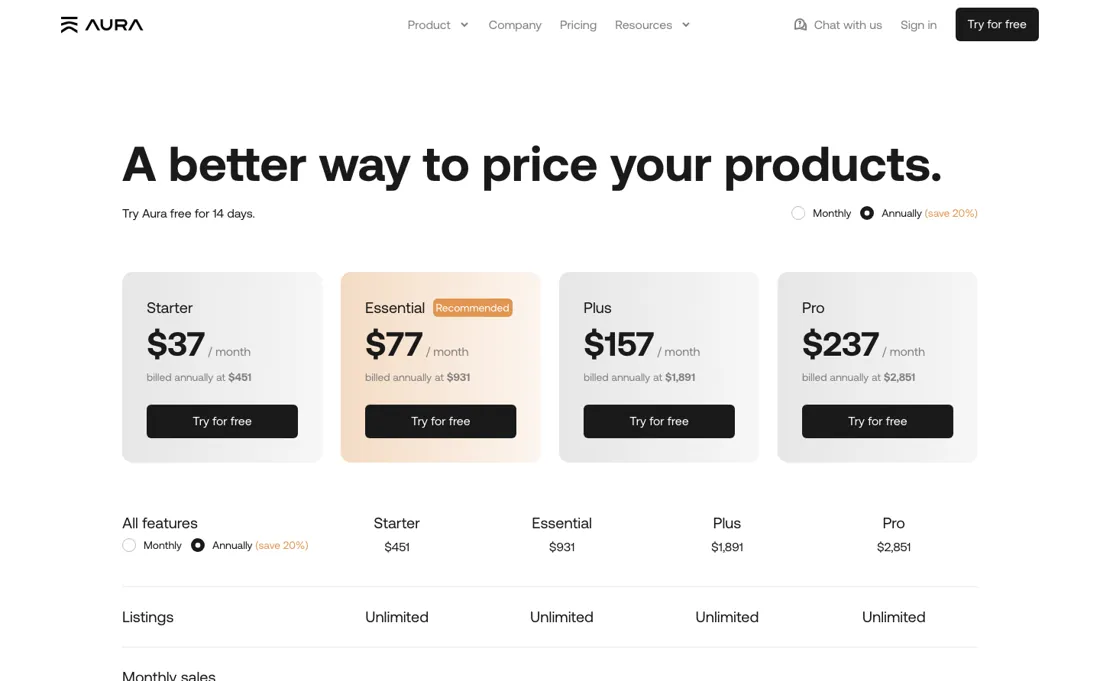
That is unusually honest as a model — a seller doing $10K a month is not subsidising one doing $900K — but it means your bill moves when your business does, in the same month, without you choosing to upgrade. Pass $15K and Starter stops being the plan you are on. Work out which band you land in the way the page measures it: their table says monthly sales are calculated on a trailing two months, so it is a sustained climb rather than a single spike that moves you up.
Two smaller things: the marketplace count is a real cap (two on Starter, so Amazon plus one), and the AI listing allowance is per listing rather than per repricing action, so a large catalogue eats it faster than a busy one.
Watch the video review
The video version of this review, from our YouTube channel.
What Aura does
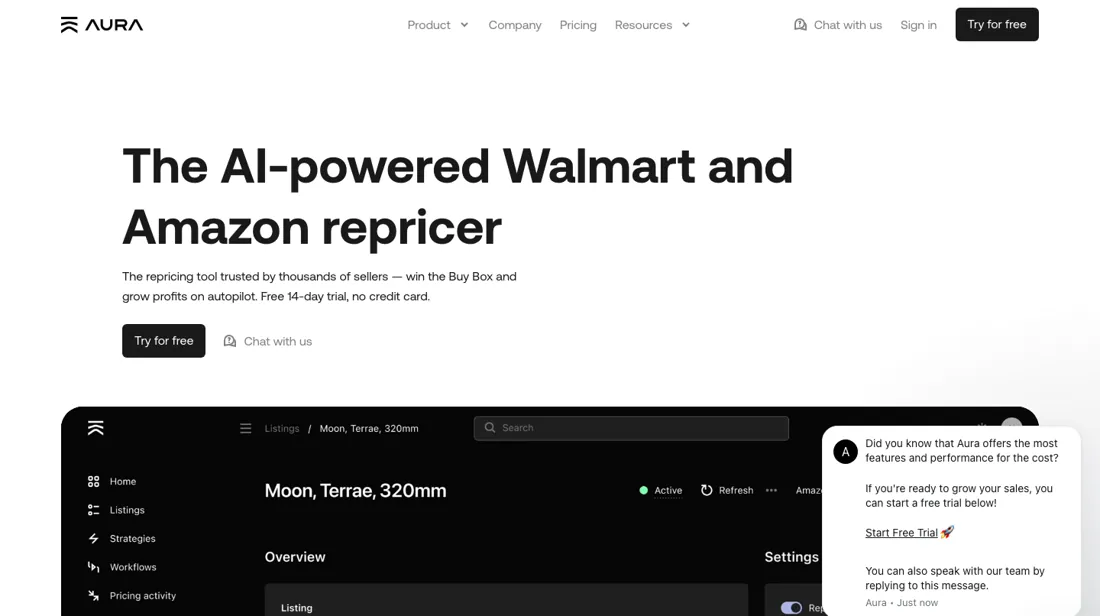
Dynamic repricing for Amazon and Walmart sellers — automated price strategy across marketplaces.
When the paid plan is worth it
You do not choose a tier here so much as your sales choose it for you, and that makes the ceilings the thing to read rather than the features. Starter is $37 a month up to $15K in monthly sales, Essential $77 up to $50K, Plus $157 up to $250K, Pro $237 up to $1M. Cross a line and the bill steps: a seller doing $16K a month pays $77 rather than $37 -- more than double the price for a thousand dollars more turnover.
Their table calculates volume on a trailing two months, so plan around a sustained level, not one spike. As a share of sales the picture reverses, and it is worth seeing both ways. At each ceiling the tool costs 0.25% of sales on Starter, 0.15% on Essential, 0.06% on Plus and 0.024% on Pro. So it is most expensive for the smallest seller and almost free at scale -- but only near the top of your band.
Sitting just above a threshold is the worst place to be. What the tiers do carry beyond volume: marketplaces (2, 3, 4 and 6), Aura AI listings (250, 500, 1,000 and unlimited), Hyperdrive allocations (10, 25, 50, 100) and seats (1, 2, 5, unlimited). Listings are unlimited on every tier and the price is per account rather than per seat, so adding people costs nothing until you hit the seat cap. Annual billing takes 20% off.
Our monthly capture read this vendor's pricing page every month from August 2026 to October 2026, and the amounts were the same all 3 times, including $451, $931, $1,891 and $2,851 from the pricing above. We keep watching — the registry records what moves.
Questions we checked
Facts about Aura that would change a buying decision, and where we stand on each. An unanswered question does not mean the feature is missing; it means we have not confirmed it yet.
- Does annual billing save 20% or up to 17%? Sources disagree
Applies to: all tiers, annual billing.
Why it matters: the same pricing page states both figures, and the monthly rates are not readable in the page source.
Answer: The toggle on goaura.com/pricing (read 11 October 2026) says 'Annually (save 20%)'; the page's FAQ says 'two months free on every tier' and 'up to 17% off compared to monthly'. We budget from the printed annual totals and treat the percentage as unconfirmed.
Checked: Aura pricing page (2026-10-11)
Have a public source that answers one of these? How we review explains how we check and correct.
How to actually use Aura
Work out which band you land in the way Aura measures it: the tier is set by monthly sales volume rather than features, and their table calculates that volume on a trailing two months. Cross $15K on that basis and Starter stops being your plan, without you choosing to upgrade. Then look at it as a take rate, because that is where the model is genuinely fair. At the top of each band you are paying 0.25% of sales on Starter, 0.15% on Essential, 0.06% on Plus and 0.02% on Pro — it gets cheaper as a share of your business the bigger you get.
Just past a threshold it is the opposite: $15,001 of sales puts you on Essential at $77, which is 0.51% of the same $15K. If your volume hovers near a boundary, that is the number to know. Count marketplaces before you count anything else. Two on Starter means Amazon plus one, and that is a hard cap rather than a soft one — three, four and six come with the tiers above.
Check the AI listing allowance the same way: it is counted per listing rather than per repricing action, so a large catalogue consumes it faster than a busy one does. Annual billing saves 20%, and because the tier moves with your sales anyway, committing annually is less binding than it sounds.
Where this section comes from: our research notes (137 words)
Aura's own pricing page (https://goaura.com/pricing), read line by line: the plan table sets the ladder by monthly sales volume rather than by features (Starter up to $15K at $37, Essential up to $50K at $77, Plus up to $250K at $157, Pro up to $1M at $237), states that monthly sales are 'Calculated on a trailing 2-months', gives the marketplaces included per tier as 2, 3, 4 and 6, counts the Aura AI (Maven) allowance in listings rather than in repricing actions (250, 500, 1,000 and unlimited), and advertises the 20% annual saving Re-verified 11 October 2026 on goaura.com/pricing (plan table and FAQ), plus the help-center articles 'How to upgrade my Aura subscription' (help.goaura.com/en/articles/8902374), 'How do I cancel or pause my subscription?' (help.goaura.com/en/articles/8183189) and 'How Can I Download / Export My Data?' (help.goaura.com/en/articles/3567186), read 11 October 2026.
Aura vs Seller Snap, side by side
Each column shows the vendor’s own published entry price, read on the date shown. Entry prices can cover different services or units, so check what each one buys. We do not average them into a score.
The Seller Snap link above is an affiliate link — we may earn a commission if you sign up, at no extra cost to you — and the other column is a plain link. Neither changes what this table says.
The natural comparison is Seller Snap or RepricerExpress — the direct repricing peers — compare on which marketplaces are included and where the volume band ends, not on the monthly sticker.
Frequently asked questions
Can I move down a tier, and how do I cancel?
Upgrading is self-serve: Aura's help article 'How to upgrade my Aura subscription' (help.goaura.com, read 11 October 2026) routes it through Settings, Plan and the billing portal, and an upgrade mid-cycle is charged as a prorated amount for the time left. Downgrading has a condition: you can only move to a tier whose sales cap sits above your average monthly revenue, so a seller who has grown into Plus cannot drop back to Essential to save money. Cancelling runs through support: 'How do I cancel or pause my subscription?' (read 11 October 2026) says to ask via in-app chat; Aura may offer a pause with a temporary account credit, otherwise it schedules the cancellation for the end of the billing cycle and keeps your account data. The pricing-page FAQ adds that there are no contracts or cancellation fees, but says you cancel from your account settings, so the two pages differ on the route.
Is the annual saving 20% or 17%?
The page says both. On goaura.com/pricing (read 11 October 2026) the billing toggle reads 'Annually (save 20%)', while the FAQ on the same page says going annual gives 'two months free on every tier' and 'up to 17% off compared to monthly'; two months free is 16.7%. The monthly rates are not printed in the page source we could read, so we cannot recompute it ourselves. Budget from the annual totals the page does print: $451, $931, $1,891 and $2,851 a year.
What can I take with me if I leave?
Your listing data, as a CSV. Aura's help article 'How Can I Download / Export My Data?' (read 11 October 2026) says a Pre-filled Template from the Uploads page exports all listing data at once. It does not mention exporting strategies, workflows or repricing history, so treat those as not confirmed.
Is this a hands-on review of Aura?
This is a researched assessment, not a hands-on test — where we've used a tool ourselves, we say so explicitly. We name what each tool is good and bad at, and we have no affiliate relationship with Aura — we earn nothing whether you sign up or not.
- Aura’s own published pricing page.
- A dated screenshot of that pricing page, kept on this site as the receipt.
Others in this category
Reviewed e-commerce tools that share ground with Aura — comparable in what they do, not drop-in swaps:
New reviews, price changes we recorded, and the cost conditions we found. No sponsored placements. Unsubscribe anytime.
This is our researched assessment — not a paid placement. How we review →