Code Bulk Discounts Review (2026)
 By Daan Haket · Researched and written with an AI assistant · who does what
Read the free plan's number twice, because the word doing the work is 'lifetime': it is 500 codes in total, not 500 a month.
shopify stores that already run email or SMS campaigns and need thousands of unique, single-use codes generated out of one existing discount and handed over as a CSV.
you need one or two codes, which Shopify's own discount screen already gives you at no cost — or the campaign itself is what you want, because this app generates and exports the codes and stops there.
Transparency: we earn nothing from Code Bulk Discounts; the links to it are plain links. How we make money →
Pricing (2026)
✓ Pricing re-verified 16 Sep 2026
Two plans, billed in USD every 30 days. Free costs nothing and covers 500 lifetime codes with CSV export. Pro is $14.99 a month and lifts that to unlimited codes per month, with the same CSV export; both plans say they work with most discount applications. The plan table lists no annual rate, no free trial on Pro and no per-code charge, so the monthly figure is the whole cost. Plans change — always verify the live price on their site.
Category context: E-commerce. Across the 44 tools in this category that we researched with a public US-dollar price, the median entry price is $19 a month (lowest paid plan as listed, per seat where the vendor prices per seat). Code Bulk Discounts’s entry price of $14.99 a month sits below that median. Compare pricing conditions in the Software Cost Atlas →
What the pricing page doesn’t say
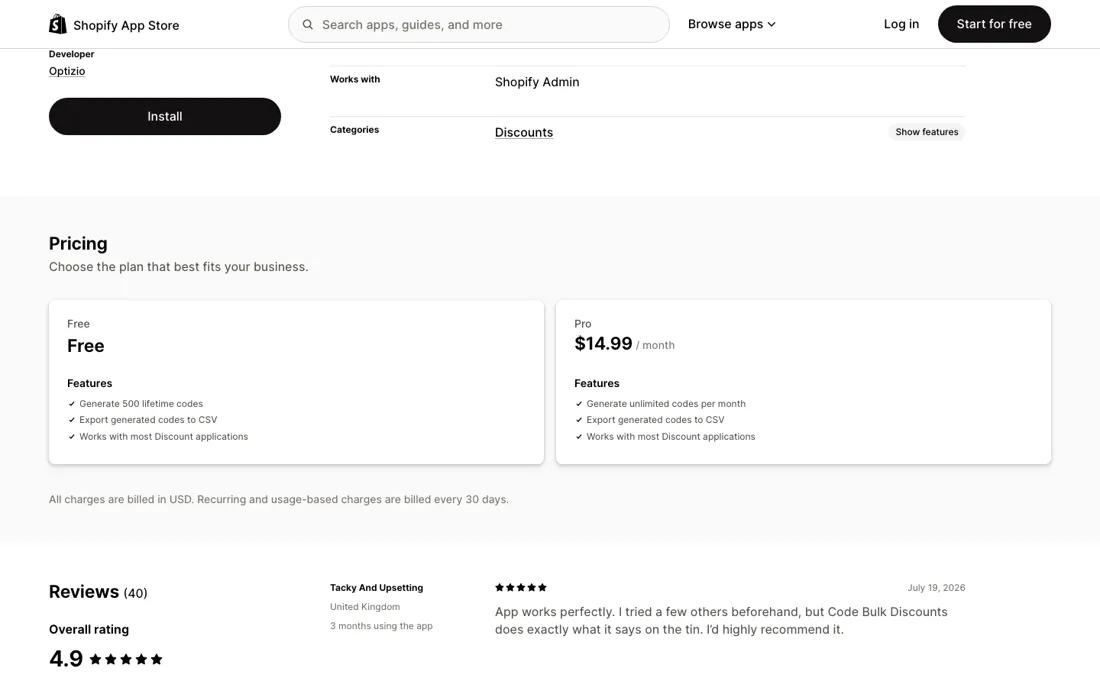
One influencer drop or one email segment can spend the whole allowance in an afternoon, and after that the only way on is $14.99 a month — so the free tier is a sample, not a plan. What the app does is also narrower than the word 'discounts' suggests. It takes a discount you have already created and multiplies it into unique codes you export as a CSV. It does not create the discount rule, does not send the codes to anyone, and does not report which ones were redeemed, so it sits between your discount settings and your email or SMS tool and needs both of those to be worth anything.
The one critical review on the listing shows what that costs in practice: when a merchant's parent discount broke after an unrelated change to their stack, every code generated from it went inactive and they learned about it from customers rather than from the app. The developer's answer is the right one to remember — the rules and logic belong to the parent discount, not to Code Bulk — but it means nothing in this app will tell you that a batch has stopped working.
The 5.0 rating also rests on 41 reviews, read 16 September 2026, which is a thin record next to the app's peers.
Watch the video review
The video version of this review, from our YouTube channel.
What Code Bulk Discounts does
Shopify app (by Optizio) that turns a discount you have already created into thousands of unique codes and exports them as CSV for email and SMS campaigns.
What buyers report about Code Bulk Discounts
Hands-on: not tested by usReported by buyers: the Shopify App Store listing and its review page, read September 2026
Themes from the buyer-review sites listed at the foot of this page, read in September 2026. We have not run Code Bulk Discounts ourselves, so this is other buyers' experience rather than ours. We summarise it here because the complaints are usually the part a vendor page leaves out.
- • 5.0 over 41 reviews on the Shopify App Store, read 16 September 2026, with 40 of the 41 at five stars and a single three-star review; the app has been listed since 24 May 2024 and carries the Built for Shopify badge.
- • The repeated compliment is narrowness done well. A UK merchant in July 2026 says they tried several others first and this one does exactly what it says on the tin; a Spanish store in April 2026 puts it as needing something that does one thing and does it right; a US merchant in February 2026 reports easy setup, zero bugs and a clean UI after twelve months on the app.
- • Price comes up unprompted as the reason merchants switched: a Belgian store in January 2026 calls it simple, effective and low-priced next to other bulk-code apps, and a US medical-device store in March 2025 says it costs a fraction of other bulk discount code generators and moved its business across.
- • Support is named repeatedly, and by name. A UK skincare brand in May 2026 says the team recorded a video for their specific question; an Indian store in April 2026 describes being walked through a code-deletion problem that turned out to be a Shopify bug rather than an app bug; a US merchant in December 2024 names the individual developers who turned their feature requests around quickly.
- • The one critical review, from a US store in January 2026, is the most useful thing on the page: their parent discount broke after an unrelated change to their tech stack, which silently rendered every code generated from it inactive, and they only learned about it when prospective customers contacted support asking why the codes did not work. Nothing in the app surfaced it.
- • The same reviewer asked for two things the app did not have: a way to delete old batches so colleagues do not reuse them, and a way to see how many codes in a batch are still active. The developer replied in February 2026 that Delete Batches had since shipped; on the visibility question the answer was that the rules and logic belong entirely to the parent discount, so the app cannot know when an external discount app stops working. That is accurate, and it is also the limitation to plan around.
- • Forty-one reviews over roughly two and a half years is a thin public record for an app you would hand a campaign's worth of codes to, and it is one of two Optizio products merchants describe using together, so some of the praise above is for the pair rather than for this app alone.
Where the ratings disagree. Only one platform could be read, and it is the vendor's own distribution channel, where the merchant and the app already have a commercial relationship and the developer replies in the same thread. Trustpilot and Product Hunt both refused the request on 16 September 2026, so no independent review platform was consulted for this entry.
Pages read (September 2026): Shopify App Store
What the $14.99 tier actually adds
The two plans differ in exactly one line: 500 lifetime codes becomes unlimited codes per month. Every other feature the table names — CSV export, working with most discount applications — is already on the free plan. So this is not a ladder with more product at the top; it is a meter, and Pro switches it off. That makes the sum unusually easy. Work out how many unique codes one campaign burns, and if the answer clears 500 over the life of the store, the free plan was never going to hold and $14.99 a month is the price of the app.
If you send one bulk campaign a quarter and each takes a couple of hundred codes, the free tier may carry you for a year before you have to decide anything.
Our monthly capture read this vendor's pricing page in September 2026 and again in October 2026, and the amounts were the same both times. We keep watching — the registry records what moves.
How to actually use Code Bulk Discounts
Installation runs from the App Store, so setup starts inside your Shopify admin rather than at a separate signup. Read the permission screen before you accept it: alongside viewing customer data — name, email address, phone number, physical address, plus device, activity and geolocation data — and the store owner's record, the app asks to view and edit orders and discounts, including draft orders and discount codes. That is a write permission on the two things it touches rather than a read-only integration, which is what you would expect from something that creates codes for you, but it is worth knowing what you granted.
Verified on the listing's own data-access section, 16 September 2026. The order of operations matters more here than the setup does: the discount has to exist first. Create the discount you want in Shopify (or in whichever discount app already makes it), then point Code Bulk at it and generate the batch. Start with a small run of a few dozen codes and push them through your email or SMS tool end to end before you generate thousands, because the free plan's 500 are gone for good once you spend them and there is no trial on Pro to fall back on.
And because nothing here reports on a batch after it leaves, re-test a code yourself whenever you change the parent discount or the app that owns it.
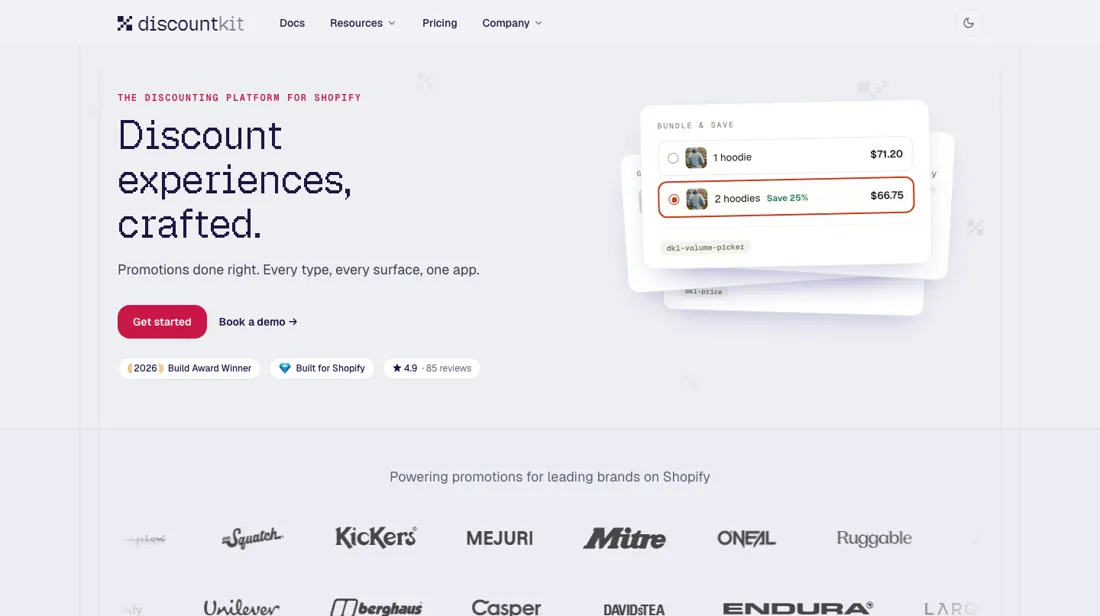
Distilled from The Code Bulk Discounts listing on the Shopify App Store (apps.shopify.com/code-bulk), read 6 September 2026 — the two plans and the wording of the free tier's cap, the absence of any annual rate or trial, the developer (Optizio), the launch date of 24 May 2024, the 4.9 rating over 40 reviews, and the data the app asks for — plus a check of the listing's own Website link, which leads to discountkit.app, a separate and pricier Optizio product rather than a page about this app.
Code Bulk Discounts vs Kite, side by side
Each column shows the vendor’s own published entry price, read on the date shown. Entry prices can cover different services or units, so check what each one buys. We do not average them into a score.
The Kite link above is an affiliate link — we may earn a commission if you sign up, at no extra cost to you — and the other column is a plain link. Neither changes what this table says.
The natural comparison is Kite — Both come out of the Shopify discount aisle and both generate bulk codes, but they are priced for different problems. Code Bulk Discounts does one job — turn an existing discount into unique codes and export them — and asks $14.99 a month once the 500 lifetime free codes run out. Kite treats bulk codes as one feature among many and puts them behind $29 a month, with the code ceilings rising by tier. So if codes are the whole requirement, Code Bulk is the cheaper and simpler answer and there is nothing to grow into. If you also want the discount mechanics themselves — free gifts, BOGO, tiered pricing, progress bars — Code Bulk cannot build any of them and Kite is the one that can..
Frequently asked questions
What does Code Bulk Discounts cost?
Two plans, re-read on the Shopify App Store listing on 16 September 2026 and unchanged since 6 September. The Free plan carries no charge and caps you at 500 lifetime codes, CSV export included. Pro costs $14.99 a month and takes that ceiling away altogether — unlimited codes per month, CSV export still included — and both tiers say they work with most discount applications. All charges are billed in USD every 30 days. The table lists no annual rate, no free trial on Pro and no per-code charge, so the monthly figure is the whole cost — and the two plans differ in exactly one line, which makes this a meter rather than a feature ladder.
Is the free plan enough?
Read the number twice, because the word doing the work is “lifetime”: it is 500 codes in total for the life of the store, not 500 a month. One influencer drop or one email segment can spend the whole allowance in an afternoon, and there is no trial on Pro to fall back on afterwards. So the honest way to size it is to work out how many unique codes one campaign burns. If that clears 500 over the life of the store, the free plan was never going to hold and $14.99 a month is simply the price of the app. If you send one bulk campaign a quarter at a couple of hundred codes each, the free tier may carry you for a year before you have to decide anything.
What does it not do?
It generates codes from a discount you have already created, and stops there. It does not create the discount rule, does not send the codes to anyone, and does not report which ones were redeemed — so it sits between your discount settings and your email or SMS tool and needs both to be worth anything. The one critical review on the listing shows where that bites: when that merchant's parent discount broke after an unrelated change to their stack, every code generated from it went inactive, and they found out when customers contacted support. The developer's reply, in February 2026, is the accurate answer to keep in mind — Code Bulk generates the unique codes while the rules and logic stay entirely with the parent discount, so it cannot know when an external discount app stops working. The same reply notes that a Delete Batches feature was added after that review asked for one. Read 16 September 2026.
Is this a hands-on review of Code Bulk Discounts?
This is a researched assessment, not a hands-on test — where we've used a tool ourselves, we say so explicitly. We name what each tool is good and bad at, and we have no affiliate relationship with Code Bulk Discounts — we earn nothing whether you sign up or not.
- Buyer reviews on the Shopify App Store listing and its review page (apps.shopify.com/code-bulk), read September 2026.
- Prices read 2026-09-06 on apps.shopify.com/code-bulk and re-verified there on 2026-09-16, unchanged.
- A dated screenshot of that pricing page, kept on this site as the receipt.
Others in this category
Reviewed e-commerce tools that share ground with Code Bulk Discounts — comparable in what they do, not drop-in swaps:
New reviews, price changes we recorded, and the cost conditions we found. No sponsored placements. Unsubscribe anytime.
This is our researched assessment — not a paid placement. How we review →