lemlist Review (2026)$69 Email, $109 a Seat Multichannel
 By Daan Haket · Researched and written with an AI assistant · who does what
The per-seat plus per-email-account model makes total cost unpredictable as you scale, and reviews flag support response times and the LinkedIn Chrome-extension's reliability.
outbound teams that live in cold email and want multichannel sequences, warm-up and a big template community in one per-seat tool.
you send occasional one-off campaigns — the entry plan starts at $69/month and only pays off with steady outbound volume.
Transparency: the “Visit” links on this page are affiliate links — we may earn a commission if you sign up, at no extra cost to you. No vendor can pay for a better review or verdict. How we make money →
Pricing (2026)
✓ Pricing re-verified 5 Oct 2026
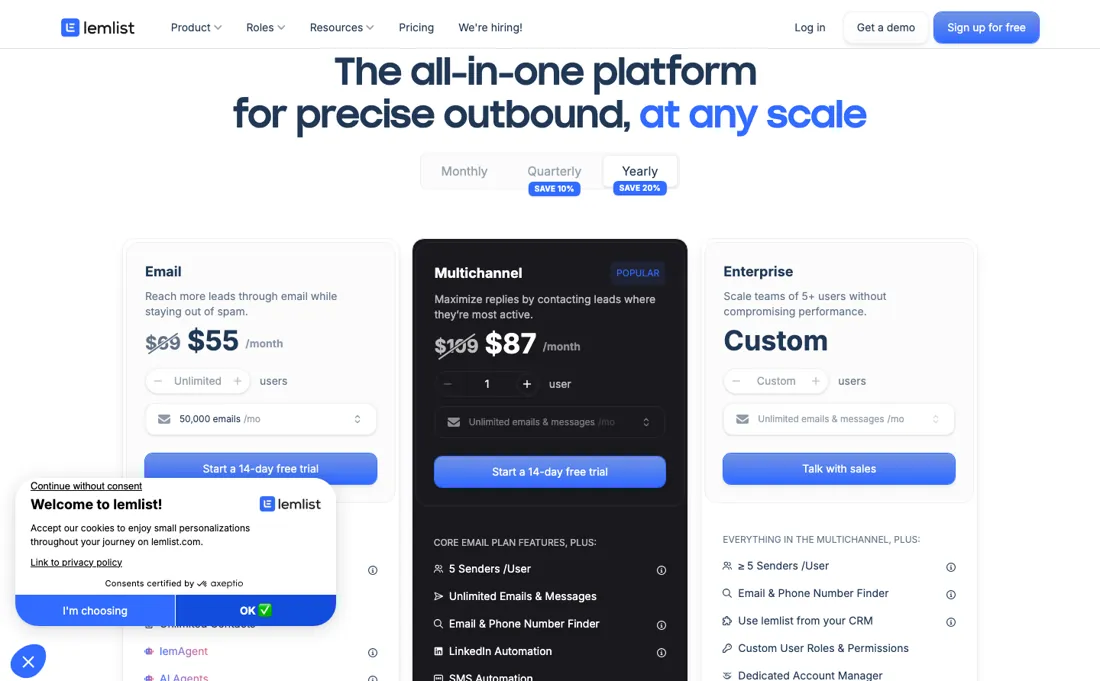
No free plan, 14-day trial. Email is $69/month, or $55/month on yearly billing, covering unlimited users and 50,000 emails a month. Multichannel is $109/month per user, or $87/month yearly, with unlimited emails and messages and 5 senders per user. Quarterly billing saves 10% and yearly 20%. Enterprise (5+ users) is quote-only. Contact data is a separate add-on: Lead data enrichment is €20 a month (€16 a month on yearly billing) for 2,000 credits, which the page equates to about 400 emails or 100 phone numbers; unused credits roll over while you stay subscribed.
Buying-intent signals are now their own add-on: €29 a month (€21 yearly) for 100 signals. Plans change — always verify the live price on their site.
Category context: Growth & Revenue. Across the 82 tools in this category that we researched with a public US-dollar price, the median entry price is about $29 a month (lowest paid plan as listed, per seat where the vendor prices per seat). lemlist’s entry price of $69 a month sits above that median. Compare pricing conditions in the Software Cost Atlas →
What the price did
We capture lemlist’s own pricing page every month and keep the figures, so this is our record of the page — not a forecast, and not someone else’s summary.
The rate card held all summer. Our July and August 2026 captures both record 'From $55 /user /mo' and 'From $87 /user /mo', alongside the same credit arithmetic: 1 credit = $0.01, and 1,000 credits for $10 buying 200 emails or 50 phones. The page returned the same on 17 August 2026. The currency shown to us has flipped between readings, euros and dollars on the same numerals. On 5 October 2026 the data side changed: the page no longer lists $10 credit packs, but a monthly Lead data enrichment add-on (2,000 credits for €20, €16 yearly) whose unused credits roll over, plus a separate signals add-on (100 signals for €29, €21 yearly). Seat prices did not move.
lemlist’s pricing page, as we read it
Watch the video review
The video version of this review, from our YouTube channel.
⚡ Short on time? Watch the 30-second verdict Short.
What lemlist does
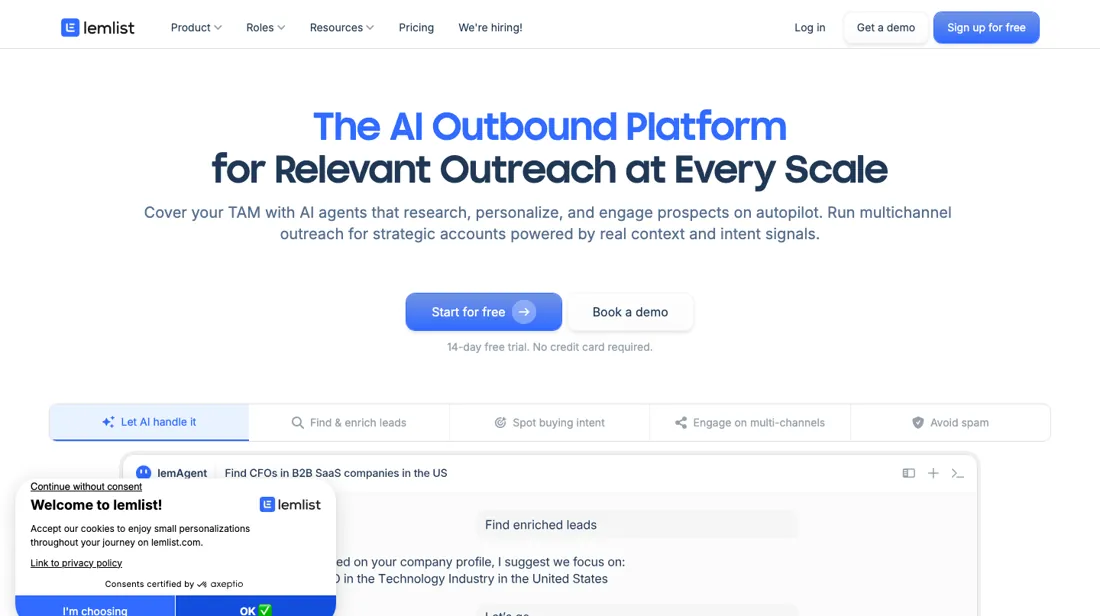
Sales outreach platform that finds target accounts, spots buying signals and enriches contacts, then runs personalized multichannel sequences (email, LinkedIn, calls) with built-in deliverability tools. An MCP server at app.lemlist.com/mcp puts the same actions inside Claude or ChatGPT: create, update, start and pause campaigns and sequences, manage leads, enrich emails and read team analytics in plain language - the enrichment calls spend credits like anywhere else in the product.
What buyers report about lemlist
Hands-on: not tested by usReported by buyers: G2 and practitioner reviews, read August 2026
Themes from the buyer-review sites listed at the foot of this page, read in August 2026. We have not run lemlist ourselves, so this is other buyers' experience rather than ours. We summarise it here because the complaints are usually the part a vendor page leaves out.
- • Personalisation — the image and video variables in particular — is what reviewers name first, and it is genuinely distinctive. 4.6 on G2 across 1,500+ reviews, 76% five-star.
- • Support responds fast, and the multichannel sequencing works as advertised.
- • In August 2026 reviewers who had signed up at $79 reported averaging $150-$200 a month once credits, extra sending addresses and add-ons were counted — 30-50% above the headline. lemlist's current plan prices differ from that $79, so see the pricing section for what it charges now.
- • Enrichment credits (200 on Email Pro, 400 on Multichannel Expert) expire monthly with no rollover, and heavy prospectors exhaust them quickly.
- • Dozens of reviewers flag it as expensive specifically at three or more seats.
- • LinkedIn functionality is thinner than dedicated LinkedIn tools, and the HubSpot integration plus Chrome extension are both reported as unstable.
When the paid plan is worth it
lemlist has no free plan — you get 14 days of full Multichannel access, no credit card required. The real decision is Email ($69/month, $55 on annual billing) versus Multichannel ($109/month, $87 annual, billed per user). Email covers 50,000 emails a month, unlimited users, the email and phone finder, and the 650M+ lead database. Multichannel lifts that cap to unlimited emails and messages, and adds LinkedIn, SMS and WhatsApp automation, a call dialer, and 5 senders per user.
Upgrade if you run LinkedIn or phone touches inside the same sequences as your email, or if you send more than 50,000 emails a month; below that volume the higher tier buys channels, not better email. The seat model also flips: Email is unlimited users, Multichannel is charged per user. Upgrading does not change enrichment either: contact data is a separate monthly add-on on every plan — Lead data enrichment, 2,000 credits a month for €20 (€16 on yearly billing), about 400 emails or 100 phone numbers — and the pricing page now says unused credits roll over while the subscription stays active.
Saleshandy, which sells a competing sequencer, puts a five-person annual Multichannel team at $435/month listed. It says the real cost can reach $700-800 once extra senders ($9/month each), credit top-ups and add-ons are counted. That same article closes by telling readers to start with Saleshandy. Check that figure against your own seat and credit use — it is a calculation by a competitor, not a measured bill.
Our monthly capture read this pricing page in September 2026 and again in October 2026. The price history below explains what changed.
How to actually use lemlist
lemlist's setup guide lists three steps: connect your email provider (Gmail, Outlook, or custom SMTP), set up your email signature, then add SPF, DKIM and a custom tracking domain to your DNS. The guide estimates 15-30 minutes depending on DNS propagation, and notes records can take up to 48 hours to show as verified in your lemlist settings — do not launch before they do.
Distilled from lemlist's own technical-setup help article for the steps and timings. The friction points come from two reviews published by companies that sell competing products: one on the blog of Saleshandy, a competing sequencer, and one from Prospeo, which sells competing lead data and aggregates G2, Trustpilot and Reddit reports.
Common lemlist setup mistakes
Where lemlist setups actually go wrong, and what it costs you when they do. Same sources as the setup notes above — not from a walkthrough we ran ourselves.
Where people get stuck: the review on Saleshandy's blog, written by a competing sequencer, found connecting email and LinkedIn accounts overly complicated for new users before their first campaign, and reports users periodically removing and reinstalling the LinkedIn Chrome extension.
- LinkedIn volume ramps automatically: newly connected accounts start at 2 invitations a day and increase by 2 per day up to your configured cap, with 20 a day the recommended setup.
- Teams that get results build and verify lead lists in external tools, then import clean contacts.
The natural comparison is Instantly or Smartlead — cheaper, unlimited-mailbox cold-email tools.
Frequently asked questions
What does lemlist cost?
Email is $69 a month, or $55 on yearly billing, with unlimited users and 50,000 emails a month. Multichannel is $109 per user a month, or $87 yearly. Paying quarterly takes 10% off the bill and paying yearly 20%. Read on 17 August 2026 — and note the same numerals appeared in euros on an earlier reading, so confirm your currency.
How much does the contact data cost on top?
It is a separate monthly add-on: Lead data enrichment costs €20 a month, or €16 on yearly billing, for 2,000 credits, about 400 emails or 100 phone numbers, and unused credits roll over while the subscription runs. Buying-intent signals are a second add-on at €29 a month (€21 yearly) for 100 signals. Read on 5 October 2026 in euros from the Netherlands. Data for a 1,000-contact campaign is a real line item alongside the seat, not an included extra.
Which plan covers LinkedIn and calls?
Multichannel, at $87 per user a month yearly. The Email plan is email only and unlimited-user, which makes it cheap for a team that just sends sequences; the moment you want LinkedIn steps the price becomes per user, which changes the arithmetic for anything larger than a couple of reps.
Is this a hands-on review of lemlist?
This is a researched assessment, not a hands-on test — where we've used a tool ourselves, we say so explicitly. We name what each tool is good and bad at, and we earn a commission only if you sign up, at no cost to you.
- Buyer reviews on G2 and practitioner reviews, read August 2026.
- Re-verified 2026-10-05 on www.lemlist.com/en/pricing; euros from a Dutch exit, the same numerals the earlier dollar reading carried — check your own checkout.
- A dated screenshot of that pricing page, kept on this site as the receipt.
Others in this category
Reviewed growth & revenue tools that share ground with lemlist — comparable in what they do, not drop-in swaps:
New reviews, price changes we recorded, and the cost conditions we found. No sponsored placements. Unsubscribe anytime.
This is our researched assessment — not a paid placement. The “Visit” links on this page are affiliate links: we may earn a commission if you sign up, at no extra cost to you, and it never changes our take. How we review →