PartnerStack Review (2026)Quote-Only, We Run 58 Programmes
 By Daan Haket · Tested hands-on · written with an AI assistant · who does what
The reporting counts clicks and calls them customers.
B2B SaaS teams that want partner payments, lead and deal registration and a marketplace of active B2B partners in one place, and are prepared to go through a demo to find out what it costs.
you want to know the price before you talk to anyone, you need click-level attribution back to the page that earned it, or you only need a simple affiliate link tracker.
Transparency: the “Visit” links on this page are affiliate links — we may earn a commission if you sign up, at no extra cost to you. No vendor can pay for a better review or verdict. How we make money →
We did not read the docs and summarise them: PartnerStack is the platform our own affiliate operation runs on. We manage 58 partner programmes through it, pull the Partner API v2 on a schedule, and stamp sub-IDs across 704 pages of our own site. PartnerStack is also an affiliate partner of ours — we earn 15% of every sale for a year on anyone who signs up through our link — which is why the findings below are things we measured against our own records rather than claims from their marketing.
- A record in the customers endpoint is a tracked click, not a signup. One plain curl on a tracking link produced a customer record one second later, has_paid false, with no browser and no account. Records surface in the API about five minutes after the click, so allow ten before concluding a test did nothing.
- Clicks arrive without a source. There is no referring-URL field in the partnership data, so the platform can tell you a link was clicked and never which page produced it. We had to build sub-ID stamping across our own pages to answer that question ourselves.
- Commission terms do not come from the API. offers.base_rate is returned null on every partnership we hold. The readable source is PartnerStack's own public directory at market.partnerstack.com — and it sometimes contradicts the vendor's own affiliate page, which is worth knowing before you quote a rate to anyone.
Pricing (2026)
✓ Pricing re-verified 16 Oct 2026
| Plan | Price | What you get |
|---|---|---|
| Launch | quoted — book a demo | pick affiliate link tracking OR lead and deal registration, not both; marketplace access, partner payments, CRM integrations, AI + MCP connector |
| Growth | quoted — book a demo | adds advanced integrations, a learning-management solution, partner challenges and incentives, MDF management and segmentation |
| Enterprise | quoted — book a demo | the only tier with tracking and both registration motions together, plus custom workflows, a designated CSM and priority support |
There is no public price at any tier. PartnerStack publishes three plans — Launch, Growth and Enterprise — and every one of them carries a Book your demo button where the number would be; /plans is a 404. What the page does publish is what moves between tiers, and it is unusually specific. Launch gives you affiliate link tracking OR lead and deal registration — you pick one — plus marketplace access, partner payments built for B2B sales cycles, onboarding and enablement tooling, CRM integrations and their AI and MCP connector.
Growth adds deeper integration support, a learning-management solution, partner challenges and incentives, MDF management and payments, and segmentation by performance or strategy. Enterprise is the only tier with full access to link tracking AND both registration motions at once, and adds custom workflows, a designated CSM with semi-annual business reviews, partner introductions and priority support. So the ladder the page shows is a ladder of partner motions rather than seats — its FAQ says you can invite as many internal users as you need — and the choice between tracking and registration on the entry tier is the line worth reading twice.
Full pricing notes (3 more paragraphs)
The same FAQ adds that the quote itself is based on your partner program size, feature needs and level of support, and is confirmed during the demo. Re-read on 16 October 2026, together with PartnerStack's standard SaaS Agreement (partnerstack.com/legal/saas-agreement), which says what the pricing page does not. The fee has two parts: an annual Subscription Fee set out in the Order Form and due when you sign, plus a monthly fee calculated as a share of the commissions your partners earn that month, at one rate for partners you bring yourself and another for partners PartnerStack refers to you.
Neither rate is published. Unless the Order Form says otherwise, fees are paid in advance in US dollars and cannot be cancelled or refunded, and you also cover the payment provider's transaction costs. The term renews automatically for another year unless either side gives written notice at least 60 days before it ends, and the annual Subscription Fees for a renewal term increase by 7% over the previous period.
When the agreement ends you have 30 days to log in and download your data before the account goes inactive. A signed Order Form or addendum overrides these default terms, and the agreement also lets an Order Form set user or usage limits despite the unlimited-users line in the FAQ, so the renewal uplift, the notice window and the commission rates are the three things to get in writing in your own order.
Plans change — always verify the live price on their site.
Category context: Marketing. Across the 26 tools in this category that we researched with a public US-dollar price, the median entry price is $29 a month (lowest paid plan as listed, per seat where the vendor prices per seat). Compare pricing conditions in the Software Cost Atlas →
The honest knock
A record in the Partner API's customers endpoint is a tracked click, not a signup: on 29 July 2026 a single bare curl against one tracking link at 07:09:01 UTC produced a customer record at 07:09:02, with no browser, no account and has_paid false. Read that endpoint's length as signups and you will report volume that never existed. The second half of the problem is that there is no referring-URL field anywhere in the partnership data, so you can see that a link was clicked and never learn which of your pages earned it — which is exactly the thing you need to decide what to write next.
Watch the video review
The video version of this review, from our YouTube channel.
What PartnerStack does
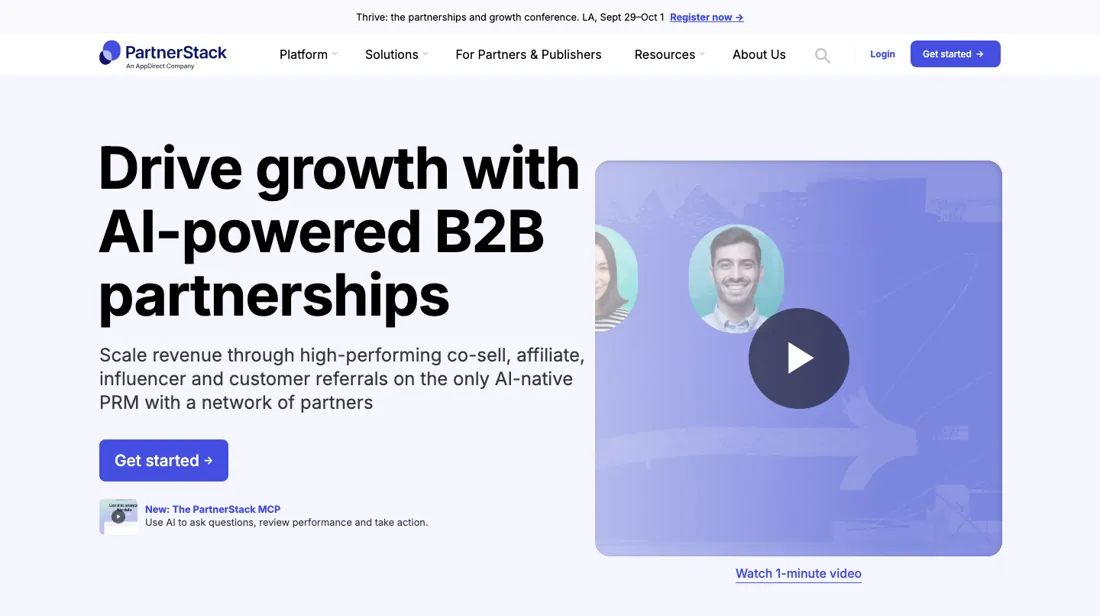
The partner platform we run our own 58 programmes on: affiliate tracking, lead and deal registration, partner payments and a marketplace where B2B partners find you. Quote-only at every tier.
What buyers report about PartnerStack
Hands-on: tested 2026-08-26Reported by buyers: Capterra and Trustpilot, read August 2026
Themes from the buyer-review sites listed at the foot of this page, read in August 2026. We tested PartnerStack ourselves on 2026-08-26, but one test is a narrow sample, so here is what other buyers report. We summarise it here because the complaints are usually the part a vendor page leaves out.
- • The marketplace is repeatedly named as the biggest single reason to be on the platform: program owners describe finding active B2B partners there instead of recruiting them one at a time.
- • Setup and day-to-day navigation are described as straightforward, and a single dashboard shows what each partner has earned, when a referral signed up and what it bought.
- • Partner payouts themselves are called quick and easy by program owners, with Stripe and PayPal as the withdrawal routes.
- • Payout mechanics generate the most friction: Stripe or PayPal only, a fixed monthly payout window rather than automatic transfers, and partners having to log in to move their own money — described as steady low-level admin. Reviewers ask for extra rails such as Payoneer.
- • The interface gets crowded as options pile up; reviewers want better filtering and a more useful default view than the one they land on.
- • Recurring feature requests: two-factor authentication, one unified partner page, and deeper reporting metrics than the dashboard offers.
- • On Trustpilot the subject is money and access rather than features. Reviews from July 2024 through July 2026 describe commissions that disappear or are never paid, withdrawals stuck in processing with no transaction ID or proof, accounts suspended without a stated reason while a balance is still inside, and support that answers with generic replies rather than investigating.
Where the ratings disagree. The two platforms are looking at opposite sides of the same product. Capterra collects the vendors and program managers who run a programme on PartnerStack, and they largely rate it well; Trustpilot collects the partners on the receiving end, and there the subject is almost entirely payouts, payout fees and account suspensions. Neither picture is wrong — they are different seats at the same table. If you are the vendor buying the platform, read Capterra for what it does and Trustpilot for what your partners will run into when a payment goes wrong.
Pages read (August 2026): Trustpilot
What a higher tier actually buys
There is no number to weigh here. Every tier ends at a demo button, and PartnerStack states that pricing is based on your partner program size, feature needs and level of support, and is confirmed during that demo (read 27 August 2026). The ladder you can read is a ladder of motions. Launch makes you choose one: affiliate link tracking or lead and deal registration, not both. Growth adds workflow — advanced integration support, a learning-management solution, partner challenges and incentives, MDF management and payments, and advanced partner segmentation.
Enterprise is the only tier that runs link tracking and both registration motions together, and adds custom workflows, a dedicated customer success manager and priority support. The upgrade question is therefore not how many partners you have but how many motions you must run at once. A programme paying affiliates and registering reseller deals is an Enterprise conversation on day one, whatever its size. What upgrading does not fix is the data underneath: not one of the three tiers advertises click-level attribution back to the page that earned a referral, so paying more buys motions rather than a clearer view of where your referrals actually came from.
What we found running PartnerStack ourselves
The first findings are at the top of this page. The rest:
- Programme status lags the reality by days. One partner sent us a welcome email with a working tracking link on 7 August; the API still read application-denied and only turned active somewhere between 13 and 18 August. Treat the vendor's email as the leading indicator and the API status as the one that catches up.
- The earned-commission endpoints are the weakest part. rewards and transactions did not return usable data for us, so what you have actually been paid is a dashboard question rather than an API one.
- Partner replies break email threading. A partner answers inside the PartnerStack dashboard and the platform sends that on as a fresh message from hello@partnerstackmail.com, with a new Message-ID and no reference to the mail it is answering. Any automation of yours that matches replies to threads will not match these.
Most of our reviews are researched rather than run — how we review explains which is which, and why we do not pretend otherwise.
How to actually use PartnerStack
Setting this up is a front-end job before it is a partner job. PartnerStack's developer docs put the tracking code in your site's header, where PartnerStackJS stores which partner referred a visitor in a first-party cookie, and they say plainly that the step needs someone with access to your front-end code who is comfortable writing JavaScript. The second half is the conversion event: you keep the click ID from the referral link and post it back with a customer key — anything that uniquely identifies that customer on your platform, often an email or an account ID — after which PartnerStack attributes the customer to the partner who referred them and rewards that partner when the customer reaches a milestone you define.
Do it in that order. Recruit partners before the conversion call is live and their traffic arrives as clicks that can never become anything payable.
Distilled from PartnerStack developer docs — https://docs.partnerstack.com/docs/partnerstackjs and https://docs.partnerstack.com/docs/step-3-tracking-conversions — plus the pricing page https://www.partnerstack.com/pricing, all read 27 August 2026. Pricing page re-read 16 October 2026 on https://partnerstack.com/pricing, together with the SaaS Agreement on https://partnerstack.com/legal/saas-agreement.
PartnerStack vs Reditus, side by side
Where a vendor publishes a price, its column shows the entry price we read and when; where it does not, the column says so rather than filling in a figure from elsewhere. We do not average them into a score.
Both names above are affiliate links: we may earn a commission if you sign up, at no extra cost to you. Neither changes what this table says.
The natural comparison is Reditus — the alternative people weigh this against — Reditus publishes its entry price ($99/mo billed annually) where PartnerStack quotes every tier, and the split is whether you want a number you can budget against or a marketplace with the volume of B2B partners PartnerStack has.
Frequently asked questions
Can I choose link tracking and deal registration on the entry plan?
No, you pick one. The pricing page, read 26 August 2026, gives Launch affiliate link tracking or lead and deal registration; only Enterprise has link tracking and both registration motions at once. None of the three plans shows a price; each has a Book your demo button.
Will PartnerStack show which page sent a click?
No. In the partnership data we pull through the Partner API v2 (as of 26 August 2026) there is no referring-URL field, so you learn that a link was clicked, not where. We stamp our own sub-IDs on links to answer that. Records also appear about five minutes after a click, and a tracked click already creates a customer record before anyone signs up.
Is this a hands-on review of PartnerStack?
Yes. We tested PartnerStack ourselves on 2026-08-26; the section above says what we tested, what we found and what we did not test, and where a figure comes from the vendor's own documentation instead. Most of our reviews are researched rather than run; we say which is which. We name what each tool is good and bad at, and we earn a commission only if you sign up, at no cost to you.
- Buyer reviews on Capterra and Trustpilot, read August 2026.
- Read 2026-08-26 on partnerstack.com/pricing.
- Our own hands-on session with PartnerStack (2026-08-26), written up in full further down this page.
Others in this category
Reviewed marketing tools that share ground with PartnerStack — comparable in what they do, not drop-in swaps:
New reviews, price changes we recorded, and the cost conditions we found. No sponsored placements. Unsubscribe anytime.
This is our researched assessment — not a paid placement. The “Visit” links on this page are affiliate links: we may earn a commission if you sign up, at no extra cost to you, and it never changes our take. How we review →