Influencer Hero Review (2026)$649 a Month, or $454 on Annual
 By Daan Haket · Researched and written with an AI assistant · who does what
The three-month minimum is the real commitment, and there is no free trial to soften it.
brands running influencer marketing as a continuous programme rather than a campaign, with enough volume to use 1,000 reach-outs a month from the first month, who want discovery, outreach, a creator CRM, UGC tracking and affiliate management in one place instead of a spreadsheet plus four tools.
you want to test the channel before committing, because the three-month minimum makes the real entry price $1,557 rather than $519, or you are a two-person team on Standard's single seat. Skip Standard if you pay more than 20 creators a month; Pro raises the cap to 200.
Transparency: the “Visit” links on this page are affiliate links — we may earn a commission if you sign up, at no extra cost to you. No vendor can pay for a better review or verdict. How we make money →
Pricing (2026)
✓ Pricing re-verified 21 Oct 2026
(pricing matrix read 18 September 2026 in documentation the vendor sent us; the public ladder at influencer-hero.com/pricing was read the same week and shows the quarterly column) Four plans, and the figure you see depends entirely on the billing term you pick. Billed monthly: Standard $649, Pro $1,049, Business $2,490. Billed quarterly: $519, $839 and $1,992 — and this is the column the public pricing page leads with, which is why $519 is the number most people quote.
Billed annually: $454, $734 and $1,743. The advertised 20% and 30% savings check out exactly against the monthly rate ($649 × 0.8 = $519.20, × 0.7 = $454.30), so the discounts are real and the headline is simply the discounted one. What each plan carries: Standard is one seat, 1,000 reach-outs a month and 20 influencer payouts. Pro is three seats, 5,000 reach-outs and 200 payouts.
Full pricing notes (3 more paragraphs)
Business is eight seats, 10,000 reach-outs and 500 payouts, and Enterprise has unlimited payouts. On 19 September the Business plan card still said unlimited while the comparison grid on the same page said 500; Influencer Hero told us the card was a leftover from a site revamp, and when we re-read the page on 24 September 2026 the card and the grid both said 500 for Business and unlimited for Enterprise.
Enterprise is custom on every other axis. Every plan carries a three-month minimum term and there is no free trial, so the smallest real commitment is three months of Standard: $1,947 billed monthly, or $1,557 if you take the quarterly rate. The influencer CRM, the outreach automation and the UGC tracking are in every plan; the ladder is gated on quota and seats.
Influencer payouts can run through bank direct debit (ACH in the US, Bacs in the UK, SEPA in the EU) with only Stripe's processing fee passed through: 0.1% to 0.4% by the vendor's own account, around 0.4% to 0.5% effective by its Payout Manager post, with US ACH capped at $5 a payout, against the 2-3% that card processors typically charge.
Plans change — always verify the live price on their site.
Category context: Marketing. Across the 29 tools in this category that we researched with a public US-dollar price, the median entry price is $29 a month (lowest paid plan as listed, per seat where the vendor prices per seat). Influencer Hero’s entry price of $649 a month sits above that median. Compare pricing conditions in the Software Cost Atlas →
What the pricing page doesn’t say
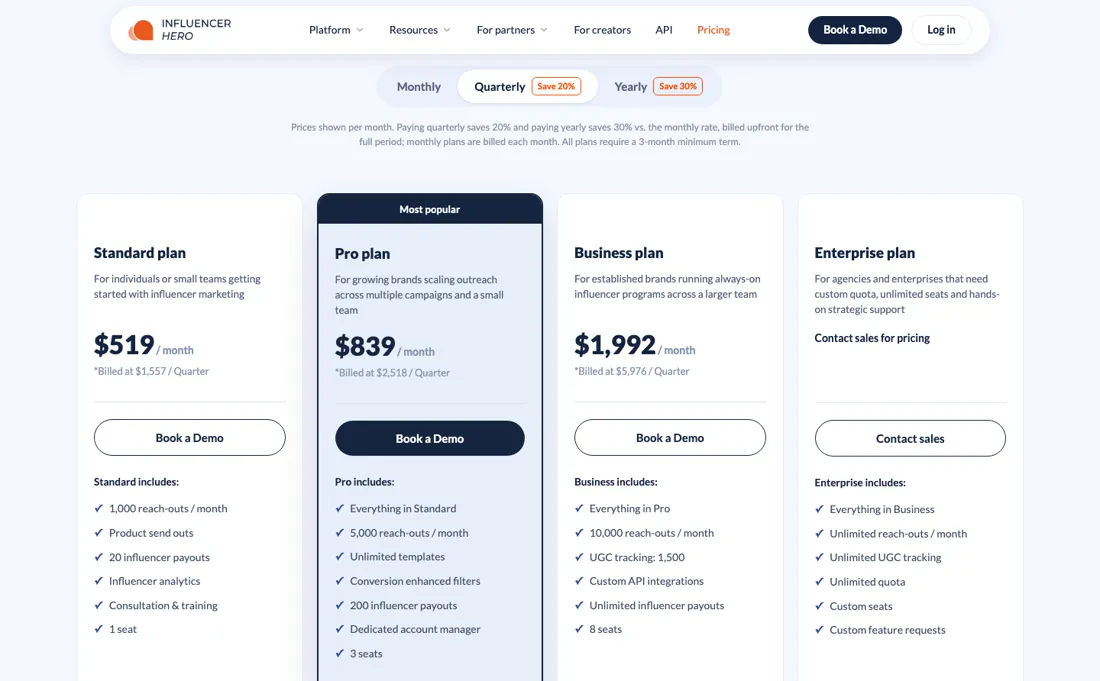
Every plan carries it, so the smallest honest entry price is not $519 but three months — $1,557 on the quarterly rate, $1,947 if you pay monthly. An influencer programme takes longer than four weeks to show you anything, so the vendor is not being unreasonable; it just means the decision is a quarter of spending rather than a month of trying. Read which column you are quoted. The public pricing page leads with the quarterly rate, so $519 is what gets repeated — but billed monthly the same plan is $649, a quarter more.
Pro is $839 or $1,049, Business $1,992 or $2,490. The 20% and 30% savings are genuine and check out exactly against the monthly rate; the trap is only that the advertised number already has the discount in it. What the ladder actually meters is worth understanding, because it is better than it looks. A reach-out counts once, at the moment you first contact a new influencer. Every follow-up, reply and ongoing conversation with that same creator after that is unlimited and never draws the quota down again — so the meter counts new relationships opened, not messages sent.
Standard's 1,000 a month is therefore 1,000 new creators, which is a great many, and nurturing the ones who answer costs nothing. Hitting the cap gives you two routes and the vendor recommends one of them against its own short-term interest: buy a top-up, or move up a tier. Their own documentation says brands who top up once tend to keep doing it, so repeated top-ups erode the saving from staying low.
No top-up rate is published anywhere, which is the one number still missing from an otherwise unusually open account. Payouts are capped per plan, and the cap is what pushes paying brands up the ladder: 20 a month on Standard, 200 on Pro, 500 on Business and unlimited only on Enterprise. The Business card briefly said unlimited after a site revamp; the vendor corrected it, and on 24 September 2026 the pricing page gave 500 on both the card and the comparison grid.
Seats follow the quota — one, three, eight — so a two-person team is pushed to Pro by headcount alone, whatever its volume.
Watch the video review
The video version of this review, from our YouTube channel.
What Influencer Hero does
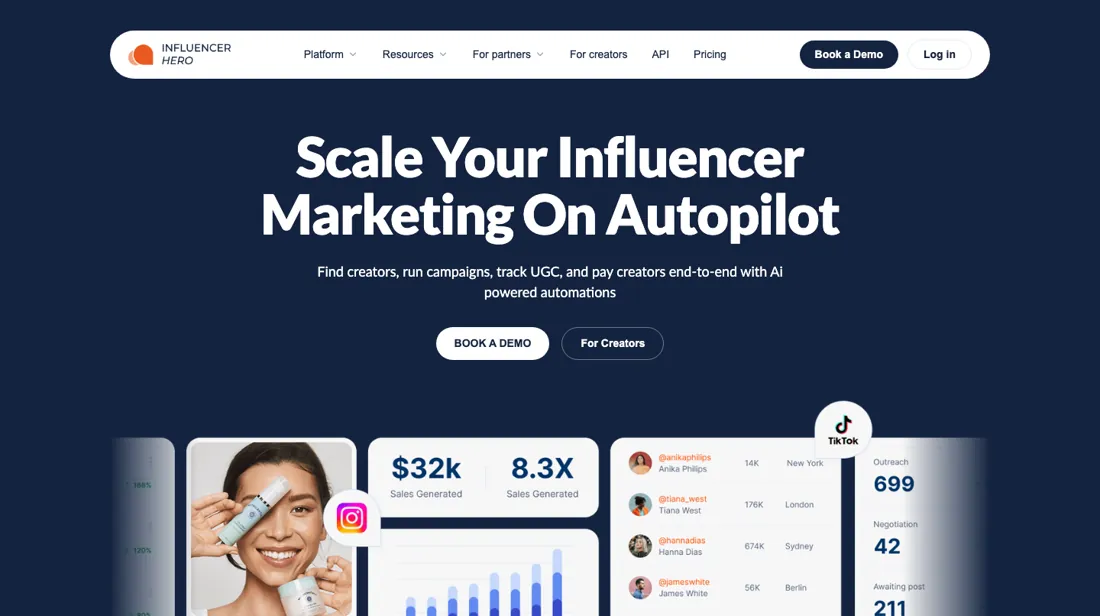
All-in-one influencer marketing platform: AI creator discovery, automated outreach, an influencer CRM, UGC tracking and affiliate management on one record per creator, with 45-plus native integrations and payouts run through bank debit at 0.1-0.4% rather than 2-3% card fees. Every plan carries the full toolset — the ladder is gated on quota and seats. A reach-out is counted once when a new influencer is first contacted — all later messaging with that creator is unlimited. Three-month minimum on every plan and no free trial.
What buyers report about Influencer Hero
Hands-on: not tested by usReported by buyers: Shopify App Store, read September 2026
Themes from the buyer-review sites listed at the foot of this page, read in September 2026. We have not run Influencer Hero ourselves, so this is other buyers' experience rather than ours. We summarise it here because the complaints are usually the part a vendor page leaves out.
- • The AI that reads the email thread with an influencer and fills in their shipping details, plus creating orders and affiliate discounts inside the app so they sync straight to Shopify — a Canadian store two months in names this as the thing that removed the manual back-and-forth (April 2026).
- • Outreach and gifting at scale. A US brand running two brands through one account rates the mass email and centralised onboarding above working through DMs or TikTok Shop affiliates (August 2025).
- • Reporting per creator. Reviewers single out being able to pull click and engagement data on any influencer rather than judging by follower count.
- • Named account managers. Several reviews credit a specific person for onboarding and ongoing help, which fits a product that no longer lets you sign yourself up.
- • A payout fee nobody mentioned. A UK merchant paying over $5,000 of affiliate commission reports a 1.5% charge for processing the payment, on top of the 10% they owed the influencers and the cost of shipping product (May 2024). That 1.5% reflects the old setup: Influencer Hero told us in September 2026 that payouts have since been rebuilt so brands can fund them by bank direct debit (ACH, Bacs or SEPA) with only Stripe's fee passed through, which it puts at 0.1% to 0.4%; its Payout Manager post (influencer-hero.com/blogs/payout-manager) gives around 0.4% to 0.5% effective and caps US ACH at $5 a payout. Card payouts still cost the standard Stripe rate, so pick the method before you budget.
- • Built for a bigger organisation than it looks. A US small business with nobody dedicated to the tool describes the self-directed platform as an agency and mid-to-large-brand product and recommends the fully managed option instead (edited June 2025).
- • Import and export. An Irish brand left for Upfluence after nine months, citing being unable to import an existing list and limited export. The vendor replied in public that CSV, Google Sheets, Zapier and API imports all exist and that the account manager should have explained them — which is a support failure rather than a missing feature, but it cost that customer nine months.
- • You cannot sign yourself up. A 2024 reviewer never received the verification code and found no contact route; the vendor's July 2026 reply confirms sign-up is now guided onboarding only, through support or a demo request.
Where the ratings disagree. The distribution matters more than the average here. 58 of the 62 reviews are five stars, and everything that costs money — the payout fee, the import and export ceiling, the dead self-serve sign-up, the size of team the platform assumes — sits in the three one-star reviews and the single three-star one. Read the 4.8 and you learn nothing you can budget against; the four low reviews take about two minutes.
Three months up front is the price, not one
Take the headline figures and turn them into what you will be charged, because this vendor quotes three different numbers for the same plan. Standard is $649 a month billed monthly, $519 billed quarterly, $454 billed annually. Pro is $1,049, $839 or $734. Business is $2,490, $1,992 or $1,743. The public pricing page leads with the middle column, so the price you have probably seen is already a 20% discount, and the annual column takes 30% off the same monthly rate.
Both check out to the cent. With the three-month minimum on every plan and no free trial, the entry ticket is a quarter: $1,947 on monthly billing, $1,557 on quarterly. On annual you are committing $5,448 to Standard, $8,808 to Pro or $20,916 to Business. Now the ladder. Per reach-out at the quarterly rate, Standard is about 52 cents, Pro about 17 and Business about 20. The cheapest new relationship on the page is Pro's, not Business's — Business buys UGC tracking, custom API integrations, more payouts and eight seats, and it costs more per reach-out to get them.
On annual the same pattern holds at 45, 15 and 17 cents. That makes the tier question unusually clean, and it is not really about volume. Because follow-ups are free and only new contacts draw the quota, most brands will not exhaust 1,000 new creators a month. What moves people up is seats — one, three, eight — and payouts, at 20, 200 and 500. A two-person team paying creators is on Pro from day one regardless of how many influencers it contacts.
One genuine saving that does not appear in the tier list: payouts run through bank debit at 0.1% to 0.4%, where a card processor would typically take 2-3%. On $20,000 of creator payments a month that is a difference of roughly $320 to $580 — real money against the subscription, and worth putting into the comparison.
Our monthly capture read this vendor's pricing page in September 2026 and again in October 2026, and the amounts were the same both times, including $1,557, $1,743, $1,992 and $2,490 from the pricing above. We keep watching — the registry records what moves.
How to actually use Influencer Hero
Decide the billing term before the tier, because it changes the price by a quarter. Standard is $649 a month billed monthly, $519 quarterly and $454 annually, and the public pricing page shows you the quarterly figure by default. Whatever you are quoted, ask which column it comes from. Then size yourself on the right unit, which is not the one most people assume. A reach-out is counted once, when you first contact a new influencer; every follow-up, reply and continuing conversation with that creator is unlimited and never touches the quota again.
So the question is not how many messages you will send but how many new creators you will open a relationship with in a month. For most brands that number is well under Standard's 1,000, which means volume is rarely what decides the tier. What usually decides it is seats and payouts. One seat, 20 payouts on Standard; three seats and 200 on Pro; eight and 500 on Business. If two people will work in the tool, or you pay more than twenty creators a month, you are on Pro whatever your outreach looks like.
Plan for the cap before you meet it. Exceed your reach-outs and you can buy a top-up or move up a tier; the vendor's own documentation advises the upgrade, on the grounds that brands who top up once tend to keep doing it until the saving is gone. No top-up rate is published, so ask for it in writing while you are still negotiating rather than when you are already over.
Then set up payouts on the cheap rail. Business carries 500 influencer payouts a month and only Enterprise is unlimited (pricing page re-read 24 September 2026). Fund payouts by bank direct debit rather than card: the vendor puts the fee at 0.1% to 0.4% and its Payout Manager post at around 0.4% to 0.5% effective, with US ACH capped at $5 a payout, which is the quietest saving in the product once you pay creators at any volume.
Sources for this review
- Influencer Hero pricing page · read 24 Sep 2026: the plans and the quarterly figures the page leads with, the 20% and 30% billing savings, the three-month minimum and the per-plan inclusions, including 500 payouts on Business after the page was corrected
- Documentation sent by Influencer Hero (vendor account, not independent) · read 18 Sep 2026: the full monthly, quarterly and annual price matrix, the definition of a reach-out and the payout fees
- Influencer Hero blog: Payout Manager · read 24 Sep 2026: the bank direct-debit payout methods, the $5 ACH cap and effective rates of around 0.4% to 0.5%
Full research notes and reading history (543 words)
Two sources, and where they disagree we say so. The public ladder comes from influencer-hero.com/pricing, read in a live browser on 17 and 18 September 2026: the four plans with the quarterly figures the page leads with ($519, $839, $1,992 and Enterprise on quote), the Monthly / Quarterly / Annual toggle with its stated 20% and 30% savings, the statement that prices are shown per month and billed up front for the full period, the three-month minimum on all plans, and the per-plan inclusions read row by row — reach-outs (1,000 / 5,000 / 10,000), seats (1 / 3 / 8), product send-outs, unlimited templates, conversion-enhanced filters, dedicated account manager, UGC tracking to 1,500, custom API integrations and unlimited follower checks — together with the note that every plan includes the full influencer CRM, outreach automation and UGC tracking.
The full price matrix and the mechanics come from documentation Gabriela Molina of Influencer Hero sent us on 18 September 2026 in reply to our questions: the monthly, quarterly and annual columns for all three named plans, the seat, reach-out and payout allowances, the three-month minimum and the absence of a free trial, the definition of a reach-out (counted once on first contact with a new influencer, with all later messaging unlimited), the two options at the quota cap (top-up or upgrade) and the vendor's own recommendation to upgrade, the 0.1%-0.4% bank-debit payout fee against 2-3% for card processors, the 45-plus native integrations, and the feature detail on campaign-board automations, AI follow-up suggestions, coupon-code leakage prevention with automatic rotation, sentiment alerts, auto-detected searchable UGC with a content-review workflow, and the All Influencers tab with natural-language filtering.
That documentation is a vendor account and is labelled as such; the one figure the sources contradict each other on is the payout allowance on Business, and a third reading shows the contradiction is internal to the pricing page: read in a headless browser on 19 September 2026, the Business card says unlimited influencer payouts while the Compare all features grid on the same page reads 20 / 200 / 500 / Unlimited on the row Number of influencer payouts, so the page disagrees with itself and its own grid agrees with the documentation at 500.
That same reading confirms the page opens on the quarterly column: the Standard card shows $519 per month, footnoted as billed at $1,557 per quarter. On 24 September 2026 we re-read influencer-hero.com/pricing in a headless browser after Gabriela Molina told us the page had been corrected: the Business card now reads 500 influencer payouts and the grid still reads 20 / 200 / 500 / Unlimited, so the contradiction is gone.
The same day we read the vendor's Payout Manager post (influencer-hero.com/blogs/payout-manager, dated 5 March 2026), which gives the bank direct debit methods per region, the $5 ACH cap and effective rates of around 0.4% to 0.5%, and the homepage, where the Dore & Rose testimonial appears. No independent reviews were read for the pricing section. The two Klaviyo answers come from Influencer Hero's Klaviyo integration guide at https://help.influencer-hero.com/en/articles/13159773-klaviyo-integration, read 21 October 2026, and the pricing page at influencer-hero.com/pricing was re-read the same day without a browser: all nine plan amounts, the 500 payouts on Business and the three-month minimum were unchanged.
Influencer Hero vs Superfiliate, side by side
Where a vendor publishes a price, its column shows the entry price we read and when; where it does not, the column says so rather than filling in a figure from elsewhere. We do not average them into a score.
Both names above are affiliate links: we may earn a commission if you sign up, at no extra cost to you. Neither changes what this table says.
The natural comparison is Superfiliate, Stamped — The useful comparison in this category is who will tell you the price. Superfiliate, from our own dossier (re-checked 5 September 2026), publishes none at all: superfiliate.com/pricing returns a 404, there is no pricing item in the navigation, and the only call to action is Book Demo — its Shopify listing publishes the shape rather than the amount. Against that, Influencer Hero putting $519, $839 and $1,992 on a public page with the quotas attached is the more respectful treatment of a buyer, and it is the reason a fair write-up is even possible. Stamped is the other end and a different job: reviews, loyalty and repeat purchasing rather than creator outreach, priced on your monthly order volume (re-verified 12 September 2026) — Reviews at $23 a month at the 200-order step, $199 at 5,000 orders, Loyalty $299, Repeat $499, and a multi-product bundle at a flat $798. If what you actually want is more from the customers you already have, that ladder starts an order of magnitude lower than this one. Influencer Hero is for going and finding people who have not bought from you yet, and the three-month minimum says the vendor knows that takes a while..
Frequently asked questions
What does Influencer Hero cost?
Three different figures per plan, depending on the billing term — from the vendor's own pricing documentation, 18 September 2026. Paying monthly costs $649 for Standard, $1,049 for Pro and $2,490 for Business; the quarterly rate drops those to $519, $839 and $1,992, and the annual rate to $454, $734 and $1,743. Enterprise is custom. The public pricing page leads with the quarterly column, so the widely quoted $519 already carries a 20% discount; the annual column is 30% off the same monthly rate, and both check out to the cent.
Can I try it for a single month?
No, on both counts. Every plan carries a three-month minimum term, and there is no free trial. So the smallest real commitment is a quarter of Standard: $1,947 if you pay monthly, $1,557 on the quarterly rate. That is the number to weigh, not $519 — and it is arguably honest of them, because an influencer programme takes longer than four weeks to show you anything.
What counts as a reach-out, and what happens at the cap?
A reach-out is counted once, at the moment you first contact a new influencer. Every follow-up, reply and continuing conversation with that same creator afterwards is unlimited and never draws the quota down again — the meter counts new relationships opened, not messages sent. So Standard's 1,000 a month means 1,000 new creators, and nurturing the ones who reply is free. At the cap you can buy a top-up or move up a tier; the vendor's own documentation recommends the upgrade, because brands who top up once tend to keep doing it until the saving is gone. No top-up rate is published, so ask for it in writing.
Which plan is cheapest per new creator?
Pro, and not by a small margin. At the quarterly rate, Standard works out at about 52 cents per reach-out, Pro about 17 and Business about 20 — so the middle tier buys the cheapest new relationship and Business is what you pay for UGC tracking, custom API integrations, more payouts and eight seats. In practice, though, volume rarely decides the tier: because follow-ups are free, most brands never exhaust 1,000 new creators a month. Seats (1 / 3 / 8) and payouts (20 / 200 / 500) are what move people up.
Is there anything cheap hiding in the price?
Yes, and it is easy to miss: influencer payouts run through bank debit at 0.1% to 0.4%, where a card processor would typically take 2-3%. On $20,000 of creator payments a month that is roughly $320 to $580 saved, which is a meaningful offset against the subscription if you pay creators at any scale. The payout allowance itself is settled: 500 a month on Business and unlimited on Enterprise, on both the plan card and the comparison grid when we re-read the pricing page on 24 September 2026.
What do customers say on Influencer Hero's own site?
The vendor's homepage carries a quote from Nick Nijhoff, co-founder of Dore & Rose: “Influencer Hero helped us significantly scale our UGC pipeline, resulting in higher ROAS and lower CAC across our campaigns.” Read on influencer-hero.com on 24 September 2026. It is a testimonial the vendor chose to publish, not an independent review; for the spread of independent opinion, including the complaints, read the Shopify App Store section of this review.
Will exporting creators to Klaviyo overwrite the profiles I already have there?
No, according to Influencer Hero's Klaviyo integration guide (help.influencer-hero.com, read 21 October 2026): existing profile data in Klaviyo is never removed or overwritten by the export. The guide does not say which plan the integration needs, so confirm that before you count on it.
What happens to the exported profiles if I disconnect Klaviyo or leave?
They stay. The same guide (read 21 October 2026) says profiles already exported to Klaviyo remain in Klaviyo after you disconnect, so the creator list you built up is not lost from your email tool when the three-month term ends. What happens to the data inside Influencer Hero itself after cancellation is not covered there and is not confirmed.
Is this a hands-on review of Influencer Hero?
This is a researched assessment, not a hands-on test — where we've used a tool ourselves, we say so explicitly. We name what each tool is good and bad at, and we earn a commission only if you sign up, at no cost to you.
- Buyer reviews on Shopify App Store (62 reviews, 4.8 average), read September 2026.
- Pricing matrix read 18 September 2026 in documentation the vendor sent us; the public ladder at influencer-hero.com/pricing was read the same week and shows the quarterly column.
- A dated screenshot of that pricing page, kept on this site as the receipt.
Others in this category
Reviewed marketing tools that share ground with Influencer Hero — comparable in what they do, not drop-in swaps:
New reviews, price changes we recorded, and the cost conditions we found. No sponsored placements. Unsubscribe anytime.
This is our researched assessment — not a paid placement. The “Visit” links on this page are affiliate links: we may earn a commission if you sign up, at no extra cost to you, and it never changes our take. How we review →