 Cloro Review (2026)500 Free Credits, Then $30/mo
The free tier is a sampler, not a trial of the real thing: 500 credits is about 100 async ChatGPT answers at the 5-credit rate we were actually charged, and their table lists 7 for a full response.
Visit Cloro → Affiliate link — the rest of this page is the honest version, including who should skip it.
Watch the 2-minute review
Same honest take, in video form — from our YouTube channel.
Pricing (2026)
✓ Pricing re-verified 17 Sep 2026
| This tool | $30 | 9th cheapest of 13 |
| Cheapest | $4.99 | Meeri |
| Median | $19.99 | |
| Most expensive | $50 | Serpstat |
Entry price per month, USD. Our own dated readings of 13 marketing tools — not a market survey, and cheapest is not best.
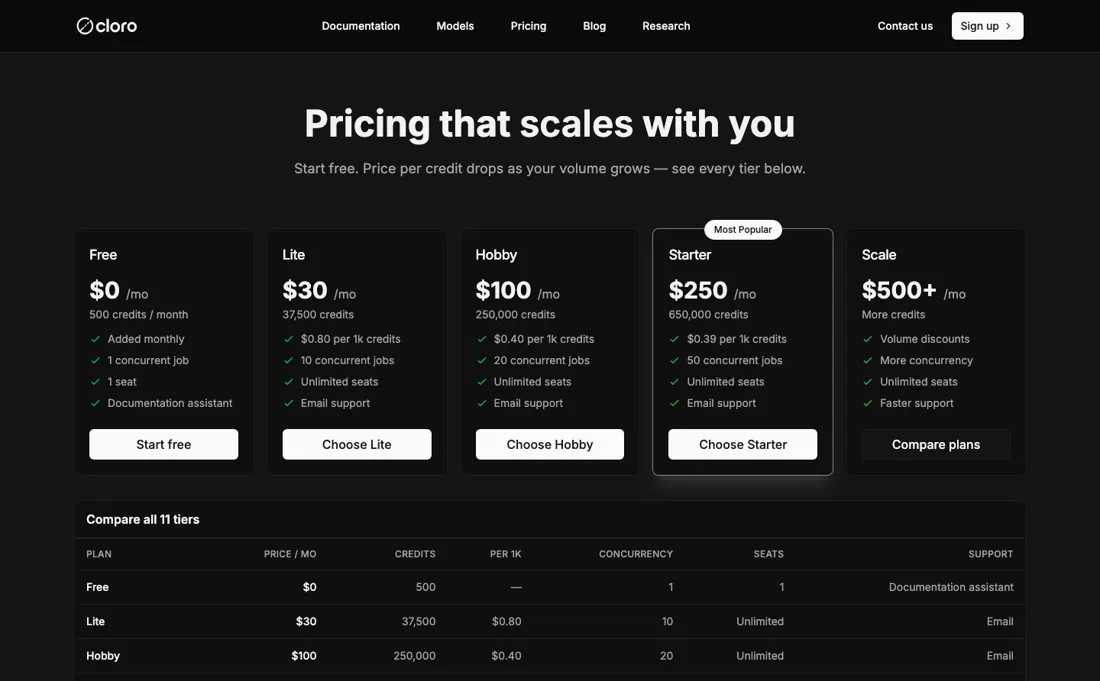
Credit-metered, and the credit table matters more than the plan price. Free is $0 for 500 credits a month, one concurrent job and one seat. Paid runs Lite $30 (37,500 credits, $0.80 per 1k, 10 concurrent jobs), Hobby $100 (250,000, $0.40, 20 jobs) and Starter $250 (650,000, $0.39, 50 jobs). Above that come Growth $500 (1,350,000, $0.37, 75 jobs) and Business $1,000 (2,800,000, $0.36, 100 jobs).
Four self-serve Enterprise steps follow: $2,000 for 5,871,025 credits at $0.34, $3,000 for 9,306,606 at $0.32, $4,000 for 12,756,261 at $0.31 and $5,000 for 16,391,783 at $0.31, where concurrency reaches 255. Seats are unlimited from Lite up. What a request costs varies by engine. ChatGPT full response is 7 credits, ChatGPT web search 5, Copilot 5, and AI Overview including the SERP 5.
Perplexity, Grok, AI Mode and Gemini are 4, and Google Search and Google News 3 plus 2 per extra page. A synchronous call adds 2 credits on top of all of those. Perplexity stood at 3 credits when we read the same table on 17 August 2026. Grok is marked temporarily unavailable, with the page warning that requests to it fail. Credits do not roll over: unused credits expire at the end of the billing cycle, and at zero the API returns 403 until you upgrade or the cycle resets. Plans change — always verify the live price on their site.
What the pricing page doesn’t say
Fewer, if you call it synchronously -- and one concurrent job means you queue. Anyone running a daily visibility check across a hundred keywords burns through it in about two days. Read the credit table before the price table -- the same $100 buys 250,000 credits, which is 35,700 full ChatGPT calls or 62,500 Perplexity ones, so your engine mix decides your bill more than your plan does. And nothing carries: their FAQ, read 17 September 2026, states that unused credits expire at the end of every cycle, so a quiet month is money gone rather than headroom for a busy one.
What Cloro does
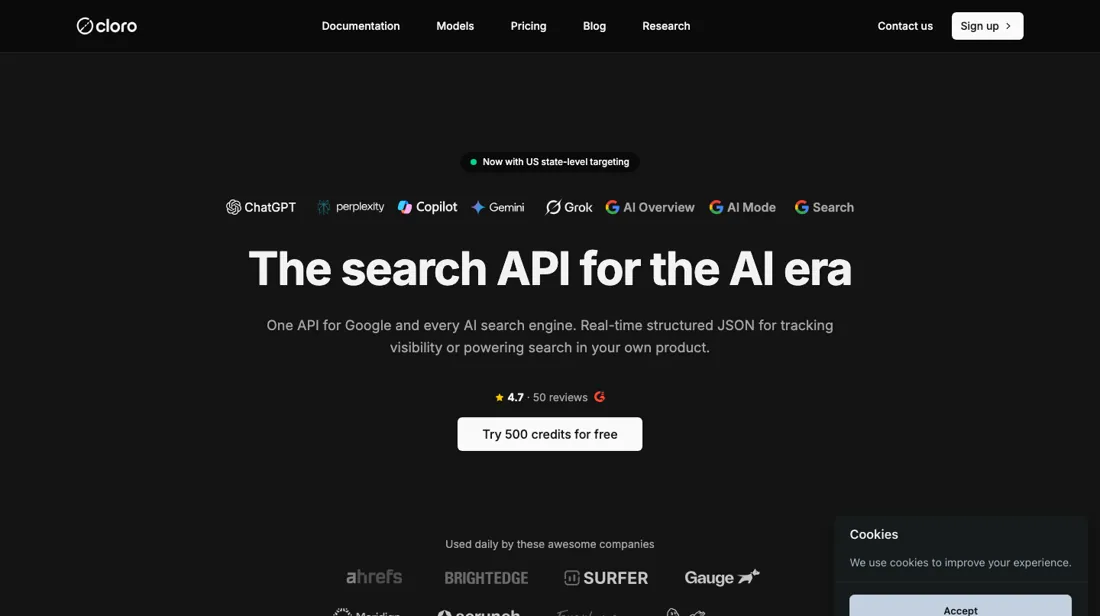
API that reads AI search engines — ChatGPT, Perplexity, Copilot, Gemini, Grok, AI Overview and Google Search — and returns the sources and citations behind every query as structured JSON.
What buyers report about Cloro
Recurring themes from the buyer-review sites listed at the foot of this page, read in September 2026. We use Cloro ourselves, but a single account is a narrow sample, so here is what other buyers report. We summarise it here because the complaints are usually the part a vendor page leaves out.
- • One API instead of one integration per engine is the thing reviewers came for. John Rey B., a full-stack digital marketer, uses a single API for calls to different AI models, gets structured JSON back, and singles out the playground on the site for testing calls before building anything of his own.
- • The visibility is at query level, not at dashboard level. Bindu A., an applied AI engineer, says it shows the actual AI response for a specific query — which brands were mentioned, which competitors appeared instead, and what sources were cited — rather than aggregate traffic numbers.
- • It holds up for bulk monitoring. A verified reviewer in computer software collects structured ChatGPT results at scale with consistent fields (advertiser, title, ad copy, destination URL, image) and calls the async batch workflow convenient for larger jobs, with support that answered detailed technical questions.
- • Starting costs little effort. Julie D. at a mid-market company had an account open and linked to a Google Sheet quickly, tracks positions twice a month that way, and says the free allowance is currently enough for her team.
- • The reporting layer is behind the data layer. Marvil F., an SEO associate, wants more detailed reporting and deeper customisation for tracking AI visibility over time, and says the workflow takes a while to get familiar with.
- • It stops at the query and does not reach the business. Bindu A. is explicit that the product gives no AI-referred traffic volume or business impact, so a second tool is still needed to turn mentions into visits.
- • There is no control over the browser environment the answers are collected in. The computer-software reviewer asks for configurable locale, Accept-Language and timezone, clearer documentation of what resets in each new browser session, and a way to verify the actual exit IP per request — all three matter if you are auditing geo-targeted results.
- • Speed is the recurring practical complaint: John Rey B. reports the API is not fast and that he notices lag.
- • Credit renewal is undocumented where the buyer can see it. Julie D. cannot tell whether credits reset at the start of the month or on her signup anniversary.
Where the ratings disagree. Read where the reviews came from before you read the average. Almost the whole set is labelled “Source: Seller invite” — the seller asked, and the people who answered were the ones willing to be asked — and G2 flags one reviewer as a business partner of the seller or a competitor and leaves them out of the score entirely. Every dated review falls between May and September 2026, so nothing in this set tells you how the product behaves after a year, how renewals go, or what happens when an engine changes its output format, which is the failure mode this whole category lives with. What the set is genuinely good for is the shape of the complaints: they cluster on reporting depth, on latency and on the absence of browser-environment controls, and those three are specific enough to test in a trial.
When the paid plan is worth it
Two things decide your bill here and the plan name is neither of them. The first is the credit rate, which more than halves as you climb: $0.80 per thousand on Lite at $30, $0.40 on Hobby at $100, then $0.39, $0.37 and $0.36, reaching $0.31 on the largest Enterprise step. So the same $100 buys 250,000 credits on Hobby against 125,000 if you bought them at the Lite rate -- upgrading is a discount on volume you were going to use anyway, not a feature purchase.
Seats are unlimited from Lite up. The second is your engine mix. A full ChatGPT response costs 7 credits and a Perplexity query 4 -- it was 3 on 17 August 2026, so the gap between the dearest and cheapest AI engine narrowed from more than double to 75%, by the cheap side going up. Then the synchronous surcharge: any engine called synchronously adds 2 credits flat. On ChatGPT that is a 29% premium; on Perplexity it is now 50%.
Batch asynchronously unless you genuinely need the answer inside the request. One correction from running this ourselves on 19 August 2026: a plain async ChatGPT task billed 5 credits rather than the 7 the table lists for a full response -- that is the web-search rate. Budget from 5 and the free tier is about 100 ChatGPT answers a month, not 71.
What we found running Cloro ourselves
We did not just read the docs: we ran 40 pricing queries across 20 tools and two engines through the async batch endpoint for a research report of our own, then spent a further handful of credits measuring what individual requests actually cost. Cloro is an affiliate partner of ours, which is why we checked their credit table against the meter instead of quoting it.
- A plain async ChatGPT task billed 5 credits, not the 7 the pricing table lists for a full ChatGPT response — that is the web-search rate. It held over 20 requests in a batch and again on a single measured call. Budget from 5 and the free tier is 100 ChatGPT answers, not 71.
- The credit meter lags. Straight after a completed ChatGPT task the balance was unchanged; the charge landed about 90 seconds later. If you gate your own spending on a balance read immediately after a call, you will overshoot.
- The harvest does not echo your request back: task.payload comes back null. Submit a batch of 40 and nothing in the response tells you which answer belongs to which query — you have to keep your own map of task id to question. This cost us a wrong result on the first pass.
- The response shape differs per engine, so there is no single schema to code against. ChatGPT returned text, sources, citationPills and model; Perplexity returned no model but added related_queries, search_model_queries and shopping_cards.
- Async tasks came back in roughly 30 to 40 seconds each, and on the free tier's single concurrent job a 40-task batch is a queue, not a burst — budget wall-clock time as well as credits.
- Source counts swing wildly and that is the engine, not the API: one Perplexity call returned 10 sources, while in our 20-tool batch 14 of 20 Perplexity answers returned no sources at all.
Most of our reviews are researched rather than run — how we review explains which is which, and why we do not pretend otherwise.
How to actually use Cloro
Sign up for the free tier, which needs no card, and spend the first credits on one engine rather than all. The per-request cost still differs by 75% between Perplexity (4 credits, up from 3 in August) and a full ChatGPT response (7). So the cheapest way to learn the shape of the data is to run the same query across engines once and compare what comes back. Use async/batch calls unless you genuinely need the answer in-request, because sync adds 2 credits to every single call regardless of engine.
Concurrency is the other limit people hit before credits: one job on Free, ten on Lite, and a backlog of queued requests looks like slowness that is actually a plan ceiling. US state-level targeting is advertised on the homepage, which matters if you track visibility for a market rather than a country. Two additions cloro announced on 28 August 2026 change how you budget and how you wire this in: a GET /v1/credits endpoint returning your balance, your credits per cycle and the reset date, and a hosted MCP server exposing the monitor endpoints as tools to an agent client.
Neither undoes the meter lag from our August run: a charge landed about 90 seconds after it finished; their FAQ, read 17 September 2026, documents X-Credits-Remaining and X-Credits-Charged headers on every response and per-task credit reporting on batches -- the better throttle. Two later changelog entries, read 16 September 2026, are worth knowing before you wire anything up. Since 2 September 2026 the ChatGPT endpoint accepts disableWebSearch: true, which returns the answer ChatGPT gives on its own instead of the search-forced one; cloro states the cost is unchanged, and result.sources, result.citationPills and result.searchQueries then come back empty for most prompts, so keep the default whenever what you are measuring is citations rather than the model text.
And on 16 September 2026 cloro reported the Perplexity endpoint back to normal after weeks of degradation, during which log-in walls hit nearly all requests. Nothing about that endpoint changed, but it is the reason to check their status page before you read a run of empty Perplexity answers as an absence of citations.
Distilled from cloro.dev homepage and cloro.dev/pricing, read 17 August 2026; the dated API changes come from cloro.dev/docs/changelog, read 16 September 2026.
More on Cloro
Everything we publish about Cloro links back here — the review stays the honest hub:
The ex-banker filter — the same yardstick on every review (how we review): My ex-banker filter is simple: does Cloro remove a real cost — time, errors, missed revenue — bigger than what it charges?
Frequently asked questions
What does a request actually cost?
Credits, and the engine decides more than the plan does. Read on cloro.dev/pricing on 17 September 2026: a full ChatGPT response is 7 credits, ChatGPT web search 5, Copilot 5 and AI Overview including the SERP 5; Gemini, AI Mode, Grok and Perplexity are 4; Google Search and Google News are 3 plus 2 per extra page. Every synchronous call adds 2 credits flat on top, which is a 29% surcharge on ChatGPT and 50% on Perplexity, so batch asynchronously unless you need the answer inside the request. One change since we read the same table on 17 August 2026: Perplexity has gone from 3 credits to 4, a 33% rise on what was the cheapest AI engine on the list. And Grok is marked temporarily unavailable, with the page itself saying requests to it fail and not to size a plan around it.
Do unused credits carry over?
No, and their FAQ says so plainly: credits are allocated per billing cycle and any you do not use expire at the end of it. There is no pay-as-you-go option either — the trade cloro names for that is a bill that is the same every month. When the balance reaches zero, requests are rejected with a 403 until you upgrade, which takes effect immediately and prorates, or the cycle resets; they email at 80% and 100% of the allocation. Only annual Enterprise contracts include overages, along with 20% more credits a month at the same fee and 1.3× concurrency. Two details that work in your favour: credits are charged only when extraction succeeds, and an upgrade preserves the unused credits from the plan you left rather than resetting them. Read 17 September 2026.
Which plan do I need?
Work it out from credits rather than from the plan names, because the rate per thousand more than halves as you climb: $0.80 on Lite at $30 a month for 37,500 credits, $0.40 on Hobby at $100 for 250,000, $0.39 on Starter at $250 for 650,000, then $0.37 and $0.36 on Growth and Business. Four self-serve Enterprise steps follow at $2,000, $3,000, $4,000 and $5,000 for 5,871,025, 9,306,606, 12,756,261 and 16,391,783 credits, at $0.34, $0.32, $0.31 and $0.31 — selectable in the dashboard rather than through sales. Concurrency climbs with them, from one job on Free to 255 at the top, and it is the limit people hit first: exceed it and you get a 429, which reads like slowness but is a plan ceiling. Read 17 September 2026.
What should I weigh before buying Marketing software?
Usually yes for the major platforms, but check yours specifically. Tools in this class typically ship native connectors for the big CMS, CRM and email platforms and fall back on Zapier, webhooks or an API for everything else. The practical question is whether your stack is on the native list or needs glue, because a missing native connector normally means either manual work or a paid middleware layer. Check the integrations page for your exact tools before you buy.
Is this a hands-on review of Cloro?
Yes. We used Cloro ourselves on 2026-08-19; the section above reports what we measured in the product, and says where a figure comes from the vendor's own documentation instead. Most of our reviews are researched rather than run; we say which is which. We name what each tool is genuinely good and bad at, and we earn a commission only if you sign up, at no cost to you.
- Buyer reviews on G2-listing g2.com/products/cloro/reviews (54 reviews, gemiddelde 4.7: 44 vijfsterren, 9 viersterren, 1 driester en geen twee- of eensterren). Vrijwel elke review in de set draagt het label “Source: Seller invite”, read September 2026.
- Prices re-read 2026-09-17 on cloro.dev/pricing.
- A dated screenshot of that pricing page, kept on this site as the receipt.
- Our own hands-on session with Cloro (2026-08-19), written up in full further down this page.
Others in this category
Reviewed marketing tools that share ground with Cloro — comparable in what they do, not drop-in swaps:
New dossiers, cost-traps we found, and tools that earned a keep — no hype, no sponsored-disguised-as-advice. Unsubscribe anytime.
This is our researched assessment — not a paid placement. The “Visit” links on this page are affiliate links: we may earn a commission if you sign up, at no extra cost to you, and it never changes our take. How we review →