LangShop Review (2026)
 By Daan Haket · Researched and written with an AI assistant · who does what
The headline promise is 'unlimited words', but every tier caps how many products you may translate and how many languages you may run, so the meter you actually pay is catalogue size.
Shopify merchants selling into several language markets who want machine translation they can correct by hand — glossary rules, brand terms, bulk editing — plus a geolocated language and currency switcher, and whose catalogue and language count fit inside a published tier.
you sell in one language; or your translations must land in metafields without checking, which is precisely what the recent one-star reviews say is unreliable; or your catalogue is large enough that the tier you need is one of the unlisted ones — check langshop.app/pricing rather than the Shopify listing before you budget.
Transparency: the “Visit” links on this page are affiliate links — we may earn a commission if you sign up, at no extra cost to you. No vendor can pay for a better review or verdict. How we make money →
Pricing (2026)
✓ Pricing re-verified 13 Oct 2026
Seven published tiers, billed in USD. The Shopify listing shows only the first four and links to more pricing plans; the vendor's own pricing page prices the rest. Free costs nothing and covers one language and 50 products, with limited manual and AI translation, the standard language and currency switcher and multilingual SEO. Basic is $10 a month or $100 a year and raises that to five languages and 250 products, with unlimited glossary rules, the OpenAI, DeepL Pro and Google Cloud engines, unlimited editing of translations, bulk editing and removal of LangShop branding.
Standard is $40 a month or $400 a year: ten languages, 2,000 products, automatic sync of 50 new items, the advanced switcher, translation of dynamic content, metaobjects and third-party apps, translation history and export/import. Advanced is $75 a month or $750 a year: twenty languages, 5,000 products, sync of 125 new items, ten content-exclusion rules and Shopify Flow support. Beyond the listing: Pro at $120 a month or $1,200 a year adds API access with 10,000 products, sync of 250 and 50 exclusion rules; Enterprise at $250 or $2,500 gives 50,000 products, sync of 1,250, 200 exclusion rules and a customer success manager; Unlimited at $500 or $5,000 lifts products, sync and exclusion rules to unlimited.
From Advanced up the language cap stays at twenty. Annual billing is described as two months free, which is the same 17% the listing quotes. Every paid tier now shows a 14-day free trial on both the pricing page and the listing. Between the 10 September and 13 October 2026 readings the bottom of the ladder was loosened at unchanged prices: languages went from one, one, three and five (Free to Advanced) to one, five, ten and twenty, glossary rules went from a cap per tier to unlimited on every paid tier, and the named engines moved down from Standard to Basic. Plans change — always verify the live price on their site.
Category context: E-commerce. Across the 44 tools in this category that we researched with a public US-dollar price, the median entry price is $19 a month (lowest paid plan as listed, per seat where the vendor prices per seat). LangShop’s entry price of $10 a month sits below that median. Compare pricing conditions in the Software Cost Atlas →
What the pricing page doesn’t say
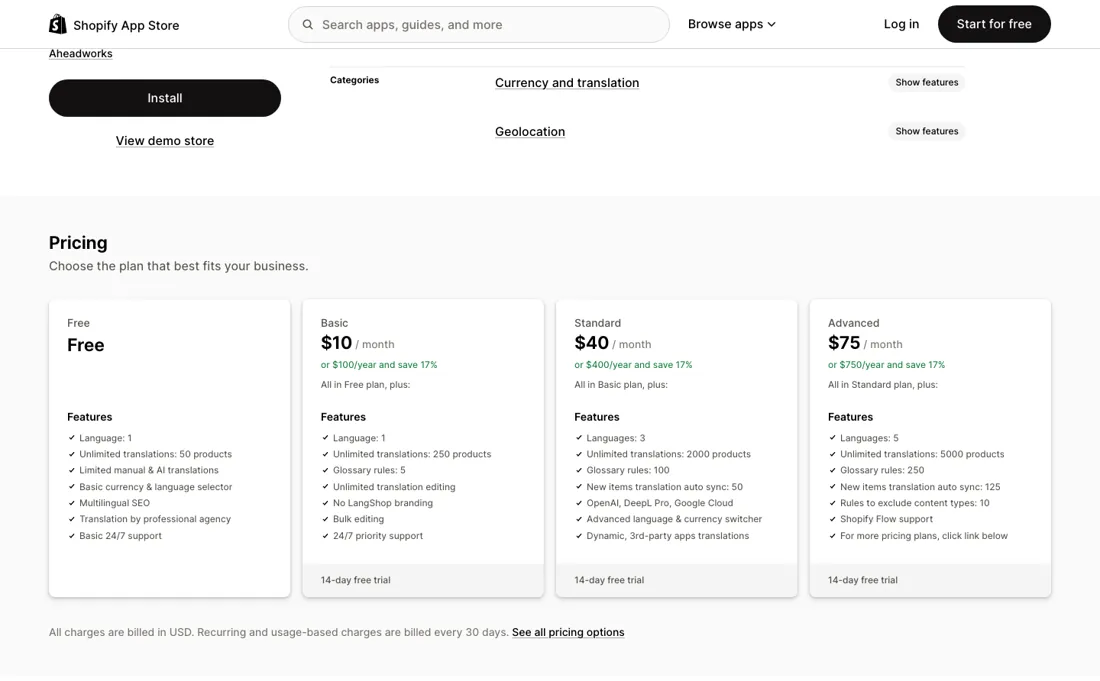
The named engines — OpenAI, DeepL Pro, Google Cloud Translation — now start on Basic at $10 a month (they were a $40 Standard feature when we read the page in September 2026), but dynamic content, metaobjects, third-party app strings and export of your translations still start at Standard. The Shopify listing also understates the ladder: it stops at Advanced and links to 'more pricing plans', while the vendor's pricing page publishes Pro at $120, Enterprise at $250 and Unlimited at $500 — and API access, which no listing tier mentions, starts at Pro.
The app is old enough to judge (launched 15 September 2016, developer Aheadworks) and most of its 473 reviews are positive (13 October 2026), but 24 of them are one-star, and the recent negative ones are specific rather than vague: a Slovak store reporting that metafield translations ignore both the AI store context and the glossary rules, and a Swedish store of almost three years reporting that products duplicated from another product carry the wrong translation across.
If metafields or duplicated products are central to your catalogue, test exactly that during the trial.
Watch the video review
The video version of this review, from our YouTube channel.
What LangShop does
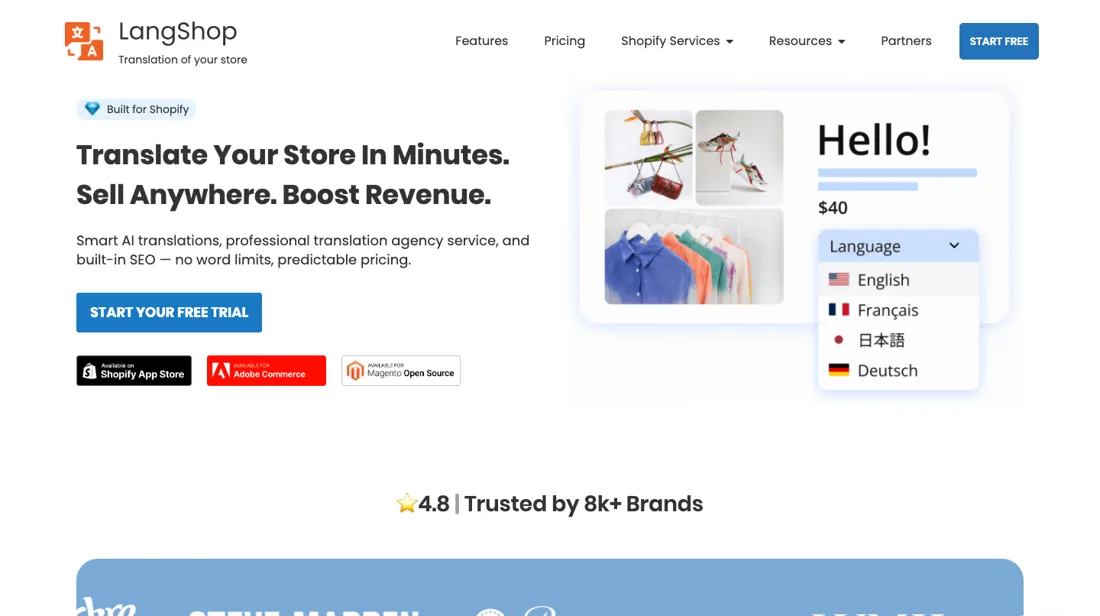
Shopify translation and currency app (by Aheadworks) that localises products, themes, checkout, SEO and third-party app content with OpenAI, DeepL Pro or Google Cloud Translation, or with professional agency translators, and adds a geolocated language and currency switcher. Glossary and content rules keep terms consistent. Launched September 2016.
What buyers report about LangShop
Hands-on: not tested by usReported by buyers: Shopify App Store, read September 2026
Themes from the buyer-review sites listed at the foot of this page, read in September 2026. We have not run LangShop ourselves, so this is other buyers' experience rather than ours. We summarise it here because the complaints are usually the part a vendor page leaves out.
- • The weight of opinion is positive: 431 of the 479 ratings are five-star and the overall sits at 4.5 (Shopify App Store, read September 2026).
- • The vendor answers negative reviews publicly and in detail rather than with a template — the replies name the mechanism, point at a specific setting, and say plainly when something is a limitation.
- • Twenty-three one-star ratings, and the recent ones are specific. A Swedish store of almost three years reports that a product duplicated from another product inherits the wrong translation, that single words which become two words in another language pick up a stray space, and that the free translation engine produces poor output.
- • A Polish store reports the app not working for three days straight, with support saying developers were on it and no further update.
- • On the duplicate-translation complaint the vendor's own reply concedes there is no workaround known to them, because LangShop stores translations in the Shopify API and they are copied along with the product.
Where the ratings disagree. The support signal and the product signal point different ways. The vendor replies to almost every complaint, quickly and substantively, which is genuinely better than most. But on the most-repeated failure the reply is an explanation of a limitation, not a fix — and the mitigation it offers, Shopify Flow, is not available below the Advanced tier. Read the one-star reviews for the mechanism, not the tone.
Pages read (September 2026): Shopify App Store
When the paid plan is worth it
The Shopify listing shows four tiers and a link to more pricing plans; langshop.app/pricing publishes seven (read 10 September 2026). Above Advanced sit Pro at $120 a month, Enterprise at $250 and Unlimited at $500 — and Pro is the one that matters, because API access starts there and the listing never mentions it. Annual billing is two months free. The meter counts products and languages, not words. Treat the word figures in the comparison table carefully: the page says they assume 250 words per product, which holds for the 50- and 250-product rows but not above them — 2,000 products is shown as 1.5M+ words where that formula gives 500,000.
What upgrading does not fix is whether the rules are obeyed. A higher tier buys more exclusion rules — glossary rules are already unlimited from Basic — but on the most-repeated complaint — products duplicated from another product carrying the wrong translation across — the vendor's own public reply says translations live in the Shopify API and duplicate with the product, with no workaround known to them. The mitigation they suggest instead is Shopify Flow, which does not appear below Advanced.
Our monthly capture read this vendor's pricing page in September 2026 and again in October 2026, and the amounts were the same both times, including $250, $400, $500 and $750 from the pricing above. We keep watching — the registry records what moves.
Questions we are still checking
Facts about LangShop that would change a buying decision, and where we stand on each. An unanswered question does not mean the feature is missing; it means we have not confirmed it yet.
- What happens to published translations after uninstalling LangShop? Still checking
Applies to: all tiers.
Why it matters: export/import only starts at Standard, so on Free or Basic whether the translations stay in the store decides whether leaving costs the work.
Checked: LangShop pricing (2026-10-13) - What does an agency (human) translation order cost? Still checking
Applies to: all tiers including Free.
Why it matters: the pricing table lists agency translation via TextMaster on every tier but prints no price.
Checked: LangShop pricing (2026-10-13)
Have a public source that answers one of these? How we review explains how we check and correct.
How to actually use LangShop
Pick the plan before anything else. The vendor's getting-started guide says you choose one as soon as you install, and the plan caps how many languages you may run — one on Free, five on Basic, ten on Standard, twenty from Advanced up (pricing page read 13 October 2026) — so a wrong choice is a re-pick rather than a setting. Then decide where machine translation is allowed to be final.
Glossary rules, unlimited on every paid tier, pin brand terms and phrases that must not move. Exclusion rules keep whole content types out of translation — the vendor's list names metafields, themes and metaobjects — and those start only at Advanced, with ten of them. Spend the trial on your hardest content rather than product titles. The specific failures merchants describe on the listing are metafields and products duplicated from another product, so translate exactly those, then open the storefront in each language and read the checkout and any third-party app strings.
Where this section comes from: our research notes (182 words)
langshop.app/pricing read on 10 September 2026 — the seven plan cards with monthly and annual rates (Free, Basic $10/$100, Standard $40/$400, Advanced $75/$750, Pro $120/$1200, Enterprise $250/$2500, Unlimited $500/$5000), the product, language, glossary, auto-sync and exclusion-rule limits per tier, the 'API access' line on Pro, the 'two months free' annual note and the comparison table's own statement that its word figures assume 250 words per product; langshop.app/faq the same day, whose banner says fourteen days where the pricing cards say seven; apps.shopify.com/langshop for the listing's four-tier view, its 14-day trial and the merchant reports of metafield and duplicated-product translation failures; and the vendor knowledge base at langshop.kb.helpcenterapp.com/langshop-for-shopify — 'Getting Started' for choosing a plan at install and selecting languages, and 'Glossary & Exclusion Rules' for the glossary, the metafield/theme/metaobject exclusion types and DeepL glossary support.
Re-verified 13 October 2026 on langshop.app/pricing and apps.shopify.com/langshop: amounts unchanged, but language caps, glossary rules and the tier where the named engines start had all changed since 10 September (see the price section), and both pages now say 14-day trial; 473 reviews on the listing that day.
The natural comparison is Hextom AI Translate & Currency, EA • Auto Language Translate — the translation shelf on the Shopify App Store is crowded and the nearest neighbours all publish a free plan, so price is a poor way to choose between them. What separates LangShop is control rather than reach: glossary rules and content rules, translation of dynamic elements (banners, pop-ups, checkout, third-party apps), a professional-agency route for the pages that must be right, and a switcher you can design. What it costs you is that dynamic-content translation only starts at $40 a month, where the free tiers of the alternatives already translate a store after a fashion. Try the cheaper option first if your storefront is mostly static product text; move to LangShop when the wrong translation in a checkout string starts costing orders. (Neighbours read 10 September 2026 on the LangShop listing.).
Frequently asked questions
How many languages does each plan allow?
One on Free, five on Basic ($10 a month), ten on Standard ($40) and twenty on Advanced ($75) and every tier above it, per langshop.app/pricing and the Shopify listing read 13 October 2026. That is more than in September 2026, when the same prices bought one, one, three and five languages.
Can I take my translations with me if I leave, and on which plan?
Per the plan comparison on langshop.app/pricing read 13 October 2026, export/import and translation history (restoring earlier translations) start at Standard, $40 a month; Free and Basic have neither. What happens to published translations after you uninstall is not stated on the pricing page — not confirmed.
Is human (agency) translation included in the subscription?
The pricing table read 13 October 2026 marks agency translation — native-speaker translators ordered from inside the app, provided through the TextMaster service per the page's own FAQ — as available on every tier, Free included. It gives no price and does not say the work is included in the subscription, so the cost of an order is not confirmed.
Is this a hands-on review of LangShop?
This is a researched assessment, not a hands-on test — where we've used a tool ourselves, we say so explicitly. We name what each tool is good and bad at, and we earn a commission only if you sign up, at no cost to you.
- Buyer reviews on Shopify App Store, read September 2026.
- Read 2026-10-13 on apps.shopify.com/langshop and langshop.app/pricing.
- A dated screenshot of that pricing page, kept on this site as the receipt.
Others in this category
Reviewed e-commerce tools that share ground with LangShop — comparable in what they do, not drop-in swaps:
New reviews, price changes we recorded, and the cost conditions we found. No sponsored placements. Unsubscribe anytime.
This is our researched assessment — not a paid placement. The “Visit” links on this page are affiliate links: we may earn a commission if you sign up, at no extra cost to you, and it never changes our take. How we review →