Dripify Review (2026)From $39/user, Against LinkedIn's Rules
 By Daan Haket · Researched and written with an AI assistant · who does what
Understand what you are buying before the price matters: LinkedIn prohibits this entire product category.
sales teams that already run LinkedIn outreach, understand that automation breaches LinkedIn's terms, and accept that risk with their eyes open — the cloud architecture means sequences run with your browser closed and no extension injected into your session.
your LinkedIn account is not expendable, since a restriction can be permanent and no tool can promise otherwise; or you are tempted by the 75-a-day ceiling, because the vendor's own advice is roughly a fifth of that.
Transparency: the “Visit” links on this page are affiliate links — we may earn a commission if you sign up, at no extra cost to you. No vendor can pay for a better review or verdict. How we make money →
Pricing (2026)
✓ Pricing re-verified 10 Oct 2026
| Plan | Price | What you get |
|---|---|---|
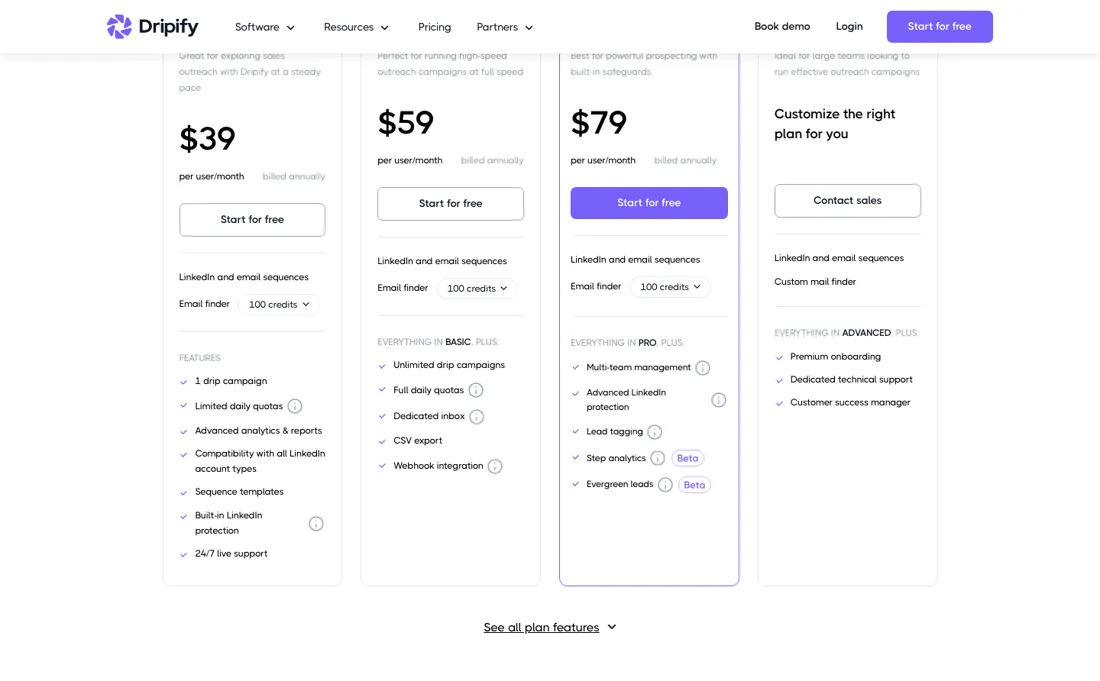
| Basic | $39/user/month annually, $59 month to month | one drip campaign, 20 connection requests and 30 messages a day, 100 email-finder credits |
| Pro | $59/user/month annually, $79 month to month | unlimited campaigns at full quotas (75 requests, 100+ messages), dedicated inbox, CSV export, webhook and HubSpot |
| Advanced | $79/user/month annually, $99 month to month | adds multi-team management, advanced LinkedIn protection, lead tagging, step analytics and evergreen leads |
| Enterprise | quote — contact sales | premium onboarding, dedicated technical support and a customer success manager |
| This tool | $39 | 3rd cheapest of 5 |
| Cheapest | $14 | Pipedrive |
| Median | $39 | |
| Most expensive | $49 | Streak |
Lowest paid entry price per seat a month, billed annually, in USD, among the 5 sales & outreach tools we have researched (read between 2026-08-26 and 2026-10-09). Only tools priced in the same unit and on the same billing are compared — not a market survey, and cheapest is not best.
Four tiers, priced per user: Basic $39, Pro $59 and Advanced $79 per user per month billed annually, plus an Enterprise tier that is quote-only. Month to month the same tiers read $59, $79 and $99 per user; both columns sit in the page and the FAQ repeats all six numbers in words. A 7-day free trial runs without a credit card.
So the 'up to 35% off' the toggle advertises is real but front-loaded: you pay a year up front to get it, and the discount shrinks as you go up the range — about 34 percent on Basic, 25 on Pro, 20 on Advanced. What each tier buys is unusually consequential here, and the page now prints the daily quotas instead of calling them 'limited': Basic sends 20 connection requests, 30 messages, 10 Sales Navigator InMails and 100 profile views a day, against 75, 100+, 30 and 200+ on Pro and Advanced.
Full pricing notes (2 more paragraphs)
Basic is also capped at one drip campaign; unlimited campaigns and full quotas start at Pro, which adds a dedicated inbox, CSV export and the webhook and HubSpot integrations, and Advanced adds multi-team management, advanced LinkedIn protection, lead tagging, step analytics and evergreen leads. Every tier includes 100 email-finder credits a month and the top-ups are priced openly: 1,000 credits $29, 2,000 $49, 5,000 $69, 10,000 $99.
One seat connects one LinkedIn account, so five reps means five seats, and ten or more seats goes through sales. Re-read 10 October 2026: prices and daily quotas unchanged, and Pro now also lists an Open API and an MCP server.
Plans change — always verify the live price on their site.
Category context: Sales & CRM. Across the 12 tools in this category that we researched with a public US-dollar price, the median entry price is about $45 a month (lowest paid plan as listed, per seat where the vendor prices per seat). Dripify’s entry price of $39 a month sits below that median. Compare pricing conditions in the Software Cost Atlas →
What the pricing page doesn’t say
Its User Agreement bans using 'bots or other unauthorized automated methods' to 'send or redirect messages', and its prohibited-software page says members using such tools 'risk having their accounts restricted or shut down'. There is no carve-out for cloud tools or low volumes, and Dripify is not an outlier here — every competitor sits on the same side of that line. Dripify's own documentation is candid about the consequence, warning that LinkedIn 'may issue warnings, temporary restrictions, or even permanent bans', and it publishes a recovery procedure for exactly that scenario.
Two things follow. First, the advertised ceiling is not a working speed: the app allows up to 75 connection requests a day, while Dripify's own setup guide tells beginners to run 10 to 15, and brand-new accounts 2 to 5, building up 10 to 20 percent a week. Anyone buying on the headline number is buying capacity they are told not to use. Second, Activity Control sits on the $79 Advanced tier.
It is the feature Dripify names as its best protection, and it adjusts your pace automatically. On Basic and Pro, safe pacing is your own manual responsibility. And when a vendor writes that a feature 'makes sure your LinkedIn account won't get flagged', read that as a claim about a third party's enforcement decisions that no vendor can actually guarantee.
Watch the video review
The video version of this review, from our YouTube channel.
⚡ Short on time? Watch the 30-second verdict Short.
What Dripify does
Cloud-based LinkedIn outreach automation — drip sequences of connection requests, messages, InMails and profile views, with configurable daily limits and a built-in email finder.
What buyers report about Dripify
Hands-on: not tested by usReported by buyers: G2, Trustpilot and independent safety testing, read August 2026
Themes from the buyer-review sites listed at the foot of this page, read in August 2026. We have not run Dripify ourselves, so this is other buyers' experience rather than ours. We summarise it here because the complaints are usually the part a vendor page leaves out.
- • Cloud-based, so it runs without your machine on, and the interface is genuinely easy. $39 to $79 a month on annual billing.
- • Reviewers running modest volumes report campaigns working as described.
- • Account restriction risk is the headline. Independent testing across 50 LinkedIn accounts found a 23% restriction rate within 90 days, and after LinkedIn's May 2026 enforcement wave user reports moved into the 27-34% range. Weigh that against what your LinkedIn profile is worth to you.
- • Billing continuing after cancellation, bugs in the billing module and confusing auto-renewal all recur.
- • No email integration, so multi-channel sequencing is out.
- • Outreach messages read generic unless you do the personalisation work yourself, and support is slow.
Pages read (August 2026): Trustpilot
When the paid plan is worth it
Basic at $39 is a trial-in-disguise: one drip campaign and quotas the page itself calls limited. If you run more than a single sequence, Pro at $59 is the real entry point — that is where unlimited campaigns, full daily quotas, a dedicated inbox, CSV export and webhooks live. The jump to Advanced at $79 buys one thing that matters more than the rest of the feature list: Activity Control, which Dripify's own safety guide tells you to switch on, and which adjusts your daily connecting and messaging limits based on your account history.
If your LinkedIn account carries real professional value, that $20 gap is cheap insurance for the category's main risk. Two things no tier fixes. Pricing is per user, so a team of five pays five times, and LinkedIn's own weekly invitation ceiling still applies no matter which plan you are on — as Dripify puts it, no automation can overcome the limits set by LinkedIn.
Narrated summary of this section — not a screen recording; every figure in it is the one sourced above.
Questions we are still checking
Facts about Dripify that would change a buying decision, and where we stand on each. An unanswered question does not mean the feature is missing; it means we have not confirmed it yet.
- Does Dripify refund any part of a paid period after cancellation? Still checking
Applies to: all paid plans.
Why it matters: the pricing FAQ says access continues to the end of the paid period but does not address refunds; reviewers report unexpected renewals.
Checked: Dripify pricing (2026-10-10)
Have a public source that answers one of these? How we review explains how we check and correct.
How to actually use Dripify
Setup is genuinely light: Dripify runs in the cloud, so there is no download and no Chrome extension for the core product — you connect your LinkedIn account and campaigns keep running with your browser closed.
Distilled from Dripify's own help centre (daily limits, safety algorithm, account and billing articles) plus LinkedIn's User Agreement and prohibited-software pages Re-verified 10 October 2026 on dripify.com/pricing (plans and FAQ) and the help article "What happens with a subscription if I remove one of my team members?" (help.dripify.com/en/articles/4915903).
Common Dripify setup mistakes
Where Dripify setups actually go wrong, and what it costs you when they do. Same sources as the setup notes above — not from a walkthrough we ran ourselves.
The friction is not technical, it is behavioural.
- Set your daily limits before your first campaign, not after: Settings → Limits & Activity has a slider per action type and a range dropdown that randomises volume, so a setting of 60 with range 5 sends between 55 and 65.
- Start at 10 to 15 connection requests a day, or 2 to 5 on a brand-new account, and raise by 10 to 20 percent a week — that is Dripify's own guidance, not ours.
- Two administrative traps worth knowing up front, both from the vendor's documentation.
- Removing a team member from your workspace does not stop billing for that seat, which has to go through support; and a downgrade only takes effect at the end of your paid term, while an upgrade bills immediately.
- Reviewers across several platforms report unexpected renewals and difficulty cancelling; the help centre documents how to buy a plan but has no article on cancelling one, so put your renewal date in your calendar yourself.
Dripify vs Expandi, side by side
Each column shows the vendor’s own published entry price, read on the date shown. Entry prices can cover different services or units, so check what each one buys. We do not average them into a score.
Both names above are affiliate links: we may earn a commission if you sign up, at no extra cost to you. Neither changes what this table says.
The natural comparison is Expandi — the closest head-to-head — both are cloud-based with a regional dedicated IP, so the 'cloud versus extension' framing you will read in affiliate roundups does not actually separate them. The real difference is the pricing model: Expandi sells one Business plan with everything included at $99 per user a month, 20 percent off annually, while Dripify tiers both quotas and safety features. Watch the $39-versus-$99 gap that roundups quote — that is Dripify's annual rate against Expandi's monthly one. Month against month it is $59 to $99 versus $99, and at the top of Dripify's range the two cost the same. Both price lists read on 2026-07-24; verify them yourself before you buy..
Frequently asked questions
Do I need a seat per rep, and what happens when someone leaves?
Yes: the FAQ on dripify.com/pricing (read 10 October 2026) says each seat connects one LinkedIn account, so five reps need five seats, and 10 or more seats go through sales. Dripify's help article on removing team members (dated 30 March 2026) says a paid team member's subscription stays active after you remove them from the team; cancel it first, or ask support to cancel it or transfer it to someone else.
Which plan do I need to manage a team?
Advanced. Per dripify.com/pricing, read 10 October 2026, multi-team management, roles, team performance tracking, duplicate-outreach prevention, shared sequence templates and managing team subscriptions are Advanced features; Pro has unlimited campaigns but none of the team tools.
What happens when the trial ends or I cancel?
Per the pricing FAQ, read 10 October 2026: the 7-day trial gives Advanced features without a card and charges nothing automatically; you pick a plan or the account goes inactive. You can cancel any time under Billing and keep access to the end of the paid period. Upgrades and extra seats apply immediately, downgrades from the next billing cycle. Refunds are not addressed on the page, so that is not confirmed.
Is this a hands-on review of Dripify?
This is a researched assessment, not a hands-on test — where we've used a tool ourselves, we say so explicitly. We name what each tool is good and bad at, and we earn a commission only if you sign up, at no cost to you.
- Buyer reviews on G2, Trustpilot and independent safety testing, read August 2026.
- Re-verified 2026-08-26 on their own pricing page — note that dripify.io now redirects to dripify.com.
- A dated screenshot of that pricing page, kept on this site as the receipt.
Others in this category
Reviewed sales & crm tools that share ground with Dripify — comparable in what they do, not drop-in swaps:
New reviews, price changes we recorded, and the cost conditions we found. No sponsored placements. Unsubscribe anytime.
This is our researched assessment — not a paid placement. The “Visit” links on this page are affiliate links: we may earn a commission if you sign up, at no extra cost to you, and it never changes our take. How we review →