Bot It AI Review (2026)Free Audit, $29 a Month for the Fixes
 By Daan Haket · Researched and written with an AI assistant · who does what
The budget behind the AI fixes is not published.
Shopify merchants who want to know how complete their catalogue data is for AI shopping agents and are willing to test an early tool, starting with the free audit before paying for automated fixes.
you want a proven, heavily reviewed SEO or feed app today; your catalogue is small enough to fix by hand from the free audit; or you need a published cap on AI usage before you commit.
Transparency: we earn nothing from Bot It AI; the links to it are plain links. How we make money →
Pricing (2026)
✓ Pricing re-verified 24 Sep 2026
| Plan | Price | What you get |
|---|---|---|
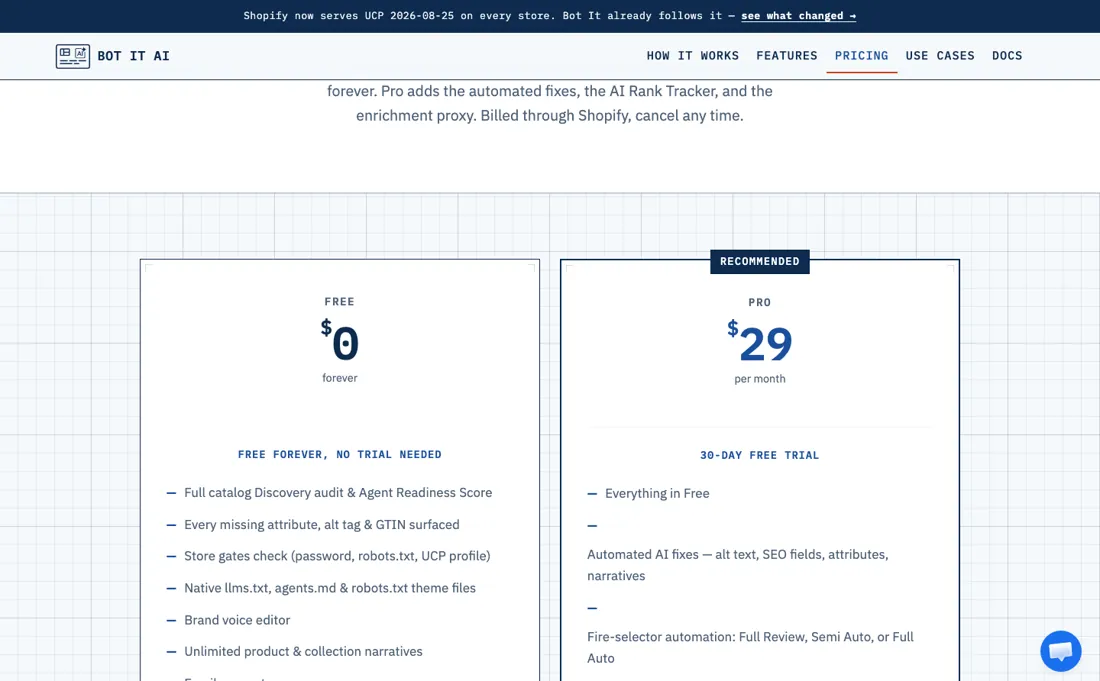
| Free | free forever | Catalogue audit, Agent Readiness Score, store gates check, llms.txt/agents.md/robots.txt, brand voice editor, unlimited narratives, email support |
| Pro | $29 a month (30-day free trial) | Automated AI fixes, AI Rank Tracker, IndexNow broadcast, MCP Enrichment Proxy, BYO-LLM connector, 90-day log retention, priority support |
Summarised from the pricing notes below; the notes carry the conditions.
| This tool | $29 | 42th cheapest of 59 |
| Cheapest | $2.99 | MX AI |
| Median | $15 | |
| Most expensive | $199 | Auware |
Lowest paid entry price per account a month, billed monthly, in USD, among the 59 e-commerce growth apps we have researched (read between 2026-08-19 and 2026-10-30). Only tools priced in the same unit and on the same billing are compared — not a market survey, and cheapest is not best.
Free is free forever, with no trial involved: the full catalogue audit and Agent Readiness Score across 13 checks per product, the store gates check (password, robots.txt, UCP profile, sitemap), native llms.txt, agents.md and robots.txt theme files, a brand voice editor, unlimited product and collection narratives, and email support. Category-attribute proposals are shown on Free but not applied. Pro is $29 a month with a 30-day free trial and adds the automated AI fixes for alt text, SEO fields, attributes and narratives under three automation levels with one-click revert, the nightly AI Rank Tracker against named competitors, IndexNow broadcast on product changes, the MCP Enrichment Proxy, a bring-your-own-LLM connector, review integration, AI-agent traffic analytics, knowledge-base sync, 90-day log retention and priority support.
Pro's AI fixes draw on a monthly token budget the vendor calls generous but does not quantify, and there is no enterprise tier yet. Billed in USD through Shopify every 30 days. Plans change — always verify the live price on their site.
Category context: E-commerce. Across the 49 tools in this category that we researched with a public US-dollar price, the median entry price is $19 a month (lowest paid plan as listed, per seat where the vendor prices per seat). Bot It AI’s entry price of $29 a month sits above that median. Compare pricing conditions in the Software Cost Atlas →
What the pricing page doesn’t say
Pro's automated fixes draw on a monthly token budget the vendor describes only as generous. Its FAQ puts a typical product at about a thousand tokens to enrich once and says the app stops proposing, never mid-write, when you reach the ceiling. For a catalogue of a few hundred products that is unlikely to matter. For tens of thousands of SKUs, or for re-enriching after every catalogue change, ask for the number in writing before you rely on it.
It is a bet on a channel that is still small. The app prepares your catalogue for AI shopping agents, including ChatGPT, Perplexity, Gemini and Claude, and tracks where your products place in their results. For most stores those agents are not yet a meaningful source of orders, so the rank tracker and the agent-traffic analytics may show very little for a while. The audit is useful regardless, because the fields it checks (categories, attributes, barcodes, alt text, variants, policies) also feed shopping feeds and on-site search.
Nobody has reviewed it yet. The app launched on the Shopify App Store on 8 May 2026 and still had zero reviews on 24 September 2026, so there is no outside account of how accurate its generated attributes are. Start in Full Review mode, where every proposal waits for your approval, before you let Full Auto write to your live catalogue.
Watch the video review
The video version of this review, from our YouTube channel.
What Bot It AI does
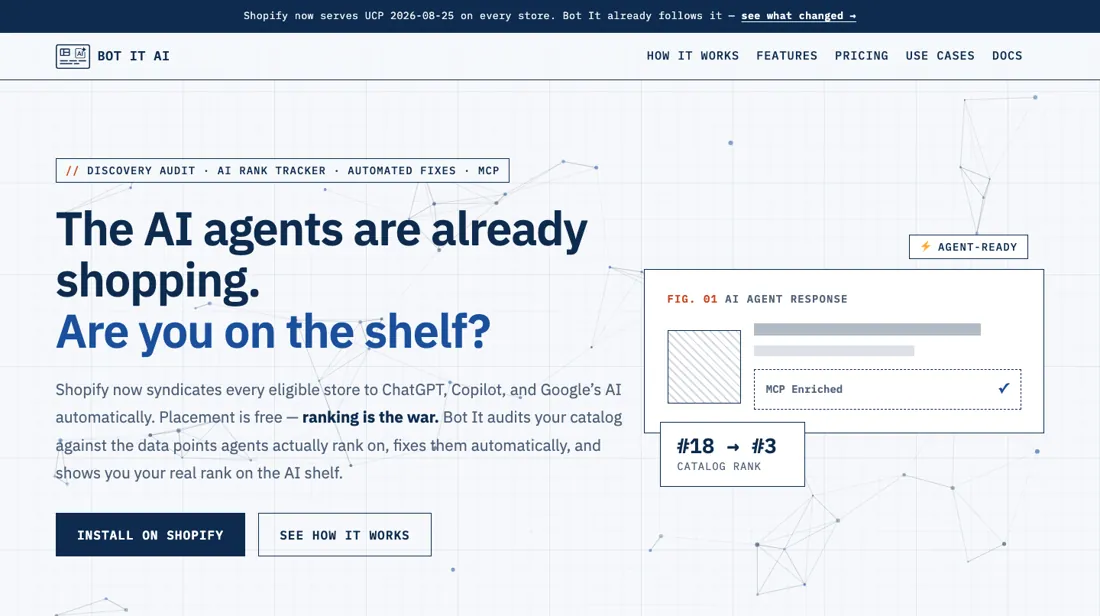
Shopify app that audits every product for the data AI shopping agents rank on (categories, attributes, barcodes, alt text, variants, policies), maintains llms.txt and agents.md, and on Pro writes the missing fields with one-click revert and tracks placement in AI shopping results. Launched May 2026, no reviews yet.
Free diagnoses, Pro repairs
The line between the two tiers is clean. On Free you get the complete audit, with every product scored on 13 checks, the list of failing products and the store-level gates check, plus the llms.txt, agents.md and robots.txt theme files, the brand voice editor and unlimited narratives. What Free does not do is write to your catalogue: category-attribute proposals are shown rather than applied, and alt text and SEO fields stay as they are.
So the $29 buys labour, and whether it is worth it depends on the size of the gap the free audit finds. If it lists a few dozen products missing alt text, writing them yourself takes an afternoon. If it lists thousands of missing attributes and barcodes, $29 a month for proposals you approve in bulk is cheap. The vendor's FAQ says the changes are written as ordinary Shopify product fields, metafields and metaobjects that stay if you uninstall, so you can run Pro for a month or two, clear the backlog and drop back to Free without losing the work.
The 30-day trial makes that cheaper still: cancel before it ends and nothing is charged, and you keep every audit result. What keeps Pro worth paying for after the backlog is gone are the parts that only run while you subscribe, namely the nightly rank tracker, the IndexNow broadcasts, the enrichment proxy and the analytics.
Our monthly capture read this vendor's pricing page in September 2026 and again in October 2026, and the amounts were the same both times, including $29 from the pricing above. We keep watching — the registry records what moves.
How to actually use Bot It AI
Install from the Shopify App Store and run the free audit first. The vendor's documentation promises a store discoverable by AI agents in under 15 minutes; what you actually get in that time is the Agent Readiness Score and a list of failing products and checks, which is the useful part. Fill in the brand voice editor next, with your brand summary, tone, shipping policies and FAQs, because the generated narratives and fixes draw on it.
If the audit shows a real backlog, start the 30-day Pro trial and set automation to Full Review, where every proposal waits for your approval. Read the first batch carefully: generated attributes and alt text are only as accurate as the product data behind them. Move to Semi Auto once the proposals are consistently right, and watch the Automation tab, which shows your token usage against the monthly ceiling. Every change is logged and revertible in one click, and the changes stay in your store if you later uninstall.
Distilled from The Shopify App Store listing at apps.shopify.com/bot-it (tiers, features, integrations, the developer Immersive Ecommerce of Athens, Georgia, the launch date of 8 May 2026 and zero reviews) and the vendor's pricing page at botitai.com/pricing, including the plan comparison table and the pricing FAQ read answer by answer, plus the documentation home at docs.botitai.com, all read in a headless browser on 24 September 2026. We have not installed the app.
Bot It AI vs StoreSEO, side by side
Each column shows the vendor’s own published entry price, read on the date shown. Entry prices can cover different services or units, so check what each one buys. We do not average them into a score.
The StoreSEO link above is an affiliate link — we may earn a commission if you sign up, at no extra cost to you — and the other column is a plain link. Neither changes what this table says.
The natural comparison is StoreSEO — StoreSEO is the closest comparison in our own dossiers, and the two now overlap on the newest ground: both generate an llms.txt and an agents.md. StoreSEO (read 19 August 2026) is a conventional Shopify SEO suite metered on products and AI credits: Free covers 25 products and 200 credits, Lite at $14.99 a month covers 100 products and 1,000 credits, Essential at $39.99 covers 250 products and 5,000 credits, with keyword tracking, schema markup and sitemap submission aimed at Google. Bot It scores the whole catalogue for free with no product cap and charges a flat $29 for the fixes, but it aims at AI shopping agents rather than search engines and publishes no usage number. A store whose traffic comes from Google is better served by StoreSEO's ladder; a store that wants every product scored for agent readiness at no cost can start with Bot It's free audit..
Frequently asked questions
What does Bot It AI cost?
The audit is free forever: every product scored on 13 checks, the store gates check and the llms.txt, agents.md and robots.txt theme files. Pro, which writes the fixes and adds the rank tracker, the enrichment proxy and analytics, is $29 a month with a 30-day free trial, billed through Shopify. Read on 24 September 2026.
Is there a limit on the AI fixes?
Yes, but it is not published. Pro runs on a monthly token budget the vendor calls generous; its FAQ says a typical product costs about a thousand tokens to enrich once and that the app stops proposing, never mid-write, at the ceiling. The Automation tab shows your usage. For a very large catalogue, ask for the number before you commit.
What happens to the changes if I uninstall?
According to the vendor's FAQ they stay. Bot It writes ordinary Shopify data, meaning product fields, standard metafields and metaobjects, so nothing depends on the app remaining installed. Downgrading to Free stops the automation but keeps the audits running.
Is this a hands-on review of Bot It AI?
This is a researched assessment, not a hands-on test — where we've used a tool ourselves, we say so explicitly. We name what each tool is good and bad at, and we have no affiliate relationship with Bot It AI — we earn nothing whether you sign up or not.
- Read 2026-09-24 on apps.shopify.com/bot-it and on the vendor's own botitai.com/pricing, which list the same two tiers.
- A dated screenshot of that pricing page, kept on this site as the receipt.
Others in this category
Reviewed e-commerce tools that share ground with Bot It AI — comparable in what they do, not drop-in swaps:
New reviews, price changes we recorded, and the cost conditions we found. No sponsored placements. Unsubscribe anytime.
This is our researched assessment — not a paid placement. How we review →