Intelis Review (2026)It Counts Variants, Not Products
 By Daan Haket · Researched and written with an AI assistant · who does what
The ladder counts variants, not products, and that is where stores get caught.
- Best for Shopify stores competing on Google Shopping prices
- Not for small catalogues testing repricing for the first time
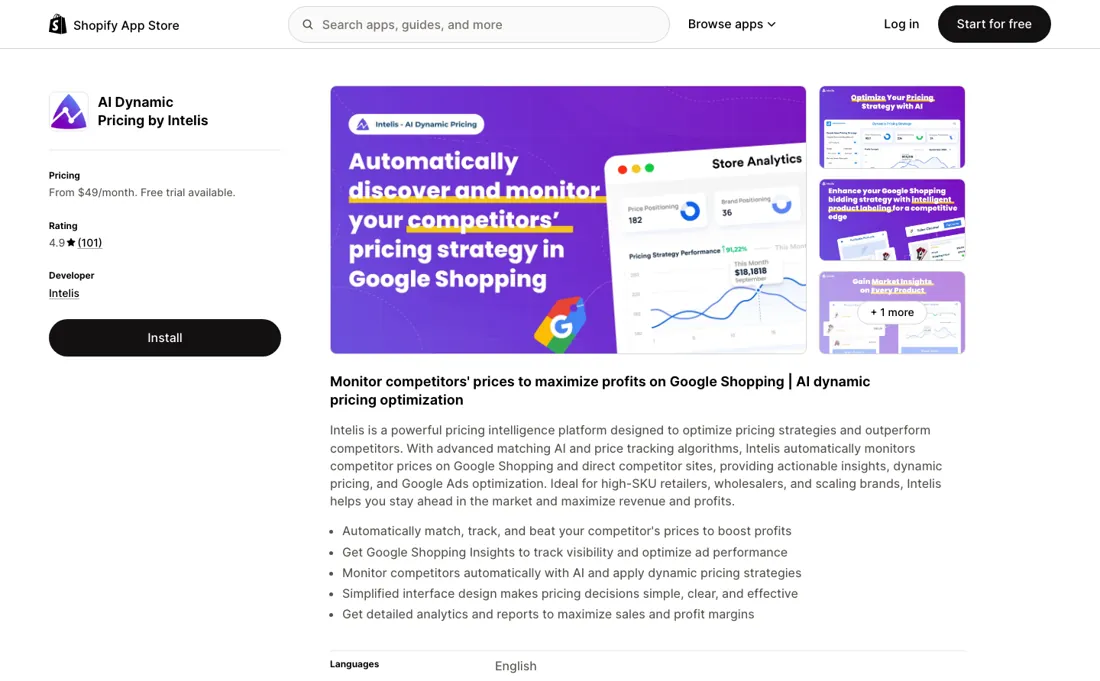
From $49 · Basic · per month for up to 100 products or variants, or $490 a year… · read 2026-10-01
Try Intelis →Affiliate link: we may earn a commission if you sign up, at no extra cost to you. It never changes our verdict.
Is Intelis right for you?
Your pain“Competitors undercut me on Google Shopping, and I only notice days later when sales have slipped.”
Does Intelis solve it?YesBuyer reports (Shopify App Store, Aug 2026): 4.9 over 75 reviews, with merchants saying the automation does the competitor watching and reports more sales.
Your planProfessional, $179 a month or $1,790 a year, covering up to 1,000 products or variants
Try Intelis →
Your pain“With thousands of variants I can't check prices by hand, and a bad match means fixing listings one by one.”
Does Intelis solve it?PartlyBuyer reports (Shopify App Store, May 2026): a Danish bike shop says it works, but products get mismatched even by EAN and need a lot of correction.
Your planBusiness, $399 a month or $3,990 a year, up to 5,000 products or variants
Try Intelis →
- Small catalogues testing repricing for the first time. Shopify listing, re-read 19 September 2026: the cheapest tier is $49 a month for up to 100 products or variants, with a 14-day trial. Better fit: Pricefy.
The “Try” buttons are affiliate links: we may earn a commission if you sign up, at no extra cost to you, and it never changes our verdict.
Also in: Software for Shopify and online stores
Transparency: the “Visit” links on this page are affiliate links: we may earn a commission if you sign up, at no extra cost to you. No vendor can pay for a better review or verdict. How we make money →
Which Intelis plan do you need?
4 plans, 3 questions, no signup.
Answer three quick questions to see your plan.
Your plan
Basic
$49 a month or $490 a year
Up to 100 products or variants; Google Shopping monitoring, dynamic pricing
Your plan
Professional
$179 a month or $1,790 a year
Up to 1,000; adds variant tracking, sales analysis, live feed export
Your plan
Premium
$249 a month or $2,490 a year
Up to 2,000; adds Shopify Markets support, Google Analytics, API access
Your plan
Business
$399 a month or $3,990 a year
Up to 5,000; adds MAP monitoring, custom labels feed; Enterprise $749 for 10,000 SKUs
Probably not Intelis
From your answers, look at Pricefy instead. Why ↓
Prices as we read them on 2026-10-01; check the checkout before you pay. The plan button is an affiliate link: we may earn a commission, at no extra cost to you.
Pricing (2026)
✓ Pricing re-verified 1 Oct 2026
| Plan | Price | What you get |
|---|---|---|
| Basic | $49 a month or $490 a year | Up to 100 products or variants; Google Shopping monitoring, dynamic pricing, chat support |
| Professional | $179 a month or $1,790 a year | Up to 1,000; adds variant tracking, sales analysis, live feed export, AI assistant |
| Premium | $249 a month or $2,490 a year | Up to 2,000; adds Shopify Markets support, Google Analytics integration, API access |
| Business | $399 a month or $3,990 a year | Up to 5,000; adds custom labels feed, MAP monitoring, AI matching, A+ support |
| Enterprise | $749 a month or $7,490 a year | Up to 10,000 SKUs |
Summarised from the pricing notes below; the notes carry the conditions.
| This tool | $49 | 54th cheapest of 60 |
| Cheapest | $2.99 | MX AI |
| Median | $17 | |
| Most expensive | $199 | Auware |
Lowest paid entry price per account a month, billed monthly, in USD, among the 60 e-commerce growth apps we have researched (read between 2026-08-19 and 2026-11-12). Only tools priced in the same unit and on the same billing are compared. This is not a market survey, and cheapest is not best.
Four tiers on the Shopify listing, priced by how many products or variants you track, each with a 14-day free trial. Basic $49 a month or $490 a year, a 17% saving: up to 100 products or variants, Google Shopping competitor monitoring, AI automatch for unlimited competitors, dynamic pricing, unlimited competitor URL tracking, reports, pricing history and chat support. Professional $179 a month or $1,790 a year: up to 1,000, adding variant tracking, sales analysis, live feed export, pricing strategy monitoring, an AI assistant and premium chat support.
Premium $249 a month or $2,490 a year: up to 2,000, adding Shopify Markets support per market, Google Analytics integration and API access. Business $399 a month or $3,990 a year: up to 5,000, adding a custom labels feed for Google Merchant Center, MAP monitoring, a customised AI matching algorithm, pricing consultation, advanced analytics and A+ support. The vendor's own pages used to disagree with the listing above Premium -- on 21 August 2026 intelis.ai/pricing showed Business at $499 with a $4,990 annual rate and Enterprise at $849, while the homepage said $749.
That is now resolved: on 8 September 2026 the pricing page and the homepage both show Business at $399 ($3,990 a year) and Enterprise at $749 ($7,490 a year) for up to 10,000 SKUs, matching the listing. The vendor's own pages count SKUs where the listing counts products or variants. All charges are billed in USD and recur every 30 days. Developer Intelis; the app launched 6 July 2021 and carries a 4.9 rating from 97 reviews on 1 October 2026 (101 on 8 September). Plans change, so check the live price on their site before you buy.
Category context: E-commerce. Across the 51 tools in this category that we researched with a public US-dollar price, the median entry price is $19 a month (lowest paid plan as listed, per seat where the vendor prices per seat). Compare pricing conditions in the Software Cost Atlas →
What the price did
We read Intelis’s own pricing page on a schedule and keep every reading, so this is our record of the page. It is not a forecast, and not someone else’s summary. A change appears here only after we confirmed the new price on the page itself.
The Shopify listing held between 8 September and 1 October 2026: $49, $179, $249 and $399 a month, or $490, $1,790, $2,490 and $3,990 a year. The vendor's own pricing page moved once: on 21 August 2026 it showed Business at $499 ($4,990 a year) and Enterprise at $849; since 8 September it shows $399 ($3,990) and $749 ($7,490) for up to 10,000 SKUs, and still did on 1 October.
What the pricing page doesn’t say
A catalogue of forty garments in five sizes and three colours is six hundred variants, so a shop most people would call small lands on the $179 tier rather than the $49 one. Count your variants, not your line items, before you read the price. The vendor's own numbers above Premium used to contradict each other, and that is worth knowing mainly because it has been fixed. On 21 August 2026 the Shopify listing said Business was $399 while intelis.ai/pricing said $499 with a $4,990 annual rate, and the homepage and the pricing page gave Enterprise as $749 and $849.
Re-read on 8 September 2026, all three pages agree: Business $399 ($3,990 a year), Enterprise $749 ($7,490) for up to 10,000 SKUs. If you are working from a comparison written earlier this year, check its figures against the listing. And automatic repricing is not a switch you leave alone. The matching is AI-driven across Google Shopping and competitor sites, and a mismatched listing quietly reprices the wrong product, while an unbounded rule set on a busy category is how a store races itself to the bottom.
Set floor prices before you turn dynamic pricing on, and audit what the automatch decided in the first fortnight.
Watch the video review
The video version of this review, from our YouTube channel.
What Intelis does
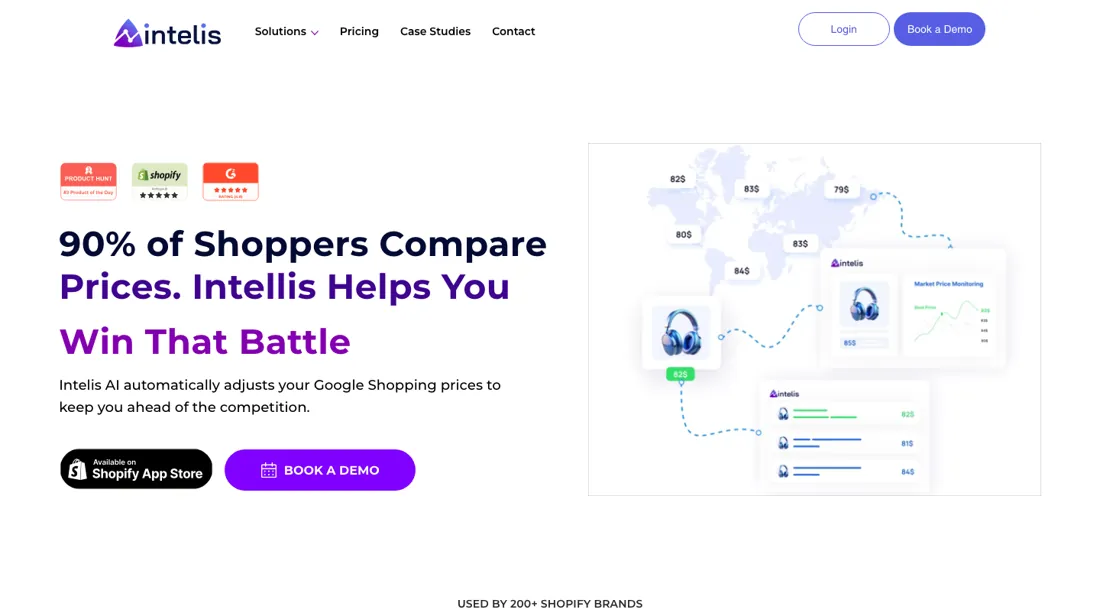
Monitors competitor prices on Google Shopping and direct competitor sites and reprices your Shopify catalogue automatically with AI matching rules.
What buyers report about Intelis
Hands-on: not tested by usReported by buyers: Shopify App Store, read August 2026
Themes from the buyer-review sites listed at the foot of this page, read in August 2026. We have not run Intelis ourselves, so this is other buyers' experience rather than ours. We summarise it here because the complaints are usually the part a vendor page leaves out.
- • 4.9 over 75 reviews, 97% of them five stars, with no one-star review at all. The recurring claim is that the automation does the watching for you: redtrinket (France, 18 days in, August 2026) credits accurate competitor tracking and an intuitive dashboard with letting them react to market moves faster, and Woody Paper (UK, June 2026) says the automation "works perfectly" and saves a large amount of time.
- • Several merchants report a revenue effect rather than a workflow one: Anume Naturals (US, July 2026) reports a clear increase in sales, and PETOPIA (Finland, August 2026) says the pricing recommendations actually work. The vendor replies to most reviews under the founder's name.
- • The two reviews that are not five stars both concern matching, not pricing. cykelgarage.dk (Denmark, 14 days in, May 2026, four stars, edited) says the app works but mismatches products "even by ean numbers, which requires a lot of work to adjust" — for a bike shop with thousands of variants that adjustment is the job the app was bought to remove.
- • Jonny Sprockets Bike Shop (Australia, 14 minutes in, January 2026, two stars) writes that it "might be too smart for its own good. Could not get it to stop what it was doing and do it how I wanted it done." Intelis replied that an automated assistant had answered instead of live support, and that a full product resync has to be run by their team rather than by the merchant.
Where the ratings disagree. Read the tenures, not the ratings. Most of the praise is written one to four days after install (Keebs with Marianne at three days, Anume Naturals at one, PETOPIA at two) while a dynamic-pricing tool only proves itself over weeks of margin data. The two reviews written by merchants who had used it longer (18 days and 14 days) are the two that talk about match accuracy, and one of them is the four-star.
Pages read (August 2026): Shopify App Store
When the paid plan is worth it
The ladder counts products OR VARIANTS, and that word is where stores get caught. Basic is $49 a month for up to 100, Professional $179 for 1,000, Premium $249 for 2,000 and Business $399 for 5,000, each with a 14-day trial and roughly 17% off on annual billing. Above that the vendor now publishes an Enterprise tier at $749 a month ($7,490 a year) for up to 10,000 SKUs. Count your variants before you read those prices.
Per variant the ladder is generous -- $0.49 on Basic falling to $0.08 on Business and $0.075 on Enterprise -- but that only helps if your variant count sits comfortably inside a band. Sitting just above a boundary is the expensive place to be: 1,050 variants pays the same $249 as 2,000. The tiers above Premium used to be unquotable: the vendor published three different figures for Business across its own pages.
As of 8 September 2026 that is fixed -- listing, pricing page and homepage all say $399, and Enterprise is openly priced at $749 rather than negotiated. If you were quoted $499 earlier this year, that number is no longer published anywhere. One operational cost no tier covers, and no upgrade removes: automatic repricing is not a switch you leave alone. Buying Business does not make the automatch more careful; it only raises the SKU ceiling.
Set floor prices before you enable dynamic pricing, and audit what the automatch decided in the first fortnight -- that fortnight of attention is part of the price at every tier.
Our monthly capture read this pricing page in September 2026 and again in October 2026. The price history below explains what changed.
How to actually use Intelis
Count variants, not products, before you read the price list. The tiers meter on products or variants, and a catalogue of forty garments in five sizes and three colours is six hundred variants -- so a shop most people would call small lands on the $179 Professional tier rather than the $49 Basic one. This is the single most common way stores misprice this app. Read the price off the Shopify listing rather than a comparison article.
The vendor's pages disagreed with the listing above Premium as recently as August 2026, and although they now match -- Business $399, Enterprise $749 for up to 10,000 SKUs, checked 8 September 2026 -- the listing is what Shopify billing actually charges you, so it stays the number to start from. Set floor prices before you switch dynamic pricing on, not after. Automatic repricing is not a feature you leave alone: an unbounded rule set in a competitive category is how a store races itself to the bottom, and a floor is the only thing that stops it.
Then audit the matching in the first fortnight. The competitor matching is AI-driven across Google Shopping and competitor sites, and a mismatched listing quietly reprices the wrong product against the wrong rival. Spend the 14-day trial checking what the automatch decided, product by product, on your top twenty sellers.
Where this section comes from: our research notes (129 words)
Three of the vendor's own published price tables, read side by side on 8 September 2026: the Shopify App Store listing (apps.shopify.com/ecoprice-analytics), intelis.ai/pricing on both its monthly and annual toggles, and the plan cards on the Intelis homepage. Reading all three is the point rather than a precaution -- on 21 August 2026 they gave three different figures for the same tier, and comparing them again today is what established that the vendor has since aligned them.
The per-variant arithmetic below is our own, on those published rates. Re-read 1 October 2026: the Shopify listing in the served HTML, and intelis.ai/pricing rendered in a headless browser on both the Monthly and the Annual toggle (the prices render client-side). Homepage intelis.ai read 9 November 2026 for the margin-aware pricing claim.
Not a fit for you?
Intelis is not the pick for small catalogues testing repricing for the first time. In that case, look at Pricefy, built for e-commerce sellers monitoring competitor prices and repricing catalogs up to ~25,000 SKUs on rules or autopilot.
Pricefy price: Free (50 SKUs); Starter $49/mo ($37 annually), Pro $99/mo, Business $189/mo, Enterprise $499/mo (read 2026-09-28)
The Visit link is an affiliate link: we may earn a commission, at no extra cost to you. We picked this alternative for fit first; commission only decides between equal fits.
Frequently asked questions
What does Intelis cost?
Four tiers on the Shopify listing, re-read on 19 September 2026 and unchanged since 8 September, each with a 14-day free trial and about 17% off on annual billing. Basic is $49 a month or $490 a year for up to 100 products or variants. Professional is $179 or $1,790 for 1,000. Premium is $249 or $2,490 for 2,000. Business is $399 or $3,990 for 5,000. The vendor’s own pages add an Enterprise tier at $749 a month ($7,490 a year) for up to 10,000 SKUs.
Does the plan count products or variants?
Variants, and this is the most common way stores misprice this app. A rail of forty garments that comes in five sizes and three colours counts as six hundred, which puts a shop most people would describe as small on the $179 rung instead of the $49 one. Do that sum before you read the price list. Per variant the ladder is generous -- $0.49 on Basic falling to $0.08 on Business -- but only if your count sits comfortably inside a band. Sitting just over a boundary is the expensive place to be: 1,050 variants pays the same $249 as 2,000 does.
Why do I see a different price for Intelis elsewhere?
Because the vendor’s own pages used to disagree with the Shopify listing above Premium. On 21 August 2026 the listing said Business was $399 while intelis.ai/pricing said $499 with a $4,990 annual rate, and Enterprise appeared as $749 on the homepage and $849 on the pricing page. That is resolved: on 8 September all three pages matched, and the listing’s figures are unchanged on 19 September. But a comparison article written earlier this year may still carry the old numbers, and the Shopify listing is what Shopify billing actually charges you, so start from there.
What should I set up before turning dynamic pricing on?
Floor prices first, an audit of the matching second. Automatic repricing is not a feature you switch on and leave: an unbounded rule set in a competitive category is how a store races itself to the bottom, and a floor is the only thing that stops it. Matching is done by AI across Google Shopping and rival storefronts, and one bad match sends your price chasing something that is not really your product. Spend the 14-day trial checking what the automatch decided on your top twenty sellers, product by product -- that is the work the trial is for.
Does Intelis take my margin into account when it suggests prices?
The vendor says it does. The intelis.ai homepage, read on 9 November 2026, says you can "Make margin-aware pricing decisions, sync them to your store, and measure the impact". It does not say which cost data that check uses, or whether a price below your cost is blocked automatically, so not confirmed: read it as a vendor claim, not a safeguard. Set your own floor prices before you switch repricing on.
Is this a hands-on review of Intelis?
This is a researched assessment, not a hands-on test. Where we've used a tool ourselves, we say so explicitly. We name what each tool is good and bad at, and we earn a commission only if you sign up, at no cost to you.
- Buyer reviews on Shopify App Store (listed as “AI Dynamic Pricing by Intelis”), read August 2026.
- Re-verified 8 September 2026 on apps.shopify.com/ecoprice-analytics, intelis.ai/pricing and the Intelis homepage; listing and pricing page re-read 1 October 2026, unchanged.
- A dated screenshot of that pricing page, kept on this site as the receipt.
Bottom line
Best for: Shopify stores competing on Google Shopping prices.
The Try button is an affiliate link; we may earn a commission at no extra cost to you.
Others in this category
Reviewed e-commerce tools that share ground with Intelis. They are comparable in what they do, not drop-in swaps:
New reviews, price changes we recorded, and the cost conditions we found. No sponsored placements. Unsubscribe anytime.
This is our researched assessment, not a paid placement. The “Visit” links on this page are affiliate links: we may earn a commission if you sign up, at no extra cost to you, and it never changes our take. How we review →