Seller Investigators Review (2026)
 By Daan Haket · Researched and written with an AI assistant · who does what
Contingency pricing is the honest kind — you pay only out of money that arrived — but 25% of a recovery is not the same as 25% of a profit, and there is one question that decides whether this is worth it for you.
established FBA sellers with enough inventory movement that discrepancies add up and nobody in-house has time to file case-by-case claims — the contingency model means an audit costs you nothing but the access you grant.
you are a small seller whose monthly discrepancies are modest, where 25% of a small recovery buys less than the hour it takes to file yourself. Also skip it until you have asked what share of the claim Amazon would have paid automatically, because that is the part of the bill that buys you nothing.
Transparency: the “Visit” links on this page are affiliate links — we may earn a commission if you sign up, at no extra cost to you. No vendor can pay for a better review or verdict. How we make money →
Pricing (2026)
✓ Pricing re-verified 11 Oct 2026
(2026-08-15, read on their own site) One number, and it is the whole model: a 25% commission, charged only after Amazon has deposited recovered funds in your account. We found it stated twice. Once on the home page — “only pay a 25% commission fee when your money is back with you” — and again in the FAQ: “no risk or upfront commitment, with a 25% recovery fee only after Amazon deposits recovered funds into your account”.
The audit is free, takes 48 hours and carries no obligation. There is no subscription and no /pricing page, because there is nothing else to price. Cases they say they cover fall into five groups: inbound shipments (cancelled shipments, receiving discrepancies, carrier damage), items lost in transit or in the warehouse, items damaged or disposed of by Amazon, customer returns (refunds not returned within 60 days, overpayments, the wrong item returned, chargebacks), and overages and discrepancies (removal orders, incorrect weights or dimensions, overcharged orders); unfair reimbursement appears as a sub-case under both the lost and the damaged group.
Re-read 29 August 2026: the 25% figure, the free 48-hour audit and the absence of any subscription are unchanged. Re-read 11 October 2026 on the home page and FAQ: the 25% commission, the free audit and the absence of a subscription are unchanged; the FAQ adds that the fee applies to all successful refunds including inventory reimbursements, valued at Amazon's per-unit amount, and is negotiable based on the size of the business. Plans change — always verify the live price on their site.
Category context: E-commerce. Across the 39 tools in this category that we researched with a public US-dollar price, the median entry price is $19 a month (lowest paid plan as listed, per seat where the vendor prices per seat). Compare pricing conditions in the Software Cost Atlas →
The honest knock
Amazon reimburses some categories automatically, and its policies on that have changed more than once. So ask, before you sign: which of these cases would Amazon have settled on its own within the claim window, and what exactly is the 25% charged on — the gross amount recovered, or what is left after Amazon's own fees? A free audit that finds $20,000 sounds decisive until you learn how much of it was already on its way. Ask for the split, in writing, before the audit turns into an engagement.
Watch the video review
The video version of this review, from our YouTube channel.
What Seller Investigators does
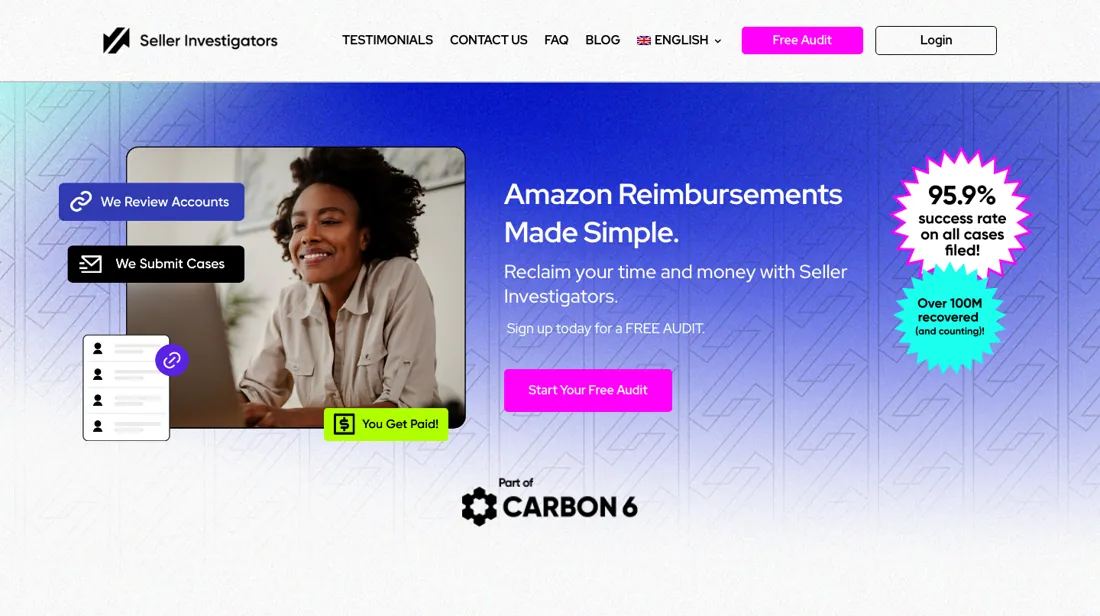
Amazon FBA reimbursement recovery on contingency: a free 48-hour audit, then a 25% commission charged only after Amazon deposits recovered funds. No subscription. Ask which cases Amazon would have settled automatically before you sign.
What buyers report about Seller Investigators
Hands-on: not tested by usReported by buyers: Trustpilot, read August 2026
Themes from the buyer-review sites listed at the foot of this page, read in August 2026. We have not run Seller Investigators ourselves, so this is other buyers' experience rather than ours. We summarise it here because the complaints are usually the part a vendor page leaves out.
- • The recoveries are real and reviewers name amounts: a Belgian seller reports more than $40,000 recovered (October 2024), and an earlier reviewer thousands on lost warehouse inventory plus incorrect FBA fees (July 2021).
- • Handing the admin over is the point, and small sellers say so — one family-owned company calls the tracking and recovery process a breeze and wishes they had found it earlier (March 2023).
- • Named individuals get credited for fast, knowledgeable email turnaround (March 2025).
- • The fee is contested rather than the service. A November 2022 reviewer calls 18-25% too expensive for work sellers can do themselves, and adds that invoice uploads and paperwork still landed on them despite being told the service handled everything.
- • A March 2026 reviewer who had used it for years says the policy changed so that reversed reimbursements are no longer refunded but held as a credit, leaving over £1,000 with the company — and notes Amazon now settles much of this automatically anyway, which is the question the pricing section tells you to ask.
- • A reviewer on 20 August 2026 reports a platform fee appearing with no notice and no reply from support. The website still states only the 25% commission (read 23 August 2026), so ask what is billed outside the commission before you sign.
- • Onboarding has been rough for sellers moving from a competitor: a 2023 reviewer lists separate accounts required for UK/EU and US/CA, weight-and-dimension claims not working in UK/EU, and slow replies during setup.
- • One seller reports six weeks with no progress on product-restriction cases that the sales conversation had presented as a speciality (March 2023).
Where the ratings disagree. The distribution and the score point in opposite directions, and both are informative. 89% of the 121 reviews are five stars, but the TrustScore sits at 2.6 because Trustpilot weights recent reviews and only three have been written in the past year — and those recent ones are about fees and refunds, not recoveries. Read it as a service that demonstrably recovers money, with the current complaints clustered on billing terms rather than on the recovery work itself.
Pages read (August 2026): Trustpilot
When the paid plan is worth it
There is no plan ladder here, so the only number to weigh is the 25% — and the FAQ says out loud that it moves: "The recovery fee is negotiable based on the size of your business." If you file real volume, treat 25% as an opening rate, not a price, and settle yours in writing before the free audit turns into an engagement. Two things about what the fee is charged on.
Inventory reimbursements are valued at the per-unit amount Amazon assigns, not at what you would have sold the unit for, so the base is Amazon's number rather than yours. And a clawback — Amazon reversing a reimbursement — is handled by reversing the fee on your next invoice, so your cash goes out and comes back instead of never leaving. What paying does not fix is the claim window. They look at items lost or damaged more than 30 days ago within the past 18 months, and miscounted inbound items from the past nine months; anything older is gone whoever files it.
Nor does it widen coverage: recovery service runs in North America, Europe, India, Australia and the UAE only.
Questions we are still checking
Facts about Seller Investigators that would change a buying decision, and where we stand on each. An unanswered question does not mean the feature is missing; it means we have not confirmed it yet.
- Is the 25% charged on the gross reimbursement or on what is left after Amazon's fees? Still checking
Applies to: contingency fee.
Why it matters: on the same recovery the two bases give different bills.
Checked: Seller Investigators FAQ (2026-10-11)
Have a public source that answers one of these? How we review explains how we check and correct.
How to actually use Seller Investigators
Registration takes about five minutes, and the first real step is connecting the store — Seller Investigators reads your account through Amazon's API to generate the case reports. Their own two clocks disagree. The home page promises a free audit "in just 48 hours"; the FAQ says the initial audit is "completed within 3 business days", and that case filing begins within 48 hours only once you onboard as a client.
Plan on the FAQ's timing. You are then assigned two Recovery Specialists who run weekly audits and file by hand — the FAQ states claims are not automated, in line with Amazon's terms. Recoveries land in Seller Central three to five days after filing, and reach your bank on your normal Amazon disbursement schedule.
Distilled from sellerinvestigators.com home page and FAQ (registration, store connection, audit timing, recovery specialists, clawbacks, invoicing, cancellation and serviced regions), read 20 August 2026. Re-read 11 October 2026: sellerinvestigators.com home page and FAQ (fee basis, clawbacks, invoicing, cancellation and data deletion).
Common Seller Investigators setup mistakes
Where Seller Investigators setups actually go wrong, and what it costs you when they do. Same sources as the setup notes above — not from a walkthrough we ran ourselves.
Where people stall is the switch.
- Leaving an existing provider means emailing their support and then removing them yourself in your user permission settings, which happens on Amazon's side and nobody does it for you.
- Invoices arrive on the 1st and 15th, and the card on file is charged a day later.
Seller Investigators vs Carbon6, side by side
Where a vendor publishes a price, its column shows the entry price we read and when; where it does not, the column says so rather than filling in a figure from elsewhere. We do not average them into a score.
The Seller Investigators link above is an affiliate link — we may earn a commission if you sign up, at no extra cost to you — and the other column is a plain link. Neither changes what this table says.
The natural comparison is Carbon6 — the comparison worth making, and the two are related — the Seller Investigators partner link runs through Carbon6's own domain. Carbon6 sells a suite of Amazon seller tools on published monthly subscriptions; this is a single contingency service with no subscription at all. If reimbursement recovery is the only job you need done, paying a percentage of what comes back is the cheaper shape; if you want inventory and profit tooling alongside it, the suite is the better buy.
Frequently asked questions
What happens to my data and reports when I cancel?
They are deleted. The FAQ on sellerinvestigators.com/faq (read 11 October 2026) says you can cancel at any time by email, with no long-term contract, and that after the cancellation is filed they halt the service and delete your account data. The FAQ does not describe an export of the recovery dashboard, so save the case reports you want before you send that email. It also does not say whether they remove their own access in Seller Central; check your user permission settings yourself.
What is the 25% charged on, and what if Amazon takes the money back?
The FAQ (read 11 October 2026) says the 25% applies to all successful Amazon refunds, including inventory reimbursements, with a unit valued at the per-unit amount Amazon assigns; that the fee is negotiable based on the size of your business; and that when Amazon reverses a reimbursement, the fee is reversed on the next invoice. Invoices go out on the 1st and 15th and the card is charged a day later. Whether the base is the gross reimbursement or the amount after Amazon's own fees is not stated: not confirmed.
Is this a hands-on review of Seller Investigators?
This is a researched assessment, not a hands-on test — where we've used a tool ourselves, we say so explicitly. We name what each tool is good and bad at, and we earn a commission only if you sign up, at no cost to you.
- Buyer reviews on Trustpilot (121 reviews), read August 2026.
- 2026-08-15, read on their own site.
Others in this category
Reviewed e-commerce tools that share ground with Seller Investigators — comparable in what they do, not drop-in swaps:
New reviews, price changes we recorded, and the cost conditions we found. No sponsored placements. Unsubscribe anytime.
This is our researched assessment — not a paid placement. The “Visit” links on this page are affiliate links: we may earn a commission if you sign up, at no extra cost to you, and it never changes our take. How we review →