SEOKart Review (2026)
 By Daan Haket · Researched and written with an AI assistant · who does what
Every plan, free included, lists free SEO consultancy, and it is worth knowing what sits next to it.
Shopify or BigCommerce merchants with a few hundred to a few thousand products who want on-page SEO cleaned up in bulk — meta tags, image alt text and file names, URLs, JSON-LD schema, 404s and redirects, image compression for page speed — and who would rather have a keyword rank tracker in the same app than pay for a second subscription.
you need keyword research, backlink data or content strategy, none of which this does; or you want daily rank checks, because the tracker runs monthly on Free and weekly above it. A small catalogue is not a reason to skip the app: if the free plan's 50 pages already cover you, the answer is to stay on Free, which the vendor says has no time limit.
Transparency: the “Visit” links on this page are affiliate links — we may earn a commission if you sign up, at no extra cost to you. No vendor can pay for a better review or verdict. How we make money →
Pricing (2026)
✓ Pricing re-verified 14 Oct 2026
Two publishers, and they do not publish the same ladder. The Shopify listing, https://apps.shopify.com/seokart, bills in USD and recurs every 30 days through Shopify, with four fixed tiers. Free covers 50 pages of one-click AI optimisation, 10 tracked keywords checked monthly, 50 image optimisations and 50 pages of bulk editing, with limited rich snippets. Pro is $20 a month or $216 a year for 1,000 products with 100 tracked keywords checked weekly, unlimited image and bulk optimisation, full rich snippets, a 404 fixer and Cruise Control auto-SEO.
Plus is $30 a month or $324 a year for 5,000 products, Max $40 or $432 for 10,000, and annual billing saves 10% on all three. On those four cards the tracked-keyword line never moves off 100 and the feature lists above Pro are word for word identical. The vendor's own page sells the same app as one configurable Pro plan and runs much further.
Full pricing notes (3 more paragraphs)
Under the APP tab on https://seokart.com/pricing (read 15 September 2026) the card carries two dropdowns. Catalogue size, priced at the base 100 keywords: 1,000 products $20 a month, 5,000 $30, 10,000 $40, 25,000 $75, 50,000 $100, 100,000 $150, 500,000 $300, 1,000,000 $500 and 2,000,000 $800. Tracked keywords are the second dropdown and run 100, 200, 300, 400, 500. That step is charged, and it costs more the larger the catalogue: on 1,000 products the five choices are $20, $30, $40, $50 and $60 a month, and on 10,000 products they are $40, $60, $80, $100 and $120.
So 500 keywords on a 10,000-product store is $120 a month, three times the $40 the Shopify card presents as the top of the range. The first three catalogue rungs match the Shopify tiers exactly; what the listing leaves out is everything above 10,000 products and the keyword dropdown altogether. The same vendor page also sells a managed SEO service at $799, $1,299 and $1,949 a month (read 14 September 2026).
That is a separate, optional service alongside the app, and it is what the free SEO consultancy in the plan table opens the door to. The app is sold for BigCommerce too: that listing, https://www.bigcommerce.com/apps/seokart/ (read 14 September 2026, last updated there 2 September 2026), publishes a $20 a month recurring fee, no upfront charge and a 10-day free trial.
Plans change — always verify the live price on their site.
Category context: SEO & Marketing. Across the 10 tools in this category that we researched with a public US-dollar price, the median entry price is about $25 a month (lowest paid plan as listed, per seat where the vendor prices per seat). SEOKart’s entry price of $20 a month sits below that median. Compare pricing conditions in the Software Cost Atlas →
What the pricing page doesn’t say
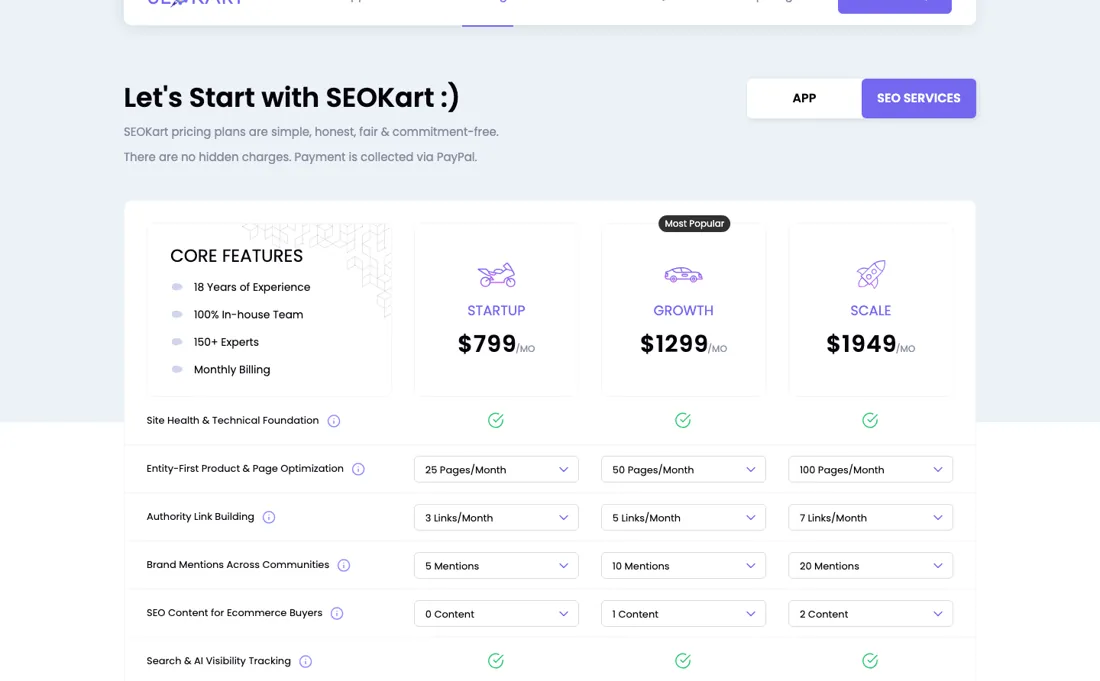
seokart.com sells a managed SEO service at $799, $1,299 and $1,949 a month (read 14 September 2026). That is a separate, optional service rather than a tier of the app, and a free consultation is the natural place for a conversation about it to start. The evidence base is decent rather than deep: 69 reviews on 12 September 2026, launched 4 June 2020, developer Activant Solutions Pvt Ltd in Jaipur.
The 5.0 average hides the shape — 67 five-star reviews and two one-star, with nothing in between. Then the two limits that decide whether this is the right tool. The rank tracker checks monthly on Free and weekly on Pro and above, so it is a trend line, not a daily rank check, and 100 tracked keywords is what every Shopify plan card publishes, but that is not the ceiling: the vendor's own configurator at seokart.com/pricing sells 200 to 500 tracked keywords as a priced step, $10 a month per extra 100 on a 1,000-product store and $20 a step on a 10,000-product one (read 15 September 2026).
And one-click AI optimisation writes meta titles and descriptions in bulk: that is the whole appeal. This review is researched rather than hands-on, so take the next line as general practice with any bulk AI writer and not as something we watched SEOKart produce -- budget a pass for reading what it wrote on your best-selling pages before you let Cruise Control run unattended. The app also needs access to products, store analytics and the Online Store, plus blog contributor data.
Watch the video review
The video version of this review, from our YouTube channel.
What SEOKart does
Shopify and BigCommerce SEO app with one-click AI optimisation: bulk meta tags, image alt text and file names, URL edits, JSON-LD schema and rich snippets, 404 fixing and 301 redirects, image compression for page speed, and a built-in keyword rank tracker with a Cruise Control auto-SEO mode.
When the paid plan is worth it
The free plan covers 50 pages of AI optimisation, 10 keywords checked monthly, and limited image, bulk and schema tools. The Shopify card labels it a trial, but seokart.com is explicit that there is no time limit and you can keep using it (read 14 September 2026), so a store that fits inside those 50 pages has a real free option rather than a countdown. Pro at $20 a month is where a larger catalogue becomes workable: 1,000 products, unlimited image and bulk optimisation, full schemas, the 404 fixer and Cruise Control auto-SEO.
Above Pro the ladder is longer than the Shopify listing lets on. Those cards stop at Max, $40 for 10,000 products, and the feature lists on Pro, Plus and Max are word for word identical. The vendor's own configurator at seokart.com/pricing keeps going on the same plan: $75 for 25,000 products, $100 for 50,000, $150 for 100,000, and on up to $800 a month for two million (read 15 September 2026).
Annual billing saves 10% on the three tiers Shopify publishes. Rank tracking is the limit worth budgeting for, and it is a priced extra rather than a fixed ceiling. Every Shopify card publishes 100 tracked keywords; the vendor's configurator adds a second dropdown running 100 to 500, and each step costs real money -- $10 a month per extra 100 keywords on a 1,000-product store, $20 a month per step on a 10,000-product one, so 500 keywords there is $120 a month against the $40 the listing implies is the ceiling.
Nothing checks more often than weekly at any price, so this stays a trend line rather than a daily rank check. And no tier at any price adds keyword research or backlink data: what the money buys is catalogue size and how many keywords you may watch. The free SEO consultancy on every plan sits next to the vendor's managed service at $799 to $1,949 a month: a separate, optional service, not a higher tier.
Our monthly capture read this vendor's pricing page in September 2026 and again in October 2026, and the amounts were the same both times, including $20 and $799 from the pricing above. We keep watching — the registry records what moves.
How to actually use SEOKart
The vendor publishes an order of operations and it is a sensible one. Their guide says to start with the SEO Optimizer on your top 25 best-sellers rather than the whole catalogue, using the AI assist for meta tags and product descriptions. Then run the 404 Fixer over broken links, add rich snippets, and only then let the Bulk Optimizer fill blank meta tags across the store. Image optimisation, size and alt text, comes next; the rank tracker last, once the optimisations are done and there is something to measure.
Two things are worth knowing first. There is a Report/Restore feature with its own tutorial, and that is the undo you want within reach before a bulk run touches a thousand products. And Cruise Control, the auto-SEO on Pro and above, is the switch to leave off until you have read what the AI wrote on the pages that actually earn money. Google Analytics 4 is connected separately, with a walkthrough of its own.
Where this section comes from: our research notes (203 words)
Setup steps and the recommended order come from SEOKart's own tutorial hub, https://seokart.com/how-to-guide/ (read 12 September 2026), which lists video walkthroughs for the SEO Optimizer, Image Optimizer, Bulk Optimizer, page-speed, rich snippets, GA4, Report/Restore, rank tracker, 404 fixer and URL editor, and closes with a written recap of the sequence. Plans, limits and the feature lists were read the same day on the Shopify listing, https://apps.shopify.com/seokart, and the managed-service prices on https://seokart.com/.
The app also ships for BigCommerce: the vendor's pricing page links out to https://www.bigcommerce.com/apps/seokart/, and that listing (read 14 September 2026, last updated there 2 September 2026) publishes the same $20 a month recurring fee, no upfront charge and a 10-day free trial. The vendor's own pricing page was read again on 15 September 2026: under its APP tab the Pro card is a configurator with a catalogue dropdown (1,000 to 2,000,000 products, $20 to $800 a month) and a tracked-keyword dropdown (100 to 500), neither of which appears on the Shopify or BigCommerce listing.
No independent third-party walkthrough was found worth citing. For the buyer questions, the vendor FAQ at https://seokart.com/faqs/ (Report/Restore, uninstall and free-plan answers) was read on 14 October 2026, when the Shopify listing and seokart.com/pricing were unchanged.
SEOKart vs StoreSEO, side by side
Each column shows the vendor’s own published entry price, read on the date shown. Entry prices can cover different services or units, so check what each one buys. We do not average them into a score.
Both names above are affiliate links: we may earn a commission if you sign up, at no extra cost to you. Neither changes what this table says.
The natural comparison is StoreSEO — Both bulk-optimise a Shopify store's metadata, and the split is catalogue size against the free ceiling. StoreSEO's Free Forever covers 25 products and its first paid tier, Lite, is $14.99 a month for 100 (read 19 August 2026); SEOKart's free tier covers 50 pages of AI optimisation and its first paid tier is $20 a month for 1,000 products with 100 tracked keywords. Under a hundred products StoreSEO is the cheaper way in. Above that the comparison flips, because $20 covering a thousand products is the cheapest full-catalogue step of the two, and rank tracking is included rather than bought separately.
Frequently asked questions
Can I undo a bulk optimisation?
Only partly, per SEOKart's FAQ (seokart.com/faqs/, read 14 October 2026). Report/Restore can roll back names, title tags, meta descriptions, descriptions and URLs for up to the past 2 updates per page, and image changes (file name, alt text, size, format) can be restored only within 3 days of the update. A third bulk run over the same pages puts the original out of reach, so download a report of your best-sellers' current metadata before you start.
What stays on my store if I uninstall?
The same FAQ says every change made through SEOKart is permanent and remains after you uninstall, with one exception: the rich-snippet script the app adds is removed on uninstall, so that structured data goes with it. Note too that the FAQ's free-plan limits (100 bulk pages, 200 images, 25 tracked keywords) do not match the Shopify listing's free card (50 pages, 10 keywords, limited image and bulk tools, read 14 October 2026); treat the listing as the current limit.
Is this a hands-on review of SEOKart?
This is a researched assessment, not a hands-on test — where we've used a tool ourselves, we say so explicitly. We name what each tool is good and bad at, and we earn a commission only if you sign up, at no cost to you.
- Price read 2026-09-12, re-verified 2026-09-15 and again unchanged on 2026-10-14.
- A dated screenshot of that pricing page, kept on this site as the receipt.
Others in this category
Reviewed seo & marketing tools that share ground with SEOKart — comparable in what they do, not drop-in swaps:
New reviews, price changes we recorded, and the cost conditions we found. No sponsored placements. Unsubscribe anytime.
This is our researched assessment — not a paid placement. The “Visit” links on this page are affiliate links: we may earn a commission if you sign up, at no extra cost to you, and it never changes our take. How we review →