AgentNest Review (2026)
 By Daan Haket · Researched and written with an AI assistant · who does what
The app launched on 6 August 2026; on 9 October 2026 the listing still showed zero reviews, which is not a criticism so much as the plain state of the evidence.
stores that want an outside read on whether their product data is complete enough for AI shopping surfaces — on the free tier, which gives the entire diagnosis at no cost and no commitment.
you want a track record before you let an app edit your catalogue, you need a billing unit you can count in advance, or your bulk edits are already handled by Shopify's own editor or an app you pay for.
Transparency: we earn nothing from AgentNest; the links to it are plain links. How we make money →
Pricing (2026)
✓ Pricing re-verified 9 Oct 2026
| This tool | $19 | 32th cheapest of 56 |
| Cheapest | $2.99 | MX AI |
| Median | $15 | |
| Most expensive | $199 | Auware |
Lowest paid entry price per account a month, billed monthly, in USD, among the 56 e-commerce growth apps we have researched (read between 2026-08-19 and 2026-10-21). Only tools priced in the same unit and on the same billing are compared — not a market survey, and cheapest is not best.
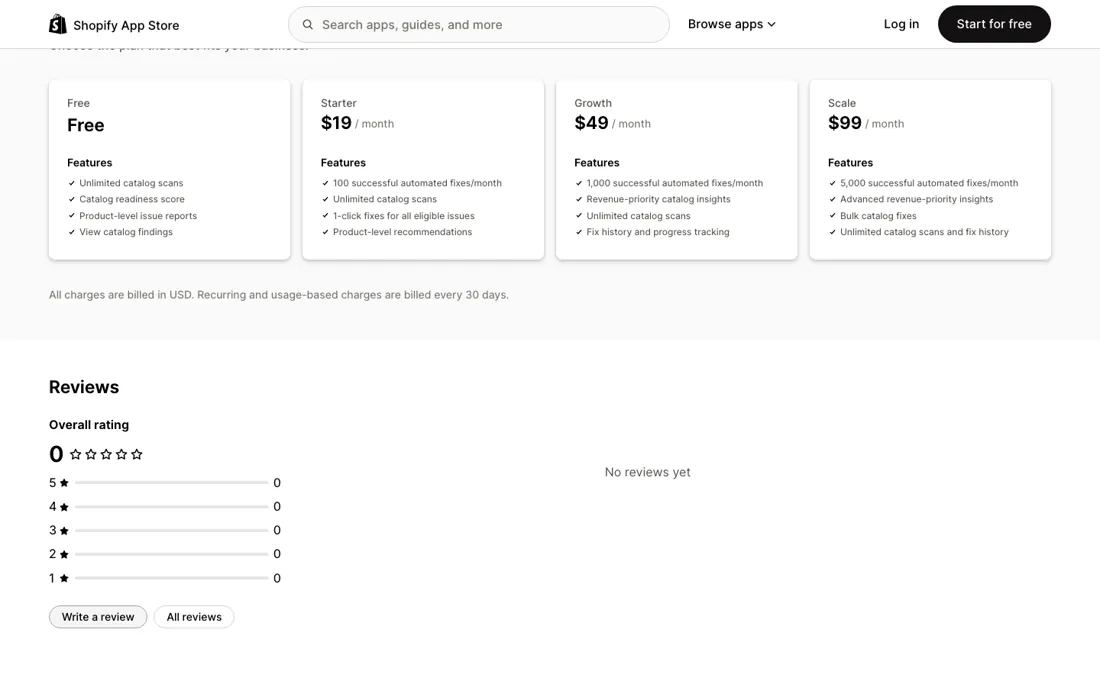
Four tiers, and the split between them is unusual: the diagnosis is free and you pay only for the repairs. Free: unlimited catalogue scans, a catalogue readiness score, product-level issue reports and the full findings view. Starter $19 a month: 100 successful automated fixes a month, one-click fixes for all eligible issues, product-level recommendations. Growth $49 a month: 1,000 fixes a month, revenue-priority catalogue insights, fix history and progress tracking.
Scale $99 a month: 5,000 fixes a month, advanced revenue-priority insights and bulk catalogue fixes. All charges are billed in USD and recur every 30 days, and no tier shows a free trial. The billing unit is a 'successful automated fix', and the listing never defines it. Whether one fix is one product, one field on one product, or one alt text on one image is the difference between $19 covering a hundred products and a hundred images.
It is also the only variable separating the three paid tiers. Developer Ecommerce Storez, 1255 23rd St NW, Washington DC; the app launched on 6 August 2026 and has no reviews at all. Plans change — always verify the live price on their site.
What the pricing page doesn’t say
Everything below is read off the listing, because there is nothing else to read. The score is the vendor's own. 'AI shopping readiness' is measured by AgentNest against AgentNest's criteria, and no external standard — no schema.org profile, no Google Merchant Center specification, no published rubric — is named anywhere on the listing. A number that only one company calculates is a prompt to go look at your catalogue, not a fact about your catalogue.
On the same page Shopify shows ListingLens and StoreBeam doing the same job, also on free plans. And the billing unit is defined by the party doing the billing. You pay per 'successful automated fix', with no definition of a fix and no definition of successful. Combined with permissions that let it edit products, collections and files across your store, the sensible way in is: run the free scan, read the issue list, fix a handful yourself, and only then decide whether the one-click version is worth 19 cents a go.
The same developer's other app, AskNest, has one review in three months — this is a two-app studio finding its feet, not an established catalogue tool.
Watch the video review
The video version of this review, from our YouTube channel.
What AgentNest does
Scans your Shopify catalogue for the product-data gaps AI shopping surfaces trip over — status, category, description, image alt text — and applies the eligible ones in a click. Launched 6 August 2026 with no reviews yet.

When the paid plan is worth it
Start from the free tier, because it is more generous than it first looks: unlimited scans, the readiness score, and every product-level issue with guidance on what to change. The entire diagnosis is free forever. What the paid tiers sell is the app applying the corrections for you — product status, categories, descriptions, image alt text — one click at a time. So the question is not which plan but what an hour of your time is worth against the alternative.
Setting categories and alt text in bulk is something Shopify's own bulk editor does for nothing, and a general-purpose bulk editor does for a few dollars. If the scan says forty products are missing categories, fixing them by hand is an afternoon and Starter is $19. If it says four thousand products need alt text, the free tier has just handed you a very good argument for Scale at $99 — or for a dedicated alt-text app you already have.
The reason not to commit yet is that you cannot size it. At 100 fixes for $19 you are paying 19 cents a fix; at 5,000 for $99 it is two cents. That is a twenty-fold spread across a unit nobody has defined, and 'successful' is judged by the vendor. Run the free scan, count the issues it reports, and ask support what counts as one fix before you pick a row.
Our monthly capture read this vendor's pricing page every month from August 2026 to October 2026, and the amounts were the same all 3 times. We keep watching — the registry records what moves.
Questions we are still checking
Facts about AgentNest that would change a buying decision, and where we stand on each. An unanswered question does not mean the feature is missing; it means we have not confirmed it yet.
- What counts as one 'successful automated fix': one product, one field, or one image alt text? Still checking
Applies to: Starter (100 fixes), Growth (1,000) and Scale (5,000).
Why it matters: the fix is the only unit separating the three paid tiers, so its definition decides whether $19 covers a hundred products or a hundred images.
Checked: AgentNest App Store listing (2026-10-09); AgentNest privacy policy (2026-10-09)
Have a public source that answers one of these? How we review explains how we check and correct.
How to actually use AgentNest
Run the free scan first and treat it purely as a checklist. Unlimited scans, the readiness score and every product-level issue cost nothing on any tier, so there is no reason to pay before you have seen what it finds. And what it finds is the only evidence about this app that exists, since nobody has reviewed it. Read ten of the flagged products yourself and judge whether the issue is real: missing categories and empty alt text are real and fixable; a low 'readiness' score against criteria the vendor does not publish is an opinion.
Ask support what counts as one 'successful automated fix' before you subscribe, because the tiers are 100, 1,000 and 5,000 of a unit that is nowhere defined. Fix a batch by hand in Shopify admin first — if that takes twenty minutes, you do not need Starter. And since the app has permission to edit products, collections and files, export your product CSV before you let it apply anything in bulk.
Distilled from apps.shopify.com/agentnest, read 19 August 2026. Documentation read on 9 October 2026: AgentNest's privacy policy (agentnest.ecommercestorez.us/docs/privacy-policy.html, effective 31 July 2026) and Shopify's help pages 'App charges on your Shopify bills' and 'Uninstalling apps'. The listing has no other help documentation.
Frequently asked questions
Why does a catalogue app ask to read my orders?
Its privacy policy (effective 31 July 2026, read 9 October 2026) says it reads limited order and line-item data from the last 60 days, such as dates, status, product and variant IDs, quantities and amounts, to rank catalogue issues by the revenue of the products involved. It says it does not use customer names, emails, phone numbers or addresses for this, and does not use order data for advertising or profiling. The Shopify listing confirms the scope: view orders for the last 60 days, edit products and collections, and edit files.
What happens to my data and billing if I uninstall AgentNest?
Billing runs through Shopify. Shopify's help pages (read 9 October 2026) say uninstalling cancels future recurring charges, but you might still be billed for the current cycle, and refunds go through the app developer. AgentNest's privacy policy says that after uninstall it restricts processing and deletes or anonymises store data once Shopify sends the shop-deletion request, apart from records it must keep for legal, security or financial reasons. Product edits it already made stay in your catalogue; there is no documented undo, so export your product CSV first.
Is this a hands-on review of AgentNest?
This is a researched assessment, not a hands-on test — where we've used a tool ourselves, we say so explicitly. We name what each tool is good and bad at, and we have no affiliate relationship with AgentNest — we earn nothing whether you sign up or not.
- Re-verified 2026-10-09 on apps.shopify.com/agentnest; first read 2026-08-19, no amount or allowance changed in between, though the listing now calls the app 'AgentNest - ChatGPT Ad Catalog' and pitches the scan as preparation for ChatGPT Ads.
- A dated screenshot of that pricing page, kept on this site as the receipt.
Others in this category
Reviewed seo & marketing tools that share ground with AgentNest — comparable in what they do, not drop-in swaps:
New reviews, price changes we recorded, and the cost conditions we found. No sponsored placements. Unsubscribe anytime.
This is our researched assessment — not a paid placement. How we review →