 Rapid Search Review (2026)$14 a Month, Metered on Visits
The meter is your traffic, not your searches.
Visit Rapid Search → Affiliate link — we may earn a commission if you sign up; it does not change what this page says.
Pricing (2026)
✓ Pricing re-verified 26 Sep 2026
| This tool | $14 | 11th cheapest of 29 |
| Cheapest | $2.99 | Scrolly |
| Median | $23 | |
| Most expensive | $250 | Seller Snap |
Entry price per month, USD. Our own dated readings of 29 e-commerce tools — not a market survey, and cheapest is not best.
Every plan carries every feature; the tiers differ only in monthly sessions and catalogue size. The Shopify listing shows four tiers. Free covers 2,000 monthly sessions and 5,000 products with email support, and the search carries Rapid Search branding. Basic 1 is $14 a month, or $140 a year, for 5,000 sessions and 100,000 products; Basic 2 is $27 a month, or $270 a year, for 12,000 sessions; Basic 3 is $39 a month, or $390 a year, for 25,000 sessions.
The paid tiers are unbranded, add chat support and start with a 14-day free trial. The vendor's pricing slider continues past the listing: $59 a month for 45,000 sessions, $79 for 75,000, $129 for 130,000 and $199 for 500,000, all still capped at 100,000 products, and $349 a month for unlimited sessions and 1,000,000 products. The listing quotes annual billing as a 17% saving and only for the three Basic tiers.
The vendor site says the trial needs no credit card and offers a refund within the first 30 days on a paid plan. All charges are in USD through Shopify's billing, every 30 days. Plans change — always verify the live price on their site.
What the pricing page doesn’t say
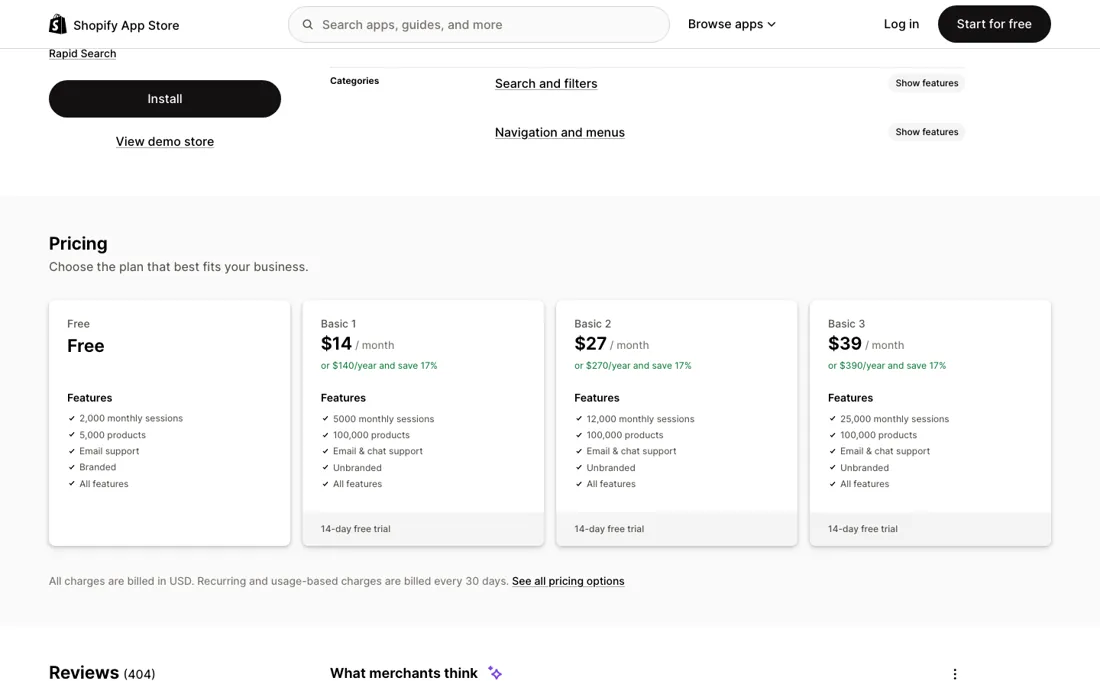
Rapid Search prices on monthly sessions, and its own FAQ defines a session as a visit to the store. A shopper who never touches the search box still counts. So the plan you need follows your total storefront traffic: 2,000 sessions free, 5,000 on the $14 tier, 25,000 on the $39 tier. A store with modest search use but a lot of visitors pays for headroom it does not search with.
Going over the cap does not bill you, it switches you back. The vendor's FAQ says it sends several warnings as you approach the limit, and that if you do not upgrade, search reverts to Shopify's built-in search until the limit resets with the next charge. That is more honest than a surprise overage, but it means the best month of the year is the month your search can quietly downgrade itself.
Upgrade before a sale, not during it. The two pricing pages tell different stories. The Shopify listing stops at Basic 3, $39 a month for 25,000 sessions. The vendor's pricing slider goes on to $59, $79, $129, $199 and $349 a month, and the product cap stays at 100,000 on every tier up to $199; the listing's line that it scales to 1M+ products describes only the $349 unlimited tier.
The customer logos (Levi's, Skechers, alo) and the claims of 5,000+ stores and a doubled search conversion rate come from the vendor's own site and are not sourced there. We have not installed the app.
What Rapid Search does
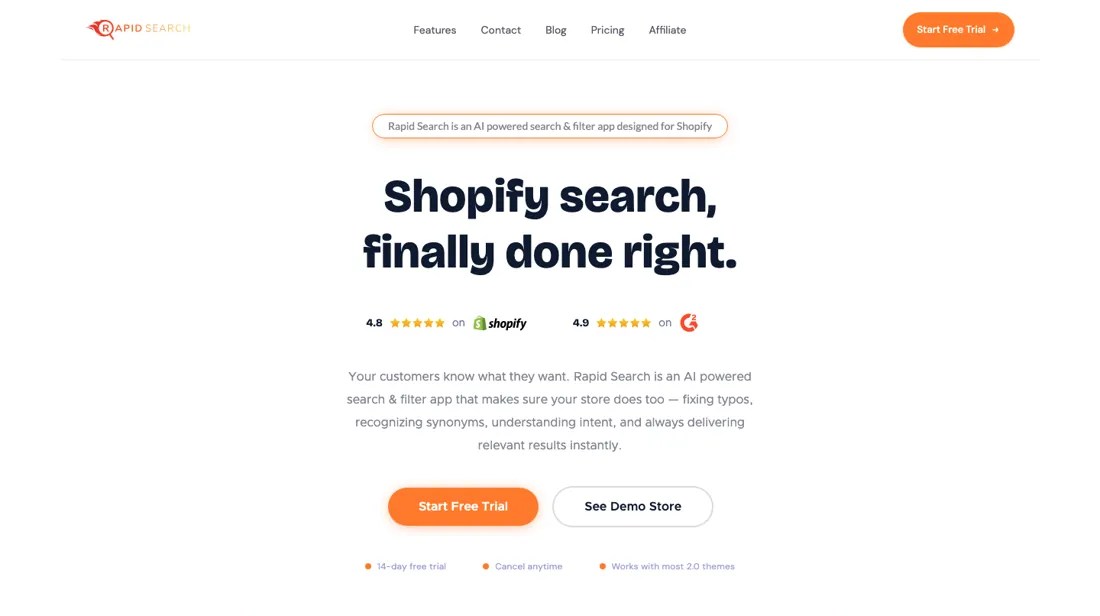
Shopify app that replaces the search icon with an always-visible AI search bar (typo tolerance, synonyms, instant results, SKU search) and adds product and collection filters on tags and metafields, hand-set pins and boosts, and search analytics.
Price it per thousand sessions
Work the ladder per thousand sessions, because sessions are the only thing the tiers change. Basic 1 is $14 for 5,000, which is $2.80 per thousand. Basic 2 is $27 for 12,000, $2.25. Basic 3 is $39 for 25,000, $1.56. On the vendor's slider it keeps falling: $59 for 45,000 is about $1.31, $79 for 75,000 about $1.05, $129 for 130,000 just under a dollar, and $199 for 500,000 about 40 cents.
Every feature is on at every step, so there is no reason to buy a tier for anything other than traffic. Check your sessions in Shopify's analytics before you pick, and add a margin for your busiest month, because running over does not cost extra but does switch you back to Shopify's own search until the cycle resets. Annual billing takes about 17% off the three Basic tiers: $140 a year instead of $168, $270 instead of $324, $390 instead of $468.
The listing does not quote an annual rate for the higher tiers. The free plan is worth a real trial for a small store: 2,000 sessions and 5,000 products with every feature, at the cost of Rapid Search branding on the search. The vendor says a store under 5,000 products can drop to it after the 14-day trial instead of paying.
How to actually use Rapid Search
Install from the Shopify App Store. The vendor says the app installs with one click, works with most Online Store 2.0 themes and needs no code, and that most stores are live within minutes. The first visible change is the search: the magnifying-glass icon becomes an always-visible search bar with instant, typo-tolerant results and SKU search. Then build the filters shoppers will actually use: price, brand, colour and size, plus tags and metafields if your catalogue carries them.
Filters are only as good as that product data, so a store with inconsistent tags will spend its first hour cleaning them up. Next add synonyms for the words your shoppers use and your catalogue does not, and pin or boost the products you want at the top of common searches. After a week, open the search analytics and read the searches that returned nothing. That list is the most useful thing the app gives you: every zero-result query is either a synonym to add or a product you do not stock.
Distilled from The Shopify App Store listing at apps.shopify.com/rapid-search (pricing table, feature list, review summary and recent reviews, developer details and the launch date of 25 June 2020) and the vendor's own pages at rapidsearch.app and rapidsearch.app/pricing, including its FAQ and the pricing slider, whose eight stops were read one by one, all in a headless browser on 26 September 2026. We have not installed the app.
Rapid Search vs Dynasort, side by side
Both columns come from the same place: each vendor’s own published pricing, read on the date shown in the sources at the foot of this page. We do not average them into a score.
Both names above are affiliate links: we may earn a commission if you sign up, at no extra cost to you. Neither changes what this table says: both columns come straight from the vendors’ own pricing pages.
The natural comparison is Dynasort — Dynasort is the closest comparison in our own dossiers, and it does a different job on the same catalogue. Dynasort (read 15 September 2026) re-orders your collection pages automatically from sales, stock and margin signals, starting at $99 a month for 25 sorted collections after a free demo tier. Rapid Search makes the search box and the filters work: typo tolerance, synonyms, instant results, filters on price, tags and metafields, and merchandising you set by hand, pinning, boosting, demoting or hiding products in the results. Its paid tiers start at $14 a month and are sized on store sessions rather than collections. A store that loses shoppers at the search box starts here; a store that loses them scrolling a badly ordered collection starts with Dynasort. The two do not replace each other..
Frequently asked questions
What does Rapid Search cost?
Free for 2,000 monthly sessions and 5,000 products, with Rapid Search branding. Basic 1 is $14 a month for 5,000 sessions, Basic 2 $27 for 12,000 and Basic 3 $39 for 25,000, each with up to 100,000 products and a 14-day free trial. The vendor's own pricing page adds $59, $79, $129 and $199 tiers up to 500,000 sessions, and $349 for unlimited sessions and a million products. Read on 26 September 2026.
What counts as a session?
The vendor's FAQ says a session is a visit to your store by a potential customer. It counts visits, not searches, so size the plan on your total monthly store traffic.
What happens if I go over my sessions?
According to the vendor's FAQ you get several warnings first. If you do not upgrade, search reverts to Shopify's built-in search until the limit resets with your next charge. There is no published overage fee.
Are features locked to higher plans?
No. Both the listing and the vendor site say every plan, the free one included, carries every feature; the tiers differ in sessions, product count, branding and support channel.
Is there a refund?
The vendor's pricing page offers a refund if you contact support within the first 30 days on a paid plan, on top of the 14-day free trial, which it says needs no credit card.
What should I weigh before buying E-commerce software?
Check your platform and version specifically. Shopify support is close to universal in this category, while WooCommerce, BigCommerce, Magento and headless setups vary a lot, and 'supported' sometimes means a generic API rather than a maintained app. A listing in your own platform's app store, with recent reviews there, is a better signal than the vendor's logo wall.
Is this a hands-on review of Rapid Search?
This is a researched assessment, not a hands-on test — where we've used a tool ourselves, we say so explicitly. We name what each tool is good and bad at, and we earn a commission only if you sign up, at no cost to you.
- Read 2026-09-26 on apps.shopify.com/rapid-search and on the vendor's own pricing page at rapidsearch.app/pricing.
- A dated screenshot of that pricing page, kept on this site as the receipt.
Others in this category
Reviewed e-commerce tools that share ground with Rapid Search — comparable in what they do, not drop-in swaps:
New reviews, price changes we recorded, and the cost conditions we found. No sponsored placements. Unsubscribe anytime.
This is our researched assessment — not a paid placement. The “Visit” links on this page are affiliate links: we may earn a commission if you sign up, at no extra cost to you, and it never changes our take. How we review →