Feedyio Review (2026)
 By Daan Haket · Researched and written with an AI assistant · who does what
Two gates decide your bill and neither is about how much value the feeds create.
Shopify merchants who need several feeds at once, in formats they control — custom XML, CSV, TXT or JSON built from their own template — and especially those selling into Central and Eastern European marketplaces and price-comparison sites, with a catalogue that fits inside a published tier.
you need one Google Shopping feed and nothing else, where the older and far more widely reviewed feed apps cover the same ground; or your catalogue runs past 65,000 products, which is where the published ladder ends.
Transparency: we earn nothing from Feedyio; the links to it are plain links. How we make money →
Pricing (2026)
✓ Pricing re-verified 13 Oct 2026
Nine published tiers, billed in USD every 30 days through Shopify. The Shopify listing shows only the first four. Free is permanent and covers up to 30 products or 100 variants, one feed, the primary market only, a daily product update and email support. Basic at $9.99 a month raises that to 1,000 products or 2,000 variants, up to five feeds, hourly product updates and the named comparison-shopping integrations (Heureka, Favi and similar), still on the primary market and language only.
Advanced at $19.99 covers 2,500 products or 5,000 variants, up to ten feeds, and all markets and languages. Pro at $29.99 covers 6,000 products or 12,000 variants and up to 30 feeds. The listing stops there and says additional plans are available; the vendor's own pricing page prices them: Enterprise $39.99 (10,000 products / 20,000 variants / 40 feeds), Enterprise Plus $59.99 (20,000 / 40,000 / 40), Enterprise Plus 2 $89.99 (30,000 / 60,000 / 40), Enterprise Plus 3 $99.99 (50,000 / 100,000 / 40) and Enterprise Plus 4 $119.99 (65,000 / 130,000 / 40).
Every paid tier has a 7-day free trial. One inconsistency on that page: the line under the table says every paid plan unlocks Shopify markets, translations and inventory levels, while the Basic card above it lists the primary market and primary language only — the Shopify listing agrees with the card, so confirm before buying Basic for a second market. Plans change — always verify the live price on their site.
Category context: E-commerce. Across the 47 tools in this category that we researched with a public US-dollar price, the median entry price is $19 a month (lowest paid plan as listed, per seat where the vendor prices per seat). Feedyio’s entry price of $9.99 a month sits below that median. Compare pricing conditions in the Software Cost Atlas →
What the pricing page doesn’t say
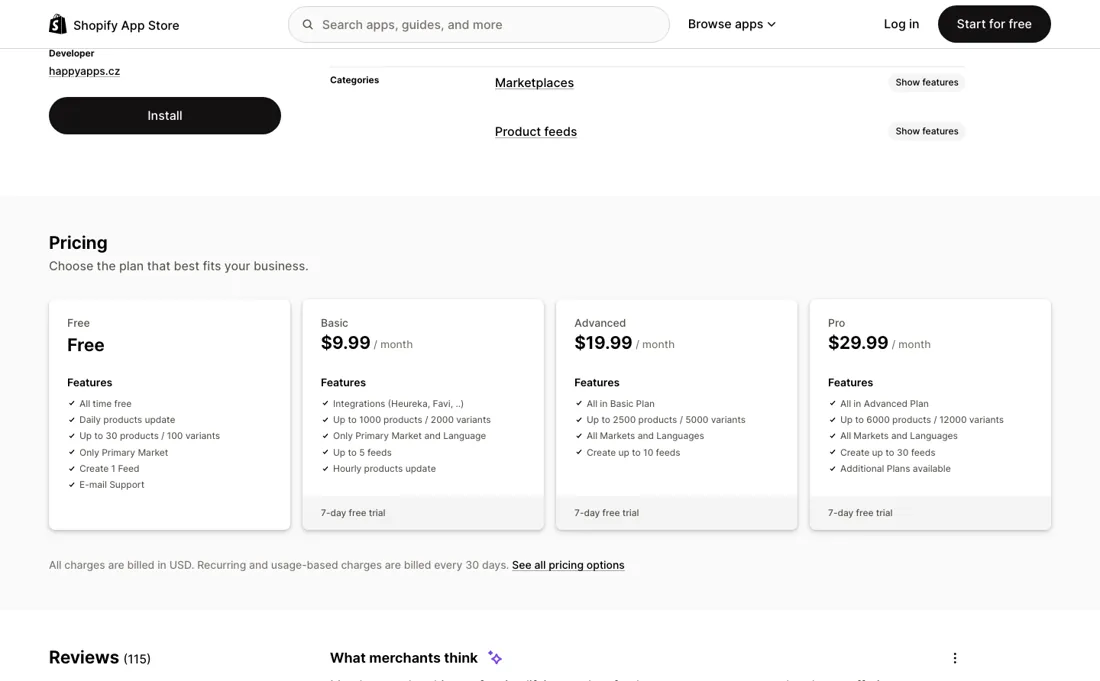
The first is catalogue size: the ladder counts products and variants, and it runs further than the Shopify listing suggests — the listing stops at Pro ($29.99, 6,000 products) and says additional plans are available, while the vendor's own pricing page publishes five more tiers up to $119.99 for 65,000 products. The second is freshness: the free tier updates products once a day and hourly updates start at $9.99, which matters when stock moves faster than a day.
Multi-market and multi-language feeds only appear at $19.99. The app is also younger and smaller than the shelf leaders: launched 16 May 2022 by happyapps.cz in Prague, with 115 reviews against thousands for the established Google Shopping feed apps. And the standout integrations — Heureka, Zboží.cz, Árukereső, Glami, Favi, Kaufland — are Central and Eastern European channels; that is the app's real edge, but it is not an edge if you only sell through Google and Meta.
Watch the video review
The video version of this review, from our YouTube channel.
What Feedyio does
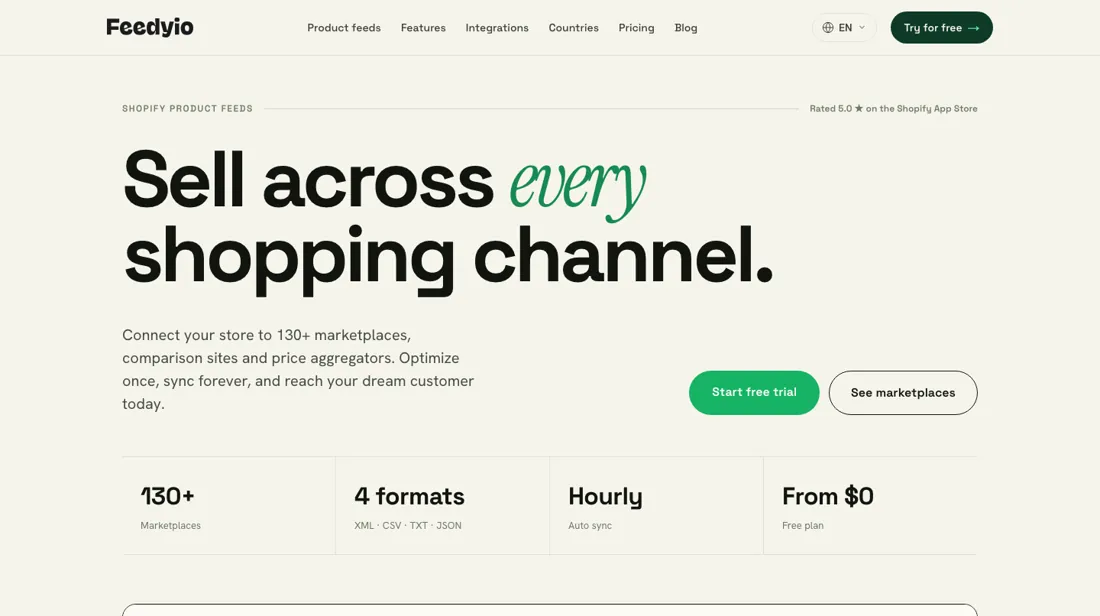
Shopify product-feed engine (by happyapps.cz) that generates and syncs feeds for Google, Meta, Pinterest, TikTok, Bing and 130-plus marketplaces and price-comparison sites, with strong coverage of the Central European channels (Heureka, Glami, Kaufland, Favi). Custom XML, CSV, TXT or JSON feeds are built from your own Liquid template, with category mapping, attribute rules and validation before products get rejected. Launched May 2022.
What buyers report about Feedyio
Hands-on: not tested by usReported by buyers: Shopify App Store, read September 2026
Themes from the buyer-review sites listed at the foot of this page, read in September 2026. We have not run Feedyio ourselves, so this is other buyers' experience rather than ours. We summarise it here because the complaints are usually the part a vendor page leaves out.
- • Merchants describe the setup as straightforward and single out the freedom to shape a feed themselves — customising fields, filtering which products go out, and keeping product data current without touching a spreadsheet (Shopify App Store, read September 2026).
- • Several reviews are about migration rather than first use: a German store moved multi-market feeds across and said Feedyio handled what its previous app could not, with an edge case diagnosed the same day and fixed within days.
- • Support comes up more than any feature, and by name — reviewers thank individual staff (Honza, Jan) for same-day answers. Long-tenure reviewers exist too: a Slovenian store over a year in, a Prague store past two years.
- • There are effectively none on this platform, and that is the honest finding: of 115 ratings, 114 are five-star and one is four-star, with nothing at three or below. A review base that uniform tells you people are happy; it does not tell you where the app breaks.
- • The base is also young and small — the app launched in May 2022 — so it carries no track record on the failure modes that matter for feeds, such as behaviour at the top of the catalogue ladder or during a marketplace's own schema change.
Where the ratings disagree. The reviews cluster in Europe — Czechia, Slovenia, Germany, Greece, Israel, with some US — which matches the app's Central and Eastern European channel coverage rather than contradicting it. What is missing is a counterweight: no public platform carries a body of critical reviews for this app, so there is no second opinion to set against the Shopify listing.
Pages read (September 2026): Shopify App Store
When the paid plan is worth it
The plan table on the Shopify listing stops at Pro and points to ‘additional plans’, which makes the top of the ladder look like a sales conversation. It is not. feedyio.com/pricing publishes all nine tiers (read 10 September 2026): above Pro sit Enterprise at $39.99 for 10,000 products, Enterprise Plus at $59.99 for 20,000, then $89.99 for 30,000, $99.99 for 50,000 and $119.99 for 65,000. Note what stops scaling. The feed allowance freezes at 40 from Enterprise upward, so each step above $39.99 buys catalogue room and nothing else.
What upgrading does not fix is the refresh you may think you are buying. The tier governs how often Feedyio rebuilds the file; the marketplace decides how often it fetches, and the vendor's own TikTok guidance tells merchants to set that schedule on the channel side. Rejections work the same way — a currency that does not match the channel catalogue, a missing image, a policy breach — and no tier changes that verdict.
Our monthly capture read this vendor's pricing page in September 2026 and again in October 2026, and the amounts were the same both times, including $9.99, $19.99 and $29.99 from the pricing above. We keep watching — the registry records what moves.
Questions we are still checking
Facts about Feedyio that would change a buying decision, and where we stand on each. An unanswered question does not mean the feature is missing; it means we have not confirmed it yet.
- Does Basic include a second Shopify market and language? Sources disagree
Applies to: Basic ($9.99) against Advanced ($19.99).
Why it matters: the Basic card and the Shopify listing say primary market and language only; the line under the comparison table says every paid plan unlocks markets and translations.
Answer: The Basic card on feedyio.com/pricing and the Shopify listing (13 October 2026) say primary market and language only; the line under the same comparison table says every paid plan unlocks markets, translations and inventory levels. Both sources are stated; neither is confirmed by the vendor as current.
Checked: Feedyio pricing (2026-10-13); Feedyio on the Shopify App Store (2026-10-13) - What happens to products above the cap between an upgrade and the next billing cycle? Still checking
Applies to: all tiers.
Why it matters: the pricing FAQ says plan changes take effect on the next billing cycle and does not say whether the feed is cut at the cap until then.
Checked: Feedyio pricing (FAQ) (2026-10-13)
Have a public source that answers one of these? How we review explains how we check and correct.
How to actually use Feedyio
Build the feed on Free before you pay for it. Free has no time limit and carries 30 products, enough to prove the output shape against a channel that has rejected you before. The path in the app is fixed: Create feed, then either pick a marketplace template or type ‘custom’ in the search box for a custom XML, CSV, TXT or JSON feed, then work through General, Mapping, Product source, Exclude products and Additional fields before saving and copying the feed URL.
Open that URL in a browser yourself before handing it over. The vendor's list of common TikTok mistakes puts a currency mismatch first and a broken or password-protected feed URL third, and both show up in a browser in seconds. Then set the fetch schedule on the channel, because the feed URL stays live and the channel decides when to read it, and open the channel's diagnostics after the first import rather than reading silence as success.
Where this section comes from: our research notes (132 words)
feedyio.com/pricing read on 10 September 2026 — the nine-row comparison table (Free $0 through Enterprise Plus 4 at $119.99 for 65,000 products / 130,000 variants / 40 feeds) that the Shopify listing truncates at Pro, plus the note that every plan includes category mapping, custom Liquid templates and UTM analytics; feedyio.com for the 130+ preconfigured channels and the four output formats; and the vendor help centre read the same day — help.feedyio.com/en/articles/9952236-create-a-new-feed-on-feedyio for the create-feed sequence (template choice, then General, Mapping, Product source, Exclude products, Additional fields) and help.feedyio.com/en/articles/11764748-common-mistakes-when-connecting-tiktok-feed-with-feedyio for the currency-mismatch, broken-URL and channel-side fetch-schedule points.
Re-verified 13 October 2026 on feedyio.com/pricing (all nine tiers and amounts unchanged, the pricing FAQ on billing, plan changes and what counts as a product, and 140+ preconfigured templates) and apps.shopify.com/product-feed-10 (118 reviews that day).
The natural comparison is Simprosys Google Shopping Feed, Koongo: Sell on Marketplaces — the difference is breadth of channel against depth of track record. Simprosys is the shelf leader for the Google, Microsoft, Meta and Pinterest set and carries thousands of reviews (read 10 September 2026 on the Shopify App Store); Feedyio carries 115 and is three years old. What Feedyio has instead is the template editor — you write your own XML, CSV, TXT or JSON in Liquid rather than picking from a fixed list — and a preconfigured set of European comparison and marketplace channels that the Google-first apps treat as an afterthought. If your channels are Google and Meta, buy on track record. If your channels include Heureka, Glami, Kaufland or a marketplace that wants a feed shaped its own way, Feedyio is the one built for that, and the free tier lets you check the output shape before paying..
Frequently asked questions
Do variants count against the product limit?
Each product in your Shopify catalogue counts once toward the plan's product limit, and variants are counted separately against the variant limit, per the pricing FAQ on feedyio.com/pricing read 13 October 2026. Every tier carries both caps — Basic is 1,000 products and 2,000 variants — so a catalogue with many variants per product can outgrow a tier on variants while still under the product limit.
Can I build a feed for a second market or language on Basic?
Not confirmed, because the vendor's own pages disagree. On feedyio.com/pricing read 13 October 2026 the Basic card lists the primary Shopify market and primary language only, and the Shopify listing says 'Only Primary Market and Language' for Basic, while the line under the comparison table says every paid plan unlocks Shopify markets, translations and inventory levels. The cards put markets, translations and inventory levels on Advanced at $19.99, so budget for Advanced if a second market is the reason you are buying.
When does a plan change take effect?
Per the pricing FAQ read 13 October 2026, you can upgrade or downgrade at any time and the change takes effect on your next billing cycle; billing is monthly in USD through Shopify, paid plans carry a 7-day trial and there is no setup fee. What happens to products above your cap until the change applies is not stated — not confirmed.
Is this a hands-on review of Feedyio?
This is a researched assessment, not a hands-on test — where we've used a tool ourselves, we say so explicitly. We name what each tool is good and bad at, and we have no affiliate relationship with Feedyio — we earn nothing whether you sign up or not.
- Buyer reviews on Shopify App Store, read September 2026.
- Read 2026-09-10 on apps.shopify.com/product-feed-10 and feedyio.com/pricing.
- A dated screenshot of that pricing page, kept on this site as the receipt.
Others in this category
Reviewed e-commerce tools that share ground with Feedyio — comparable in what they do, not drop-in swaps:
New reviews, price changes we recorded, and the cost conditions we found. No sponsored placements. Unsubscribe anytime.
This is our researched assessment — not a paid placement. How we review →