Dynasort Review (2026)
 By Daan Haket · Tested hands-on · written with an AI assistant · who does what
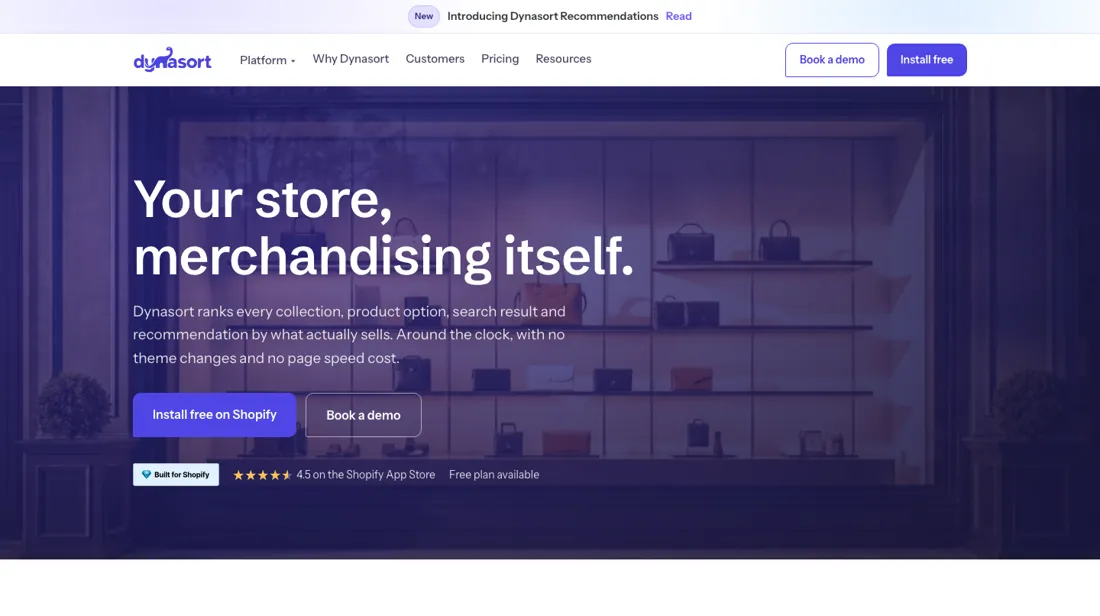
Sorting driven by 40+ blended signals is powerful and opaque in the same breath: a recipe that ranks by margin, velocity and stock at once will sometimes bury a product you wanted seen, and there is real trial and error in getting the recipes to match how you actually merchandise.
- Best for Small stores unsure sorting will pay off
From $99 · Basic · per month for 25 sorted collections and 100,000 serves · read 2026-11-17
Visit Dynasort →Is Dynasort right for you?
Your pain“I do not know if automatic sorting would lift sales on my shop before I commit to a monthly fee.”
Does Dynasort solve it?YesOur test (17 Nov 2026): the free Demo plan opened with no card and no billing screen. It sorted a real collection, so a small store can see the result before paying.
Your planDemo is free, no end date, 2 sorted collections. Paid plans have a 30 day free trial.
Your pain“I want to test two sort recipes against each other, and I need to know which tier has that.”
Does Dynasort solve it?Vendor says yesPricing page, read 17 November 2026: A/B testing and collection analytics are listed on the free Demo card, and A/B tests of recommendation recipes start on Pro.
Your planDemo, free, for A/B testing; Pro at $249 a month for tests of recommendation recipes
Your pain“Sold-out products stay at the top of my collections, and re-ordering them by hand eats hours every week.”
Does Dynasort solve it?PartlyOur test (17 Nov 2026): one switch on a collection of 8 products and Dynasort sorted it by itself, no dragging. We saw no sold out item move and tried no big catalogue.
Your planDemo is free for 2 sorted collections. Basic is $99 a month, $49 in the app on 17 Nov 2026.
- your catalogue is small enough for one person to curate in an afternoon, the order barely changes, or you are not on Shopify: at $99 a month for the first paid tier, the sorting has to be earning its fee.
Also in: Software for Shopify and online stores
Transparency: we earn nothing from Dynasort; the links to it are plain links. How we make money →
We created the account and our AI assistant ran the test in our browser. On 17 November 2026 we installed Dynasort on a Shopify development store, waited for the first synchronisation and applied its sort rule to a collection of 8 products. We paid and approved nothing. The full run is in the exit test section below.
How we tested
- Installed on a Shopify development store and timed the first synchronisation
- Applied the default sort rule to one collection and checked the result in the Shopify admin
- Read the plan page and the uninstall dialog without paying
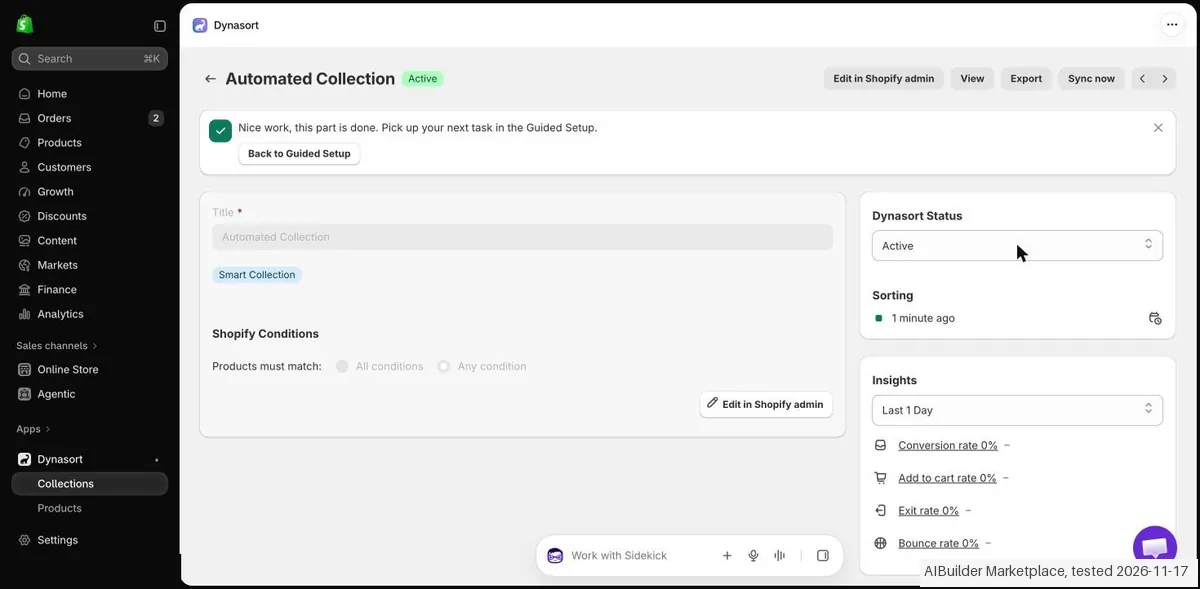
- Text we checked: "Processing is not turned on yet. Go to Settings to enable it". What we saw: After the Dynasort Status was set to Active and saved, the app said that processing was not turned on; Processing had to be switched On in Settings (interval 60 minutes) before the collection was sorted.
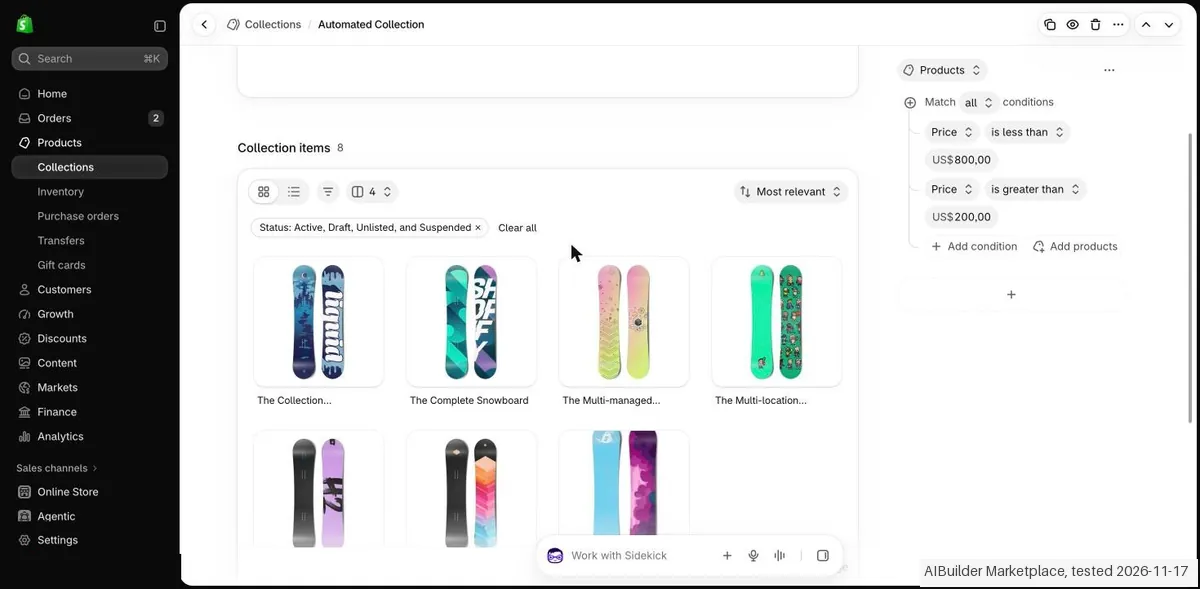
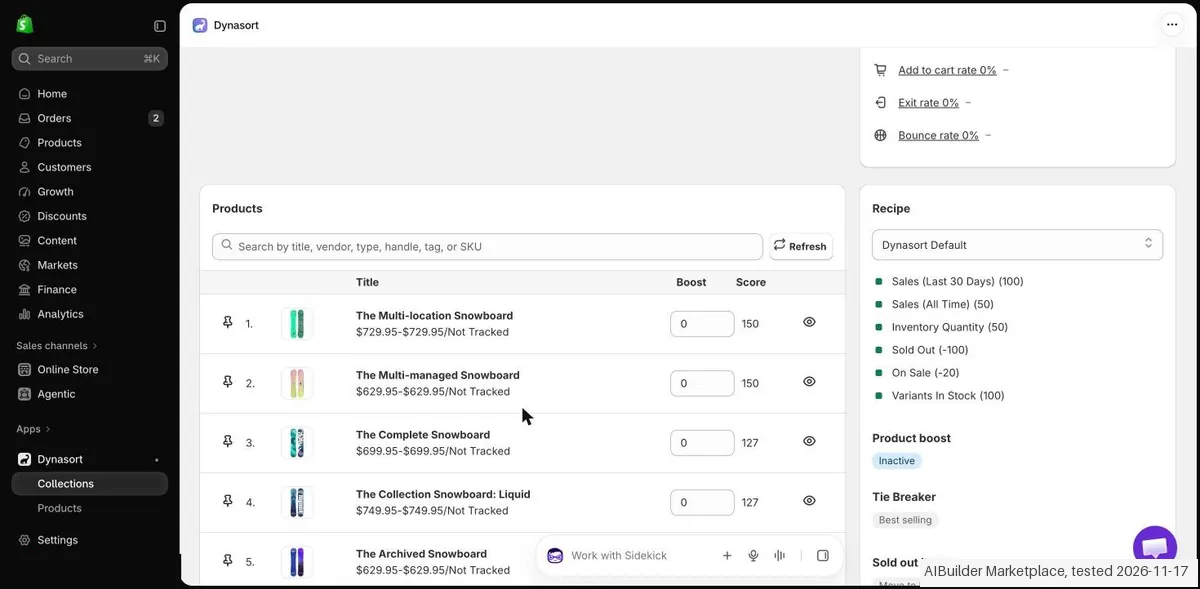
- Text we checked: "Sales (Last 30 Days) (100), Sales (All Time) (50), Inventory Quantity (50), Sold Out (-100), On Sale (-20), Variants In Stock (100)". What we saw: After Sync now the page showed Sorting 1 minute ago, and the sort choice in Shopify changed from Most relevant to Manually with the products in the order and scores of the app (150, 150, 127, 127).
- Text we checked: "Revert To (When Off)". What we saw: After the Dynasort Status was set to Off and saved, the Shopify sort choice stayed on Manually instead of returning to Most relevant; it was set back by hand and the original order returned.
Pricing (2026)
✓ Pricing re-verified 17 Nov 2026
| Plan | Price | What you get |
|---|---|---|
| Demo | free | search, recommendations, post-purchase included; 2 collections, 10 recipes, 2 managed collections, 10,000 serves, 60-min re-sort, A/B testing, connector API |
| Basic | $99 a month | 25 collections, 20 recipes, 10 managed collections, 100,000 serves, Customers Also Bought, 30-min re-sort |
| Pro | $249 a month | 100 collections, 50 recipes, 25 managed collections, 1 million serves, 20-min re-sort, mobile vs desktop analytics |
| Enterprise | $499 a month | 1,000 collections, 250 recipes, 100 managed collections, unlimited serves, 10-min re-sort, 365-day analytics, priority support and onboarding |
Summarised from the pricing notes below; the notes carry the conditions.
| This tool | $99 | 68th cheapest of 72 |
| Cheapest | $4.95 | Essent Preorder Back in Stock |
| Median | $17 | |
| Most expensive | $1,500 | Superfiliate |
Lowest paid entry price per account a month, billed monthly, in USD, among the 72 e-commerce growth apps we have researched (read between 2026-09-28 and 2026-11-27). Only tools priced in the same unit and on the same billing are compared. This is not a market survey, and cheapest is not best.
Four tiers, all billed in USD and recurring every 30 days. Demo is free for as long as you like: 2 sorted and 2 managed collections, 10 recipes built from 40+ signals, a sort refresh every 60 minutes, variant sorting on 2 products, 10,000 recommendation serves a month, A/B testing and collection analytics, and a connector API for your stack or an LLM.
Basic is $99 a month and adds, on top of Demo, 25 sorted and 10 managed collections, 20 recipes, a refresh every 30 minutes, variant sorting on 50 products, 100,000 serves a month and Customers Also Bought recipes. Pro is $249 a month for 100 sorted and 25 managed collections, 50 recipes, a refresh every 20 minutes, variant sorting on 200 products, 1 million serves a month, mobile versus desktop analytics, 30 day serving analytics and A/B tests of recommendation recipes.
Full pricing notes (3 more paragraphs)
Enterprise is $499 a month for 1,000 sorted and 100 managed collections, 250 recipes, a refresh every 10 minutes, variant sorting on 5,000 products, unlimited serves, 365 day analytics with custom ranges and priority support and onboarding. Every paid tier carries a 30 day free trial. The mix up we recorded on 14 September and again on 3 October 2026, with the Pro and Enterprise capacity blocks under each other's headings, is gone: on 17 November 2026 the Pro card listed the 100 collection allowance and the Enterprise card the 1,000 collection allowance.
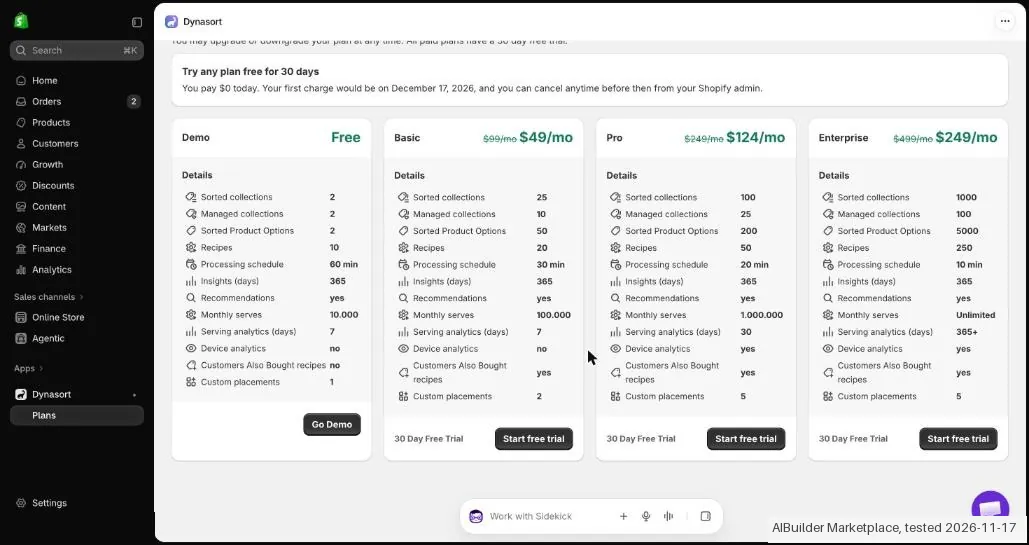
The prices have not moved. In our own test on a Shopify development store the app showed a banner, “Special pricing for your store”, with Basic, Pro and Enterprise marked down by half ($99 to $49, $249 to $124 and $499 to $249) and an end date six days away; that is a temporary offer on the app's screen and not on the listing, so we do not count it as the price.
The app's own text said any plan is free for 30 days, “You pay $0 today”, with a first charge on 17 December 2026. We chose Demo and saw no payment screen. The listing's rating block read 4.6 from 14 reviews, thirteen five star and one one star.
Plans change, so check the live price on their site before you buy.
Category context: E-commerce. Across the 76 tools in this category that we researched with a public US-dollar price, the median entry price is $15 a month (lowest paid plan as listed, per seat where the vendor prices per seat). Dynasort’s entry price of $99 a month sits above that median. Compare pricing conditions in the Software Cost Atlas →
What the price did
We read Dynasort’s own pricing page on a schedule and keep every reading, so this is our record of the page. It is not a forecast, and not someone else’s summary. A change appears here only after we confirmed the new price on the page itself.
Unchanged. Every price on Dynasort’s pricing page was identical across our 14 reads from 15 Sep 2026 to 16 Nov 2026 (62 days).
Four dated readings, prices unchanged, cards not. On 14 September 2026 the listing priced Basic, Pro and Enterprise at $99, $249 and $499 with the Pro and Enterprise capacity blocks under the wrong headings; on 15 September the ladder read correctly and the paid cards listed no serve allowance. On 3 October 2026 the prices were the same, but the cards had been rewritten: serves now appear on every paid card (100,000 on Basic, 1 million and unlimited above it), the signal count went from 40+ to 60+, and the two upper feature lists again sit under self-contradictory headings. On 17 November 2026 the prices were unchanged again and the cards had been rebuilt once more: the signal count was back at 40+, A/B testing, collection analytics and the connector API sat on the free Demo card, and the Pro and Enterprise capacity blocks sat under the right headings.
What the pricing page doesn’t say
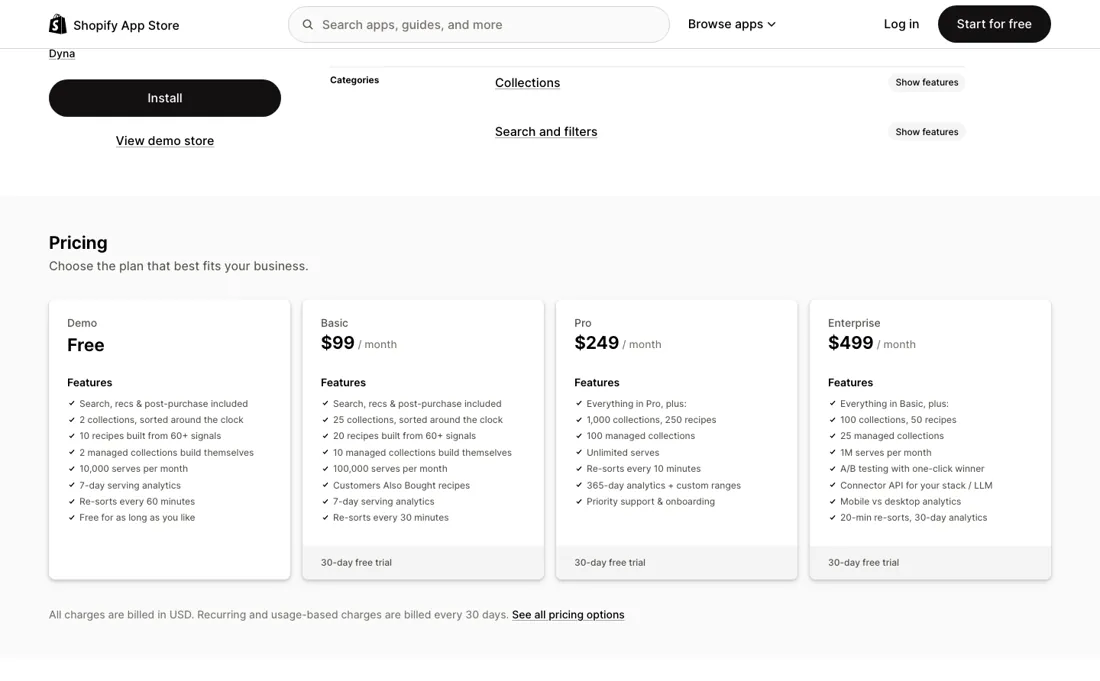
The jump from free to paid is steep at $99 a month, and it buys capacity rather than capability: search, recommendations and post-purchase are already in the free Demo, and Basic multiplies collections, recipes and serves (100,000 a month against 10,000). Above that the cards were printed under each other's headings in September and early October 2026; they read correctly on 17 November 2026, and A/B testing and the connector API sit on the free Demo card.
And the evidence base is thin: 14 reviews, with thirteen fives and a single one-star and nothing in between. It is Shopify-only, so it is not an option if any part of your catalogue lives elsewhere.
Watch the video review
The video version of this review, from our YouTube channel.
What Dynasort does
Shopify app that re-sorts collections, variant lists, search results and upsell blocks automatically, using recipes built from 60+ signals such as sales, margin, inventory and reviews.
What buyers report about Dynasort
Hands-on: tested 2026-11-17Reported by buyers: Shopify App Store listing apps, read September 2026
Themes from the buyer-review sites listed at the foot of this page, read in September 2026. We tested Dynasort ourselves on 2026-11-17, but one test is a narrow sample, so here is what other buyers report. We summarise it here because the complaints are usually the part a vendor page leaves out.
- • Tenure is the unusual part of this set. Reviewers write at almost three years, at over a year twice, and at eleven months of continuous use: a different signal from a wall of first-week enthusiasm. The long-tenure reviewers are retailers in Israel, the United States and the United Kingdom.
- • Sorting on margin is described as a money outcome rather than a convenience. An Australian bathware retailer at about a year says they make better margins because they can prioritise the products that earn well, in an industry where sell prices track the market.
- • A US golf retailer says the app's ordering converts at a higher rate than Shopify's own. A UK fabric merchant gives the concrete version: out-of-stock products pushed to the bottom of every collection, hours saved each week against doing it by hand, and recipes flexible enough to follow the seasons as new stock replaces last year's sellers.
- • It is the app that survived a bake-off at high SKU counts. A US fashion brand lists Algolia, Boost, Sort'd and Fast Simon as tools they had used and says Dynasort is the only one that could handle what they do.
- • One support name recurs across independent reviews, Wade, described as answering within minutes, building custom work including multi-location views, and fixing a year's single issue on the spot.
- • The single negative review is worth reading in full before you install. A US merchant three days in calls it a completely non-working app and a waste of time, and says two days of support produced generic replies with no specifics and that the basic rules could not be set up.
- • The vendor's public reply to that review names a cause that belongs on any buyer's checklist: the merchant's theme was overriding Shopify's manual sort order by defaulting to best-selling, a theme-level setting that bypasses whatever a collection app writes through the Shopify API. Check your theme's default collection sort before you judge the app: by the vendor's account it affects every app in this category, not only this one.
- • The scoring takes learning. A UK merchant nine days in says it takes a while to understand the logic of the scoring before it becomes powerful, which is the same opacity our own note on this page flags.
- • The base is small and English-speaking: fifteen reviews from the United States, the United Kingdom, Israel and Australia, and not one of them describes a failure mode other than the theme conflict above.
Where the ratings disagree. Fifteen reviews is a thin base and the shape is all-or-nothing: fourteen fives and one single star, with nothing in between. What makes it more useful than a larger pile of first-week praise is the spread over time: the set runs from November 2024 to June 2026, and several reviewers are writing at one to three years of continuous use, which is the durability evidence a new app cannot offer. It also helps that the one bad experience has a documented technical cause the vendor answered in public, so you can check whether it applies to your theme rather than guessing.
Pages read (September 2026): Shopify App Store
Basic buys capacity; Pro and Enterprise buy more of it
Basic at $99 a month is a straight capacity step over the free Demo: 25 sorted collections instead of 2, 20 recipes instead of 10, 10 managed collections, 100,000 serves a month instead of 10,000, a 30-minute re-sort and Customers Also Bought recipes. Search, recommendations and post-purchase are already in the free tier, so Basic does not add a new surface; it lets the same engine work on more of your catalogue.
Above Basic the cards now read correctly; in September and early October 2026 they were printed under each other's headings. Pro at $249 gives 100 sorted collections, 50 recipes, a 20 minute refresh and 1 million serves a month, plus mobile versus desktop analytics and A/B tests of recommendation recipes. Enterprise at $499 gives 1,000 collections, 250 recipes, a 10 minute refresh, unlimited serves, 365 day analytics and priority onboarding.
A/B testing and the connector API are already on the free Demo card. What no tier fixes is the work: the recipes still have to be built and watched, and a sort blended from 40+ signals will still bury products you wanted seen. Paying more buys reach and speed, not better merchandising judgement.
Our monthly capture read this vendor's pricing page in September 2026 and again in October 2026, and the amounts were the same both times, including $99, $249 and $499 from the pricing above. We keep watching, and the registry records what moves.
What we found running Dynasort ourselves
The first findings are at the top of this page. The rest:
- Text we checked: "Special pricing for your store". What we saw: A banner in the app showed Basic $49, Pro $124 and Enterprise $249 a month, half of the crossed out $99, $249 and $499, which are the App Store prices; the banner said the offer ends in 6 days. Only reported, not compared with a price field.
- Text we checked: "Demo 2 collecties, Basic 25, Pro 100, Enterprise 1000". What we saw: The plan page lists 2, 25, 100 and 1000 sorted collections for Demo, Basic, Pro and Enterprise, with processing schedules of 60, 30, 20 and 10 minutes. The App Store listing now shows the collection counts in the right column, while our research still describes the mislabelled plan cards of October.
Claim vs. what we measured
We set a claim from Dynasort's own pages next to what we saw in our test, on the plan named. The status says whether the two describe the same thing and match; it is not a verdict on the product. Confirmations are listed too.
| What the vendor says | What we measured | Status | What it means if you buy |
|---|---|---|---|
| Setting up your store: about 5 minutes remainingSource: our test notes, read 17 Nov 2026 | Measured 2026-11-17: The app said about 5 minutes remaining while syncing 3 collections, 23 products and 2 recent orders; it took more than 7 minutes before the store was ready, and the first sorted result stood on screen about 8 minutes after the install.Our test, 17 Nov 2026; Free Demo plan only; the paid plans were not clicked | Not comparableThe wording of the setup screen against one run on a store of 23 products; larger stores and other days were not tried, so the duration is not set against a fixed claim. | Expect to wait longer than the app says before the first sort; the wait was a synchronisation of a very small store. |
| Processing is not turned on yet. Go to Settings to enable it.Source: our test notes, read 17 Nov 2026 | Measured 2026-11-17: After the Dynasort Status was set to Active and saved, the app said that processing was not turned on; Processing had to be switched On in Settings (interval 60 minutes) before the collection was sorted.Our test, 17 Nov 2026; Free Demo plan only; the paid plans were not clicked | ConfirmedThe message of the app against the result after the switch; no other setting or plan was compared. | Setting a collection to Active is not enough: the collection stays unsorted until Processing is switched On in Settings, one extra step the app only shows afterwards. |
| Sales (Last 30 Days) (100), Sales (All Time) (50), Inventory Quantity (50), Sold Out (-100), On Sale (-20), Variants In Stock (100)Source: our test notes, read 17 Nov 2026 | Measured 2026-11-17: After Sync now the page showed Sorting 1 minute ago, and the sort choice in Shopify changed from Most relevant to Manually with the products in the order and scores of the app (150, 150, 127, 127).Our test, 17 Nov 2026; Free Demo plan only; the paid plans were not clicked | ConfirmedThe recipe and scores of the app against the product order in the Shopify admin on one smart collection; the online store itself was not checked. | One switch sorted a collection of 8 products by itself, with no dragging; the Shopify sort choice changes to Manually while the app is active. |
| Move to bottomSource: our test notes, read 17 Nov 2026 | Measured 2026-11-17: The collection of 8 products held no sold out product, so the setting Sold out items: Move to bottom was not seen at work.Our test, 17 Nov 2026; Free Demo plan only; the paid plans were not clicked | Not testableThe Sold out setting of the recipe against a collection without any sold out product; nothing could be compared. | Whether sold out products really drop to the bottom is not shown by this test; check it on a collection that contains a sold out product. |
| Revert To (When Off)Source: our test notes, read 17 Nov 2026 | Measured 2026-11-17: After the Dynasort Status was set to Off and saved, the Shopify sort choice stayed on Manually instead of returning to Most relevant; it was set back by hand and the original order returned.Our test, 17 Nov 2026; Free Demo plan only; the paid plans were not clicked | ContradictedThe recipe setting Revert To (When Off) against the Shopify sort choice some minutes after Status Off; a longer wait or a later processing run was not tried. | Switching Dynasort off does not by itself put the collection back; a merchant has to reset the sort choice in Shopify. |
| Try any plan free for 30 days. You pay $0 today.Source: our test notes, read 17 Nov 2026 | Measured 2026-11-17: The paid plans were not clicked, so the free trial and the Shopify approval screen were not seen; the free Demo plan was chosen instead and opened with no card or billing screen.Our test, 17 Nov 2026; Free Demo plan only; the paid plans were not clicked | Not testableThe trial text of the plan page against a Shopify approval screen that never appeared; no paid plan was started. | The trial wording is on the plan page, but whether a paid plan really costs $0 today was not tested; the free Demo plan was. |
| Special pricing for your store.Source: our test notes, read 17 Nov 2026 | Measured 2026-11-17: A banner in the app showed Basic $49, Pro $124 and Enterprise $249 a month, half of the crossed out $99, $249 and $499, which are the App Store prices; the banner said the offer ends in 6 days. Only reported, not compared with a price field.Our test, 17 Nov 2026; Free Demo plan only; the paid plans were not clicked | ContradictedThe discounted prices in the app against the crossed out list prices on the same plan page; the discount is temporary and tied to the store, so no stored price was compared. | The app showed half of the App Store prices for this store for a limited time; the price you see can differ from the listing and can end after a few days. |
| Demo 2 collecties, Basic 25, Pro 100, Enterprise 1000Source: our test notes, read 17 Nov 2026 | Measured 2026-11-17: The plan page lists 2, 25, 100 and 1000 sorted collections for Demo, Basic, Pro and Enterprise, with processing schedules of 60, 30, 20 and 10 minutes. The App Store listing now shows the collection counts in the right column, while our research still describes the mislabelled plan cards of October.Our test, 17 Nov 2026; Free Demo plan only; the paid plans were not clicked | Out of dateThe plan page of the app against the current App Store listing; the October state of the listing was not seen in this test. | The plan page and the listing agree on the collection counts; the recorded text about mislabelled cards no longer matches the listing. |
| Basic $99/mo doorgestreept, $49/moSource: our test notes, read 17 Nov 2026 | Measured 2026-11-17: The plan page shows Basic at $99 a month crossed out and $49 a month, Pro $249 crossed out and $124, Enterprise $499 crossed out and $249. The paid plans were not clicked, so no approval screen, total, tax or renewal term was seen.Our test, 17 Nov 2026; Free Demo plan only; the paid plans were not clicked | Not testableThe prices on the plan cards against a Shopify approval screen that never appeared; no tax, term or stored cost rule was compared. | The price you would pay for a paid plan is not confirmed by a Shopify approval screen; start with the free Demo plan and check the screen before you approve a paid plan. |
Exit test: can you take your data out?
The app was installed on our Shopify development store, which we set up, and our AI assistant ran the test in our browser. On 17 November 2026 the session tested Dynasort (collection sorting) on a Shopify development store: the install, the free Demo plan without a card or billing screen, the first synchronisation (more than 7 minutes, where the app said about 5), the sort rule on Automated Collection (8 products) with the recipe Dynasort Default, the message that Processing had to be switched On in Settings first, the result in Shopify (the sort choice changed from Most relevant to Manually in the order of the app scores, about 8 minutes and 14 steps after the install), the switch back (Shopify stayed on Manually until the sort choice was reset by hand), the plan page with a temporary 50% discount (Basic $49, Pro $124, Enterprise $249 a month) and the uninstall, which asks for a reason. Nothing was paid or approved. Install: the app (App Store name Dynasort Collection Sorting, developer Dyna, Denver; Built for Shopify; rating 4.6 from 14 reviews) was installed from its App Store listing through the install form in our own tab. The install started at 22:12 (clock of the test computer). The permission screen said that the app needs access to view customer data, view staff and contributor data and view and edit store data; it was approved with Install. The app opened as Dynasort from Dyna, the same product as the listing, on its Plans page. Plan choice: the free Demo plan was chosen with the button Go Demo. No card and no billing screen came up. A welcome screen asked for a goal; Better merchandised collections was chosen and Build my setup plan was clicked. Wait: the screen Setting up your store said about 5 minutes remaining and Syncing 3 collections, 23 products, and 2 recent orders. It took more than 7 minutes before it said Your store is ready. Core action: the app listed the collections Hydrogen (3 products), Automated Collection (8 products) and Home page (0), with the recipe Dynasort Default, status Off and the text 0/2 Sorted. Automated Collection, a smart collection, was chosen. In Shopify it was sorted Most relevant before the test. The recipe Dynasort Default weighs Sales (Last 30 Days) (100), Sales (All Time) (50), Inventory Quantity (50), Sold Out (-100), On Sale (-20) and Variants In Stock (100), with the tie breaker Best selling and Sold out items set to Move to bottom, and Revert To (When Off) set to Most relevant. The Dynasort Status was set to Active and saved (Collection saved). The status box is a native select inside an iframe, so a mouse click could not open it; pressing Escape and then typing the first letter (A for Active, O for Off) worked. A message then said that processing is not turned on yet and that Dynasort will not auto-sort the collections otherwise. In Settings, Processing was switched from Off to On (interval 60 minutes) and saved. After Sync now and about 1 to 2 minutes, the page showed Sorting 1 minute ago (about 22:20). The first result therefore came about 8 minutes after the install, most of it waiting for the first synchronisation, in about 14 steps. Result in Shopify: the sort choice of the collection changed from Most relevant to Manually, and the order became The Multi-location Snowboard, The Multi-managed Snowboard, The Complete Snowboard, The Collection Snowboard: Liquid, then the products Hidden, Hydrogen and Compare at Price, equal to the order and scores in the app (150, 150, 127, 127 and so on). The collection holds no sold out product, so the rule Sold Out (-100) with Move to bottom was not seen at work. Switching back: the Dynasort Status was set to Off and saved, but Shopify stayed on Manually; the revert to Most relevant did not happen at once. The sort choice was set back to Most relevant by hand in Shopify and saved, and the original order returned. A merchant who switches the app off should check the sort choice of the collection. Plans: a banner says Special pricing for your store and that Basic, Pro and Enterprise are discounted for the store, starting at $49/mo, and that the offer ends in 6 days. Plan page: Demo Free; Basic $99/mo crossed out, $49/mo; Pro $249/mo crossed out, $124/mo; Enterprise $499/mo crossed out, $249/mo, so 50% off the list price in the app. The text says: Try any plan free for 30 days. You pay $0 today. Your first charge would be on December 17, 2026, and you can cancel anytime before then from your Shopify admin. The discount is temporary and tied to the store; the App Store listing shows $99, $249 and $499 without a discount. Sorted collections per plan: Demo 2, Basic 25, Pro 100, Enterprise 1000; processing schedule Demo 60 min, Basic 30, Pro 20, Enterprise 10. Demo has no Customers Also Bought recipes and no device analytics. The App Store listing now shows the collection counts in the right column; our research still describes the mislabelled plan cards seen in October. Checkout: the free Demo plan was chosen, the paid plans were not clicked, so no Shopify approval screen, no total, no test charge and no card field was seen. Nothing was approved. Cancelling: no paid plan was started. In Settings, Apps, Uninstall opened the dialog Uninstall Dynasort? Which says that the app can no longer be used, that data managed by the app will be deleted and that a request will be sent to the app developer within 48 hours to delete all personal customer information. A reason for uninstalling is required (Testing multiple apps was chosen). The app was uninstalled at about 22:22 after the evidence was complete and is gone from the installed apps. Not tested: the paid plans and the free trial, the A/B test, a sold out product moving to the bottom, variant sorting, recommendations, the effect in the online store (only the Shopify admin was checked), a large catalogue, Insights (data appears after 24 hours) and Sort rotation. Clean up: the collection order was set back to Most relevant, the Dynasort Status was set to Off, Processing had been switched On in the app and disappeared with the uninstall, the app was uninstalled and our own tab was closed. No other app was touched. The price fields are not changed here. No kit records were entered. Test date: 17 Nov 2026. We describe the friction rather than score it; this is one run with synthetic records, not a verdict on Dynasort.
| What we checked | What we saw |
|---|---|
| Fields offered by the export dialog | |
| Not offered in the field selector | None noted. |
| The exported file | We did not inspect the file, so data retention and loss remain unverified. |
| Awkward but not lost | The app did not sort until Processing was switched On in Settings, which the app only said after the status was set to Active. The first synchronisation took more than 7 minutes (the app said about 5). The sort choice of the collection in Shopify changes to Manually, and after the app was switched off Shopify stayed on Manually until the sort choice was reset by hand. The paid plans showed a temporary discount in the app that the App Store listing does not show, and our research still describes the mislabelled plan cards of October. |
| Export route | No export or reimport was performed; no file was downloaded or examined. The two categorised kit records were not entered; the objects tested were not kit records. |
| Export format | No downloaded bytes examined. |
| Re-importing the export | No reimport performed. |
| Cancelling | No cancellation or downgrade performed. |
What the exit test does not show:
- Session and source-reading date: 17 November 2026. Times are CET. The session started at about 22:12 CET. These are approximate tester observations, not benchmark timings. Midnight timestamps are required date anchors, not measured event times.
How this compares: across our exit tests of 330 tools, 60 gave us an export file. For Dynasort no usable export file reached us during the test session. Report 08: can you get your data out?
Mail in the first 14 days
Measurement running until 2026-11-30T23:00:00Z (last observed 2026-11-27T02:18:03.805777Z).
1 emails in the 14-day window so far; first email after signup: unknown (exact signup time not recorded); 0 with an explicit offer.
Retained inbox and junk only; removed or archived mail is outside this observation. Ambiguous supplier attribution is excluded. Day numbers use elapsed 24-hour periods since the recorded signup date at midnight Europe/Amsterdam; the signup hour is unknown. Offer flags quote literal subject/body text. Replies in our own correspondence (support tickets, our comment requests) are excluded; one-time codes, our own address, our account name and our name are replaced in brackets.
| Day | Time (UTC) | Sender | Literal subject | Folder | Offer evidence |
|---|---|---|---|---|---|
| Day 0 | 2026-11-17 21:13:31 UTC | Dynasort team / dynasort.io | Your Dynasort setup has started | inbox |
Screenshots from our test (click to enlarge)
What this test does not show:
- Original store creation and identity check, which we did ourselves.
- The paid plans and the 30 day free trial.
- The A/B test.
- A sold out product moving to the bottom of the collection.
- Variant sorting, recommendations and Sort rotation.
- The effect in the online store (only the Shopify admin was checked).
- A large catalogue and the Insights numbers (data appears after 24 hours).
- Export and reimport.
Most of our reviews are researched rather than run. How we review explains which is which, and why we do not pretend otherwise.
How to actually use Dynasort
Use the free Demo tier properly rather than as a preview: it sorts 2 collections around the clock, which is exactly enough for a controlled comparison. Pick your best-selling collection and one you suspect is badly ordered, record the conversion rate and revenue per visit for both before you change anything, and let a single recipe run for a full two weeks. Start with one clear signal (push sold-out products down, or sort by sell-through) before you blend margin and inventory into it, because a recipe built from six signals at once is one you cannot reason about when a product disappears from view.
Watch which products drop as much as which ones rise; that is where automated merchandising goes wrong. Then check the serve allowance against your traffic (10,000 a month on Demo, 100,000 on Basic) and take the full 30-day trial to see a real sales cycle.
Where this section comes from: our research notes (255 words)
The Shopify App Store listing at apps.shopify.com/dynasort, read 14 September 2026 and re-read 15 September 2026: all four pricing cards with their capacity lines and trial terms, the “All charges are billed in USD” note, the feature and integration lists, and the rating block, which reads 4.6 from 15 reviews (93% five-star, 7% one-star). The listing carries Shopify's Built for Shopify badge, names the developer as Dyna and dates the app's launch to 19 September 2022.
The 15 September re-read is the one the pricing and plan-comparison text above is built on; it corrected the capacity figures recorded on 14 September for the Pro and Enterprise tiers. Listing re-read 3 October 2026 (served HTML): same prices and 30-day trials; rewritten cards with serves on every paid tier (Basic 100,000; upper cards 1M and unlimited), A/B testing and connector API on the $499 card, 'Everything in Pro, plus' heading on the $249 card; 60+ signals; rating still 4.6 from 15.
Dynasort's FAQ page (dynasort.io/faqs), read on 22 October 2026 for the theme, uninstall and cancellation answers. Read again on 17 November 2026: the listing at apps.shopify.com/dynasort (prices unchanged; cards rebuilt with Pro 100 and Enterprise 1,000 collections under the right headings; 40+ signals; A/B testing and the connector API on the Demo card; 4.6 from 14 reviews). In our own test session that day we installed the app on a Shopify development store, read its plan screen, including a temporary half price banner on the paid plans, chose the free Demo plan and uninstalled the app.
Frequently asked questions
Can you export your data from Dynasort?
Exit check 2026-11-17; route excerpt: No export or reimport was performed; came along (excerpts): not tested; lost (excerpts): not tested; re-import: not tested.
What does Dynasort cost?
Read on 17 November 2026 on its Shopify App Store listing: a free Demo tier, then Basic $99 a month, Pro $249 and Enterprise $499, all in USD every 30 days, each paid tier with a 30 day free trial. Demo is a working plan rather than a countdown: 2 collections sorted round the clock, 10 recipes, 2 managed collections, 10,000 serves a month, a sort refresh every 60 minutes, A/B testing, collection analytics and a connector API, with search, recommendations and post purchase included. Inside the app we saw a temporary half price banner on the paid plans, ending within a week; it is not on the listing and is not the price.
Which tier do I actually need?
Start from serves and collections. Basic covers 25 sorted collections and 100,000 serves a month. Pro at $249 covers 100 sorted collections and 1 million serves, and Enterprise at $499 covers 1,000 collections and unlimited serves, with a 10 minute refresh and priority onboarding. On 3 October 2026 the two upper cards were printed under each other's headings; on 17 November 2026 they read correctly. If A/B tests of recommendation recipes decide it for you, those start on Pro.
How many serves do I get on a paid plan?
The cards say: 10,000 a month on the free Demo, 100,000 on Basic, 1 million on Pro and unlimited on Enterprise, as read on 17 November 2026. In September the paid cards published no serve number at all. Use the 30 day trial to measure your own volume.
Does Dynasort need changes to my Shopify theme?
Not for collection or product-option sorting. Dynasort's FAQ, read on 22 October 2026, says both run entirely through Shopify's APIs, so nothing is added to the theme. Search re-ranking and recommendations are different: each is added once in the theme editor as an app block or app embed.
What happens if I uninstall Dynasort?
The same FAQ (read 22 October 2026) says uninstalling removes the app and its storefront blocks entirely, and each sorted collection has a Revert To sort order (best selling, manual, newest and so on) that it falls back to when you disable it. Billing runs through Shopify; cancelling is uninstalling from the Shopify admin.
Is this a hands-on review of Dynasort?
Yes. We tested Dynasort ourselves on 2026-11-17; the section above says what we tested, what we found and what we did not test, and where a figure comes from the vendor's own documentation instead. Most of our reviews are researched rather than run; we say which is which. We name what each tool is good and bad at, and we have no affiliate relationship with Dynasort; we earn nothing whether you sign up or not.
- Buyer reviews on Shopify App Store listing apps.shopify.com/dynasort (15 reviews, 4.6 average: 14 five-star, one one-star, and nothing at four, three or two), read September 2026.
- Read 2026-11-17 on apps.shopify.com/dynasort and in our own test the same day; earlier reads 14 and 15 September and 3 October 2026.
- A dated screenshot of that pricing page, kept on this site as the receipt.
- Our own hands-on session with Dynasort (2026-11-17), written up in full further down this page.
Bottom line
In one line: The jump from free to paid is steep at $99 a month and buys capacity rather than capability: search, recommendations and post-purchase are already in the free tier.
Best for: small stores unsure sorting will pay off.
Others in this category
Reviewed e-commerce tools that share ground with Dynasort. They are comparable in what they do, not drop-in swaps:
New reviews, price changes we recorded, and the cost conditions we found. No sponsored placements. Unsubscribe anytime.
This is our researched assessment, not a paid placement. How we review →