Selleasy Review (2026)Flat Shopify Upsell Plans, No Order Meter
 By Daan Haket · Researched and written with an AI assistant · who does what
The pricing changed under this review in October 2026, and the vendor's own page has not caught up.
shopify stores that want bundles, add-ons, cart funnels and post-purchase offers out of one app on a flat fee that never takes a share of upsell revenue — small stores can test on the free plan, and Shopify Plus stores get checkout upsells from $29 a month.
you want more than 5 campaigns for free, or you already have an upsell app you like: Selleasy's strength is the low flat price, and its own pricing page still disagrees with itself about how it charges.
Transparency: we earn nothing from Selleasy; the links to it are plain links. How we make money →
Pricing (2026)
✓ Pricing re-verified 30 Oct 2026
| This tool | $9 | 12th cheapest of 59 |
| Cheapest | $2.99 | MX AI |
| Median | $15 | |
| Most expensive | $199 | Auware |
Lowest paid entry price per account a month, billed monthly, in USD, among the 59 e-commerce growth apps we have researched (read between 2026-08-19 and 2026-10-30). Only tools priced in the same unit and on the same billing are compared — not a market survey, and cheapest is not best.
Billed in USD through Shopify, recurring charges every 30 days. Four flat plans, each with unlimited orders. Free costs nothing and allows up to 5 campaigns, with the 18 upsell and cross-sell strategies, Shopify and manual recommendations, and chat, email and Zoom support. Starter is $9 a month or $91 a year and adds unlimited campaigns, 50 free AI recommendations and free setup on a call.
Pro is $29 a month or $295 a year and adds 1,000 AI recommendations a month, an AI campaign optimizer, checkout upsells for Shopify Plus, advanced campaign targeting and metafield bulk recommendations. Max is $59 a month or $601 a year and adds 2,500 AI recommendations a month, advanced customizations, a rules engine, an AOV advisor and priority support. The paid plans carry a 30-day free trial.
An Enterprise plan is quoted on request. What changed: until October 2026 Starter was priced by your store's total monthly orders (free to 50, $9 to 500, $19 to 1,000, $29 above), and Pro and Max were $49 and $99. Logbase's pricing page still carries a block with that old ladder next to the new plan cards and comparison table on 30 October 2026; the App Store listing, which is what Shopify bills from, shows only the flat plans. Check the charge Shopify shows at install. Plans change — always verify the live price on their site.
Category context: Growth & Revenue. Across the 84 tools in this category that we researched with a public US-dollar price, the median entry price is about $30 a month (lowest paid plan as listed, per seat where the vendor prices per seat). Selleasy’s entry price of $9 a month sits below that median. Compare pricing conditions in the Software Cost Atlas →
What the pricing page doesn’t say
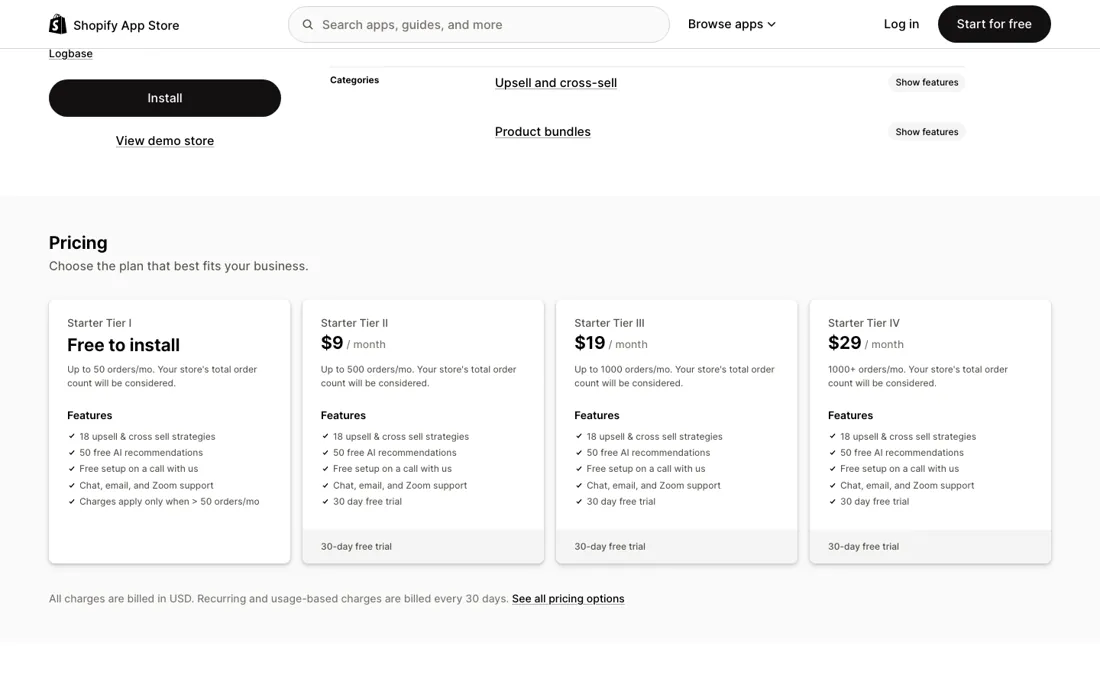
The App Store listing now shows four flat plans with unlimited orders; logbase.io/selleasy/pricing shows the same plans in its cards and comparison table but still carries a block with the old order-based ladder and the line 'Priced on total store orders, not app orders'. Merchants who installed earlier may still be on the old ladder. Look at the charge Shopify shows at install rather than at either page. The free plan now caps campaigns instead of orders: up to 5, against unlimited from Starter at $9.
Five is enough for a test, not for a store that wants a separate offer on each collection. Starter says '50 free AI recommendations' with no period attached, while Pro says '1,000 AI recommendations / month' and Max '2,500 AI recommendations / month'. The contrast suggests the 50 is a one-off allowance, but neither page says so outright. Ask before you plan around it. And treat the vendor's headline claims as claims: the 20% AOV increase and the 40,000+ brands are Logbase's own figures on its own site, with no methodology attached to either.
Watch the video review
The video version of this review, from our YouTube channel.
What Selleasy does
Shopify upsell and cross-sell app (by Logbase): bundles and product add-ons on the product page, add-on pop-ups and response-based funnels on the cart, one-click post-purchase offers and thank-you page add-ons. Flat plans with no order limit and no share of upsell revenue, including a free plan with up to five campaigns.
What buyers report about Selleasy
Hands-on: not tested by usReported by buyers: Shopify App Store, read September 2026
Themes from the buyer-review sites listed at the foot of this page, read in September 2026. We have not run Selleasy ourselves, so this is other buyers' experience rather than ours. We summarise it here because the complaints are usually the part a vendor page leaves out.
- • Support that gets on a call. Reviewers from Poland, Spain, India, Estonia and the UK name individual Logbase staff for Zoom sessions that either set the app up or fixed a broken widget in under fifteen minutes. It is by some distance the most repeated theme on the listing.
- • Setup speed. A US store reports a Frequently Bought Together offer live within an hour of installing; a Latvian store almost four years in reports cart value up significantly since.
- • It matches the theme. Styling the widget in the store's own colours comes up repeatedly as the reason it does not read as a bolt-on.
- • A $0.00 checkout. A US store almost two years in reports an order for a $1,199 product that checked out at zero, shipped and was delivered before they caught it, and says repeated support tickets were met with denial rather than investigation (July 2026, still unresolved when they wrote). This is one merchant's account and Logbase disputes involvement; it is also the most serious thing on the listing, and it concerns an app that sits in the checkout flow.
- • The meter, again. A US store that left after three days says the app charges on the number of sales your website does, not the number its upsells generate — the same objection our pricing section makes, from someone who paid it (November 2025).
- • Add-ons do not appear behind Shopify's accelerated checkout. Logbase's public reply confirms it: the 'Buy it now' button sends only the main product and third-party apps cannot change that, so add-ons work with the standard Add to Cart button and not with express checkout.
- • Pressure after a bad review. The same November 2025 reviewer describes being emailed repeatedly within 24 hours and contacted through their own storefront chat after posting one star; Logbase disputes the count and the route in its public reply. Both sides are on the page.
Where the ratings disagree. 4.9 across 2,705 reviews, with 97% at five stars against 26 one-star and 5 two-star. The average is close to meaningless at that skew and the 26 carry everything worth knowing, so filtering the listing to one and two stars is the ten seconds that pays: it surfaces what the app meters, what it cannot do behind accelerated checkout, and one unresolved checkout incident. One more thing about this listing specifically — Logbase replies in public to nearly every review, positive and negative, which makes the replies a second source. The grandfathered pricing in our Q&A came out of one of them.
Pages read (September 2026): Shopify App Store
What the money actually buys
On Free the money buys nothing because there is none: unlimited orders, 18 strategies, Shopify and manual recommendations, capped at 5 campaigns. Starter at $9 a month buys unlimited campaigns, 50 free AI recommendations and a free setup call. That step is the one most stores will take, and it is cheap. The real feature step is Pro at $29 a month, $295 a year. That is where the AI layer opens (1,000 recommendations a month instead of 50, an AI campaign optimizer, advanced campaign targeting, metafield bulk recommendations) and where checkout upsells for Shopify Plus live.
Max at $59, $601 a year, raises recommendations to 2,500 a month and adds advanced customizations, a rules engine, an AOV advisor and priority support. Before October 2026 those two tiers cost $49 and $99 and appeared only on Logbase's own site. Read on apps.shopify.com/upsell-cross-sell-kit-1 on 30 October 2026.
Our monthly capture read this vendor's pricing page in September 2026 and again in October 2026, and the amounts were the same both times, including $19, $29, $49 and $99 from the pricing above. We keep watching — the registry records what moves.
Questions we checked
Facts about Selleasy that would change a buying decision, and where we stand on each. An unanswered question does not mean the feature is missing; it means we have not confirmed it yet.
- Is Selleasy priced by store-order tier or by flat plan? Sources disagree
Applies to: the October 2026 repricing.
Why it matters: the old ladder charged by total store orders ($0/$9/$19/$29); the new plans are flat ($0/$9/$29/$59) with unlimited orders.
Answer: Flat on the listing that bills, contradictory on the vendor's own page. The Shopify App Store listing read 30 October 2026 shows only four flat plans with unlimited orders: Free (up to 5 campaigns), Starter $9, Pro $29, Max $59 a month. logbase.io/selleasy/pricing, read the same day, shows those plans in its cards and comparison table but still carries a block with the old store-order ladder and Pro from $49 and Max from $99.
Checked: Selleasy on the Shopify App Store (2026-10-30); Selleasy pricing (2026-10-30)
Have a public source that answers one of these? How we review explains how we check and correct.
How to actually use Selleasy
Start on Free: it costs nothing, has no order limit and gives you up to 5 campaigns with all 18 strategies, which is enough to find out whether upsells move anything in your store. Move to Starter at $9 a month only when you need more than five campaigns, or want the 50 free AI recommendations and the free setup call. Before you install, decide which of the six offer types you actually want: bundles and product add-ons on the product page, add-on pop-ups and response-based funnels on the cart, one-click post-purchase offers on the same order, and thank-you page add-ons.
Set up one of them rather than all six and let it run a fortnight; a frequently-bought-together bundle on your best seller is the usual first test. Two things push you to Pro at $29 a month: wanting AI recommendations at volume, and being on Shopify Plus and wanting checkout upsells.
Where this section comes from: our research notes (293 words)
Two pages, both read in a live browser on 19 September 2026. The Shopify App Store listing at apps.shopify.com/upsell-cross-sell-kit-1 gave the Built for Shopify badge, the rating of 4.9 from 2,704 reviews, the launch date of 15 July 2021, the developer record (Logbase Technologies LLP, PSG STEP E-Lab, PSG College of Technology, Peelamedu, Coimbatore, Tamil Nadu 641004, India), the categories Upselling and cross-selling and Product bundles, the integration list (Checkout, customer accounts, Shopify Admin, AppHQ Slide Cart, Conversion Bear, Geolocation, LogBase Store Pickup, PageFly), the seven storefront languages, and the four Starter tiers with their order ceilings, prices, identical feature lists and 30-day trial.
Logbase's own product page at logbase.io/products/shopify-upsell-app-selleasy gave the rest, and it is the only place the upper half of the ladder appears: the Pro tier at $49 a month or $499 a year and the Max tier at $99 a month or $1,009 a year, with their feature splits, the Enterprise tier quoted on request, the six offer types, and the vendor's own marketing claims of a 20% AOV increase and 40,000+ brands, which are the vendor's figures and are not independently verified.
Re-read 20 October 2026: Logbase's pricing page at logbase.io/selleasy/pricing, for the Starter ladder, the flat $15 Starter figure, the Pro and Max monthly and yearly prices, the 15% yearly toggle, the 30-day trial, the Thinking Model credit rule and the pause-instead-of-charge rule. Re-read 30 October 2026 on apps.shopify.com/upsell-cross-sell-kit-1 (now 4.9 from 2,760 reviews) and logbase.io/selleasy/pricing: the order-based Starter ladder and the $49/$99 Pro and Max prices are replaced by four flat plans with unlimited orders (Free with up to 5 campaigns, Starter $9 or $91 a year, Pro $29 or $295, Max $59 or $601); the logbase.io page still carries a block with the old ladder.
Selleasy vs UpsellPlus, side by side
Each column shows the vendor’s own published entry price, read on the date shown. Entry prices can cover different services or units, so check what each one buys. We do not average them into a score.
The UpsellPlus link above is an affiliate link — we may earn a commission if you sign up, at no extra cost to you — and the other column is a plain link. Neither changes what this table says.
The natural comparison is UpsellPlus — Both cover the same surfaces — product page, cart, checkout, post-purchase — so the difference that matters is what you are billed for. UpsellPlus meters the upsell revenue the app is allowed to generate for you, and that meter does not stop where the pricing page appears to: $500 a month on free and on its $49 plan, $2,000 at $119, then a Scale ladder that runs $199 up to $5,000, $299 up to $10,000, $399 up to $15,000, $499 up to $20,000, $699 up to $30,000, $799 up to $40,000 and $999 with no ceiling. Only the $199 step is published; UpsellPlus support confirmed the rest in writing on 21 September 2026, and a store that passes $5,000 is moved to the $299 tier automatically, so the bill rises by itself. Selleasy charges a flat plan instead and never touches the revenue: Free with up to 5 campaigns, $9 for unlimited campaigns, $29 for Pro with the AI layer and Plus checkout upsells, all with unlimited orders (App Store listing, read 30 October 2026). That makes the two apps diverge hardest exactly where an upsell app is working: at $20,000 of upsell revenue a month UpsellPlus is $499 and Selleasy is still $9 to $29. Run your own upsell revenue through UpsellPlus's ladder before you compare entry prices. Check the Plus question on both. On UpsellPlus their FAQ says Shopify Plus is required only for checkout customization and checkout upsells, which is Shopify's restriction rather than theirs; cart, product page, drawer, thank-you and post-purchase offers work without it. On Selleasy the checkout upsells sit on Pro at $29 a month..
Frequently asked questions
What is Selleasy actually metering?
Since its October 2026 repricing, nothing that grows with your store. Read on apps.shopify.com/upsell-cross-sell-kit-1 on 30 October 2026, every plan says 'Unlimited orders': Free costs nothing and caps you at 5 campaigns, Starter is $9 a month and lifts that to unlimited campaigns, Pro is $29 and Max is $59. The order-count ladder this review used to be built around (free to 50 store orders, then $9, $19 and $29 by order volume) is gone from the listing that does the billing. What still rises with use is the AI allowance: 50 free AI recommendations on Starter, 1,000 a month on Pro and 2,500 a month on Max.
Where do AI recommendations at volume and checkout upsells start?
At Pro, $29 a month or $295 a year on the App Store listing read 30 October 2026. That is the first plan with a monthly AI allowance (1,000 recommendations) and the only route to checkout upsells, which also need Shopify Plus. Max, $59 a month or $601 a year, is for stores that want 2,500 recommendations and the rules engine. Before October Logbase's own site put those two tiers at $49 and $99; the listing now shows all four plans, so the ceiling is no longer hidden.
If the price goes up, am I moved onto the new one?
On the evidence of Logbase's own public answer, no. When a merchant complained on the App Store in November 2025 that the fee had climbed from $8.99 to $16.99 to $19, Logbase replied in public with the account history: that store installed in September 2024, paid $8.99 while it sat in the 51-500 order band, moved to $16.99 once it passed 500 orders a month, and would stay at a $16.99 ceiling — the $19 rate applied only to stores installing from that point on. So two different things were being felt at once: the order band doing what it says, and a list price that new installs pay and existing ones do not. It is a support reply rather than a published policy, so ask for it in writing if the grandfathering is part of your decision.
Does the Thinking Model use up AI credits faster?
Yes. Logbase's pricing page (logbase.io/selleasy/pricing, read 20 October 2026) says using the Thinking Model uses 2 credits per product. The page does not spell out how credits map onto the recommendation allowances (50 free on Starter, 1,000 a month on Pro, 2,500 on Max), so check the in-app counter after a first run before you switch a whole catalogue over.
What happens when the AI recommendations run out?
No surprise bill: the same page says recommendations pause rather than auto-charging. The flip side is that AI picks stop until you upgrade or the allowance resets; what shoppers see in the meantime is not described.
Is this a hands-on review of Selleasy?
This is a researched assessment, not a hands-on test — where we've used a tool ourselves, we say so explicitly. We name what each tool is good and bad at, and we have no affiliate relationship with Selleasy — we earn nothing whether you sign up or not.
- Buyer reviews on Shopify App Store (2,705 reviews, 4.9 average), read September 2026.
- Prices read 2026-10-30 on apps.shopify.com/upsell-cross-sell-kit-1 and on logbase.io/selleasy/pricing; the order-based ladder read on 19 September and 20 October 2026 has been replaced.
- A dated screenshot of that pricing page, kept on this site as the receipt.
Others in this category
Reviewed growth & revenue tools that share ground with Selleasy — comparable in what they do, not drop-in swaps:
New reviews, price changes we recorded, and the cost conditions we found. No sponsored placements. Unsubscribe anytime.
This is our researched assessment — not a paid placement. How we review →