Grapevine Review (2026)
 By Daan Haket · Researched and written with an AI assistant · who does what
The flat price is the whole pricing page, which cuts both ways.
Shopify stores running more than one marketing channel that want attribution from customers rather than from cookies — post-purchase 'how did you hear about us', NPS and CSAT — with unlimited responses at a predictable flat price, and that already send data into Klaviyo, GA4 or Shopify Flow.
your order volume is small enough that $25 a month buys a handful of answers; you want a single one-off survey rather than a running programme; or you need a permanently free tier, because the only free access here is the 14-day trial.
Transparency: the “Visit” links on this page are affiliate links — we may earn a commission if you sign up, at no extra cost to you. No vendor can pay for a better review or verdict. How we make money →
Pricing (2026)
✓ Pricing re-verified 13 Oct 2026
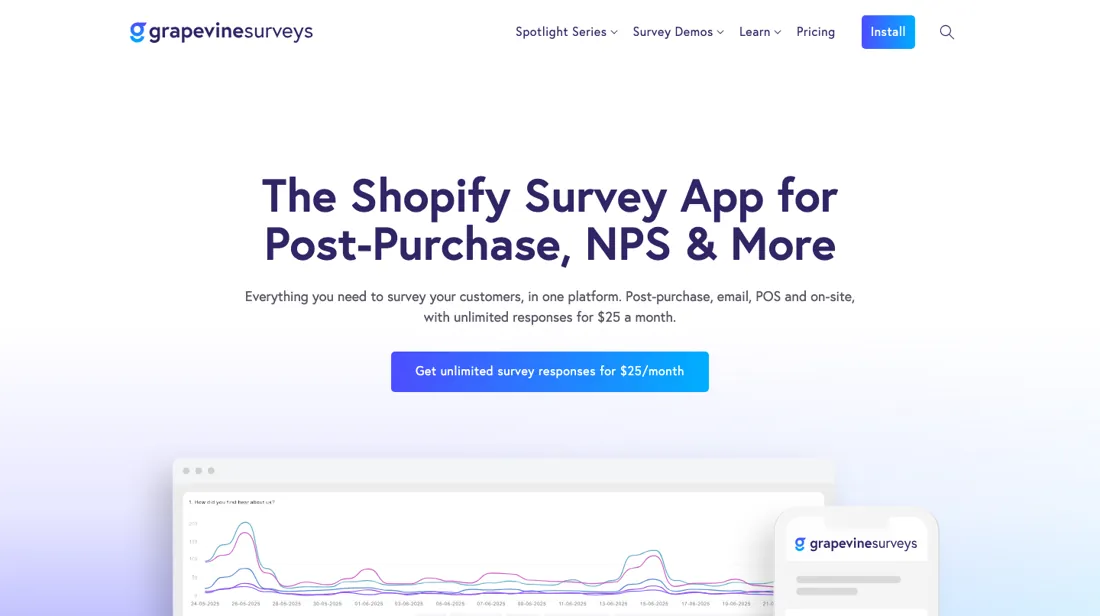
One plan, called Complete, at $25 a month, billed in USD every 30 days, with a 14-day free trial and no free tier. There is no response limit and no per-response charge: unlimited post-purchase, NPS, CSAT and attribution responses are included at that price, on every Shopify plan. The single price also covers revenue and AOV reporting per marketing channel, targeting by order value, product, country, payment method and customer, delivery on-site, by email and on Shopify POS, exports to Shopify Flow, Klaviyo and GA4, and querying your survey data with your own AI assistant through the vendor's MCP server. Plans change — always verify the live price on their site.
Category context: Marketing. Across the 29 tools in this category that we researched with a public US-dollar price, the median entry price is $29 a month (lowest paid plan as listed, per seat where the vendor prices per seat). Grapevine’s entry price of $25 a month sits below that median. Compare pricing conditions in the Software Cost Atlas →
What the pricing page doesn’t say
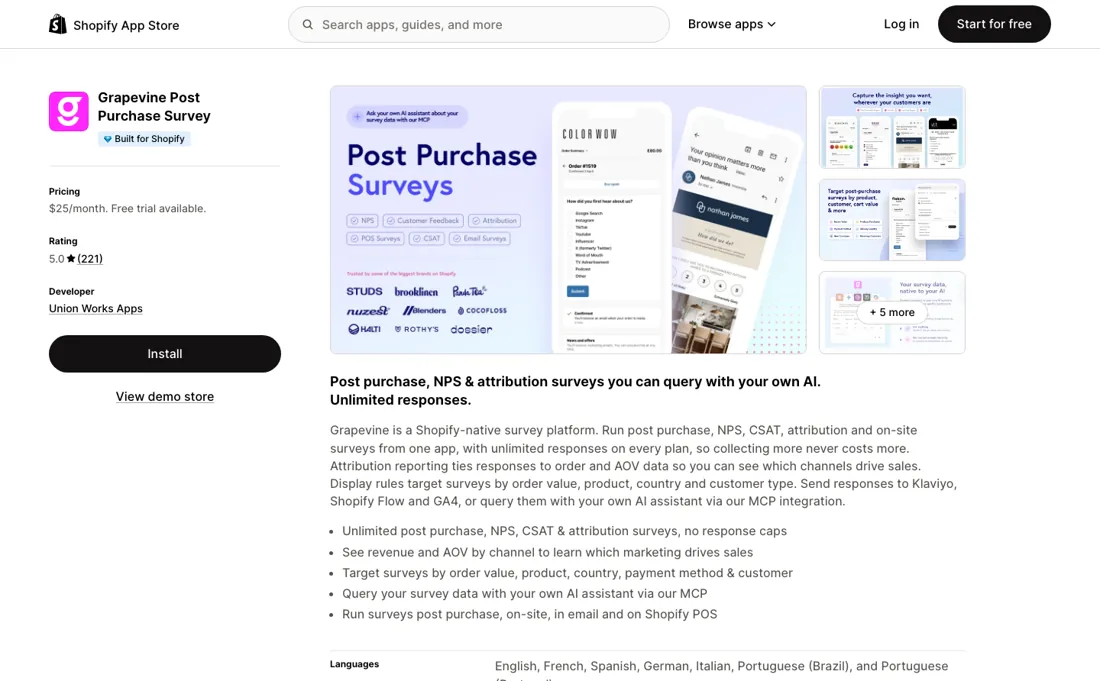
There is no free tier and no small plan, so from day fifteen the app costs $25 a month whether it collects four responses or forty thousand — a low-volume store pays the same as a high-volume one, and several of the nearest alternatives do publish a free plan. The second thing to weigh is access rather than price: the listing's data section asks for customer data including sensitive, device and activity data, plus orders, staff accounts and the online store, which is a lot of reach for a survey tool and worth reading the privacy policy over.
The evidence base is otherwise good for a Shopify app — launched 17 August 2017 by Union Works Apps in London, and 232 reviews on 13 October 2026 of which 225 are five-star and none below four.
Watch the video review
The video version of this review, from our YouTube channel.
What Grapevine does
Shopify-native survey platform for post-purchase, NPS, CSAT and attribution questions, with unlimited responses on a single plan. Reports revenue and AOV per marketing channel, targets surveys by order value, product, country, payment method or customer, runs on-site, by email and on Shopify POS, and exports to Shopify Flow, Klaviyo and GA4; survey data can be queried with your own AI assistant through the vendor's MCP server. Launched August 2017.
What buyers report about Grapevine
Hands-on: not tested by usReported by buyers: the Shopify App Store listing for Grapevine Post Purchase Survey, read September 2026
Themes from the buyer-review sites listed at the foot of this page, read in September 2026. We have not run Grapevine ourselves, so this is other buyers' experience rather than ours. We summarise it here because the complaints are usually the part a vendor page leaves out.
- • A Hungarian supplements retailer five months in uses it for NPS and open feedback, and singles out how many options it offers for the price and how fast support answers by name.
- • A German yarn shop says it settled their remaining attribution questions outright, and that support volunteered ways to get more out of it — their line is that any store running more than one marketing channel gets real value from it.
- • A US mushroom brand more than two years in values the monthly trend view and the fact that responses export for reporting they build themselves.
- • No substantive complaint appears in the reviews on the listing: 222 reviews on 10 September 2026, 215 of them five-star and none below four. Read that as a strong public record, not as evidence that the drawbacks in this review do not exist — the flat $25 and the breadth of store data the app asks for are both visible on the listing itself and neither shows up in the reviews.
Pages read (September 2026): Shopify App Store
There is nothing to upgrade to
One plan at $25 a month, nothing above it and nothing below it, so the only decision left is Grapevine against the meter its rivals run. Its own pricing page makes that argument openly: unlimited surveys and unlimited responses, every integration from the moment you install, the same $25 whether you collect fifty responses a month or fifty thousand, and no inflated monthly rate designed to push you onto an annual contract.
Do that comparison at your own volume, because a flat fee is the expensive option at the bottom of the range. A store collecting a handful of answers a month can sit on a competitor's free tier for nothing while this costs $300 a year; the flat rate only starts winning at the volume where a usage-priced app would have moved you up a tier. What the $25 does not buy is a response rate.
Placement, display rules and how many questions you ask decide that, and since none of them sit behind a paywall here, a survey nobody answers cannot be fixed by spending more. It does not buy data custody either: uninstall, and everything is deleted after thirty days.
How to actually use Grapevine
Let the setup assistant build the first survey. There are three routes in — the assistant, the template library, or from scratch — and the assistant is the short one. Decide where the survey runs before you decide what it asks. The options are the thank-you page, the order status page, a hosted on-site page with its own URL, an embed on any page, one-click links in email, and a Shopify POS tile.
On the two post-purchase pages the vendor's own advice is to place the app block near the top; further down the page costs you answers. Use Display Rules rather than a second survey to split audiences — new against returning, order value, products in the order, or the customer tags you already keep in Shopify — so first-time buyers and VIPs get different questions without rebuilding those segments inside the app.
Switch on the one-response-per-customer setting before you launch, not after. And export before you leave: the CSV sits in each survey's Report or Responses view, and uninstalling wipes responses, stats and configurations permanently after thirty days.
Where this section comes from: our research notes (198 words)
Grapevine's own documentation at docs.grapevine-surveys.com, read 10 September 2026: 'Getting started with Grapevine Surveys' (the setup assistant, template library and build-from-scratch routes, the eight question types, the publishing surfaces — thank-you page, order status page, on-site survey page, embed, one-click email links and POS tile — the recommendation to place the app block towards the top of the post-purchase pages for maximum engagement, and Display Rules for new versus returning customers, order value, products and Shopify customer tags), and 'What happens to my survey data if I uninstall Grapevine Surveys?' (thirty days of retention after uninstall, then permanent deletion; CSV download from each survey's Report or Responses view).
Pricing read the same day on grapevine-surveys.com/pages/pricing, which states the single $25 plan with unlimited surveys and responses, every feature from install, no usage tiers or per-response fees, and no annual rate — and on apps.shopify.com/grapevine, which shows the same $25 Complete plan with a 14-day free trial. Re-verified 13 October 2026 on apps.shopify.com/grapevine (still one Complete plan at $25 a month with a 14-day trial; 232 reviews) and grapevine-surveys.com/pages/pricing; buyer questions from the docs.grapevine-surveys.com articles on automatic translation, data collected and the data processing agreement, read the same day.
The natural comparison is Zigpoll Customer Surveys, Fairing Post Purchase Surveys — all three do post-purchase and attribution surveys, and the honest split is volume against entry price. Zigpoll and Fairing both advertise a free plan on their listings (read 10 September 2026), so a store sending a few dozen surveys a month can start at nothing; Grapevine has no free tier and asks $25 from the end of the trial. What Grapevine buys for that is the absence of a response meter — the plan states unlimited responses with no extra charge — plus revenue and AOV per channel and an MCP endpoint so you can interrogate the answers with your own AI assistant. Check the response limits on the free plans before you assume they are cheaper for you: a free plan that caps at a few hundred responses is a different product from an uncapped one..
Frequently asked questions
Will my survey be translated automatically for customers in other languages?
No. The help article 'Can my survey automatically be translated into another language?' (read 13 October 2026) says surveys are not translated by location or language. You create one post-purchase survey per checkout language and write every question, answer option and thank-you message yourself, then assign the language under Manage Visibility; for email the suggestion is one on-site survey page per language segment, and on Shopify POS a different survey per location. For a store selling in several languages that means a survey per language to build and keep in step.
What customer data does Grapevine keep, and can I sign a data processing agreement?
Per 'What do you do with the data that you collect?' (5 June 2026) and 'GDPR and our Data Processing Agreement' (29 December 2025), read 13 October 2026: the app requests Shopify customer and order data at install but stores only survey questions, answers and responses, the data needed to report revenue against responses, and the customer's name and email in the response listing; the rest is ignored. Union Works Ltd (UK) acts as data processor for your customers' data, has appointed an external data protection officer, and offers a DPA you can sign online. That narrows what is kept, not the access scopes the Shopify listing requests.
Is this a hands-on review of Grapevine?
This is a researched assessment, not a hands-on test — where we've used a tool ourselves, we say so explicitly. We name what each tool is good and bad at, and we earn a commission only if you sign up, at no cost to you.
- Buyer reviews on the Shopify App Store listing for Grapevine Post Purchase Survey, read September 2026.
- Read 2026-09-10 on apps.shopify.com/grapevine.
- A dated screenshot of that pricing page, kept on this site as the receipt.
Others in this category
Reviewed marketing tools that share ground with Grapevine — comparable in what they do, not drop-in swaps:
New reviews, price changes we recorded, and the cost conditions we found. No sponsored placements. Unsubscribe anytime.
This is our researched assessment — not a paid placement. The “Visit” links on this page are affiliate links: we may earn a commission if you sign up, at no extra cost to you, and it never changes our take. How we review →