 Bouncer Review (2026)$8 per 1,000 Emails, Credits Keep
Not charging for unknowns and duplicates is genuinely fair — many rivals do. Throughout this review we weigh it against ZeroBounce.
Visit Bouncer → Affiliate link — the rest of this page is the honest version, including who should skip it.
⚡ Short on time? Watch the 30-second verdict Short.
Pricing (2026)
✓ Pricing re-verified 11 Sep 2026
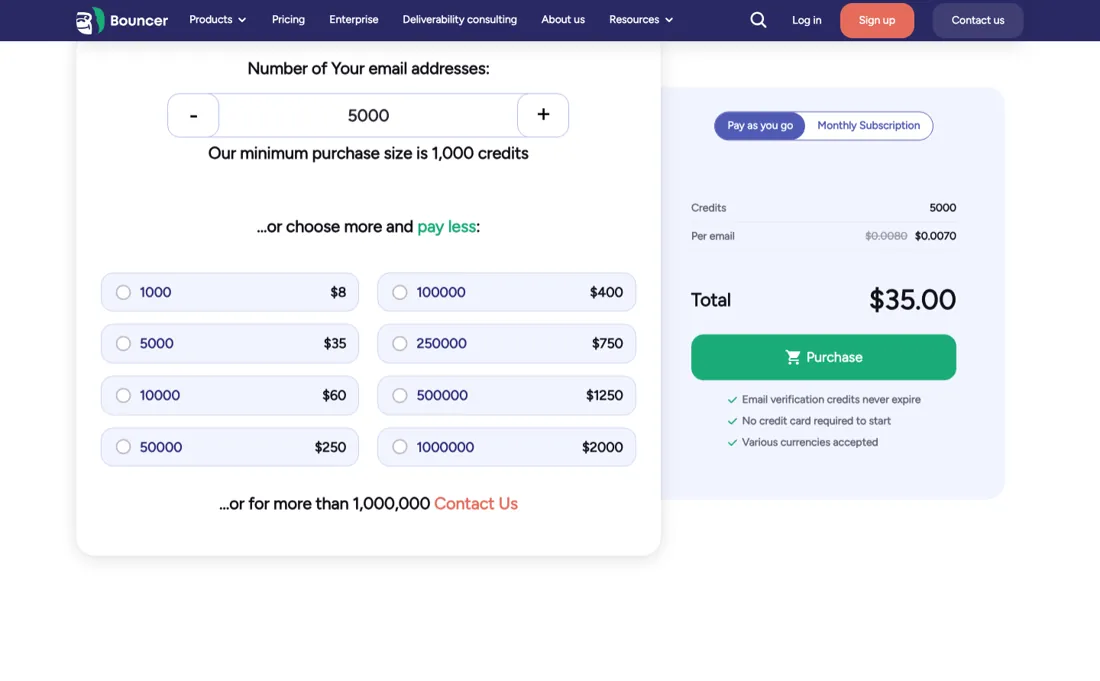
Email verification credits, pay-as-you-go and never expiring: $8 per 1,000 credits is the minimum purchase. Volume brings the rate down to $35 per 5,000, $60 per 10,000 and $250 per 50,000. Above that it runs $400 per 100,000, $750 per 250,000, $1,250 per 500,000 and $2,000 per 1,000,000 - about $2 per 1,000 at the top volume, with anything above a million quoted by sales.
The same calculator offers a monthly-subscription mode for verification that Bouncer states is discounted against pay-as-you-go; it publishes no fixed monthly tiers, so price it at your own volume. 100 free credits to test; duplicates and 'unknown' results aren't charged. The $25/$125/$250 per month tiers are the separate Deliverability Kit and now carry published allowances - 250, 1,000 and 2,500 test emails and 10, 25 and 50 IPs or domains monitored, with an unlimited Enterprise tier on quote.
Shield is a separate real-time product laddered by monthly checks: $2 for 1,000, $20 for 10,000, $300 for 250,000 and $1,050 for 1,000,000. Plans change — always verify the live price on their site.
Correction after re-checking: Bouncer sells email verification as credits, in two purchase modes on one calculator. There are pay-as-you-go blocks — 10,000 credits is a $60 one-off purchase, not a monthly fee — and a monthly-subscription mode Bouncer states is discounted against it, with no standing tiers published. The $25/$125/$250 per month tiers belong to the separate Deliverability Kit (inbox-placement monitoring) and the Shield subscriptions from $2 per month cover signup-form verification (re-verified 2026-08-11).
What the pricing page doesn’t say
The honest framing for any verifier: it removes invalid addresses, which protects deliverability, but it can't make a cold list warm or a purchased list legitimate. Verify before every big send (lists decay measurably per month), and treat 'accept-all' domain results as the gamble they are, not as verified.
What Bouncer does
Email-list verification sold as credits that never expire: $8 per 1,000 (also the minimum purchase), falling to about $2 per 1,000 at the top volume. Unknowns and duplicates are not charged. Treat 'accept-all' domain results as unverified.
What buyers report about Bouncer
Recurring themes from the buyer-review sites listed at the foot of this page, read in August 2026. We have not run Bouncer ourselves, so this is other buyers' experience rather than ours. We summarise it here because the complaints are usually the part a vendor page leaves out.
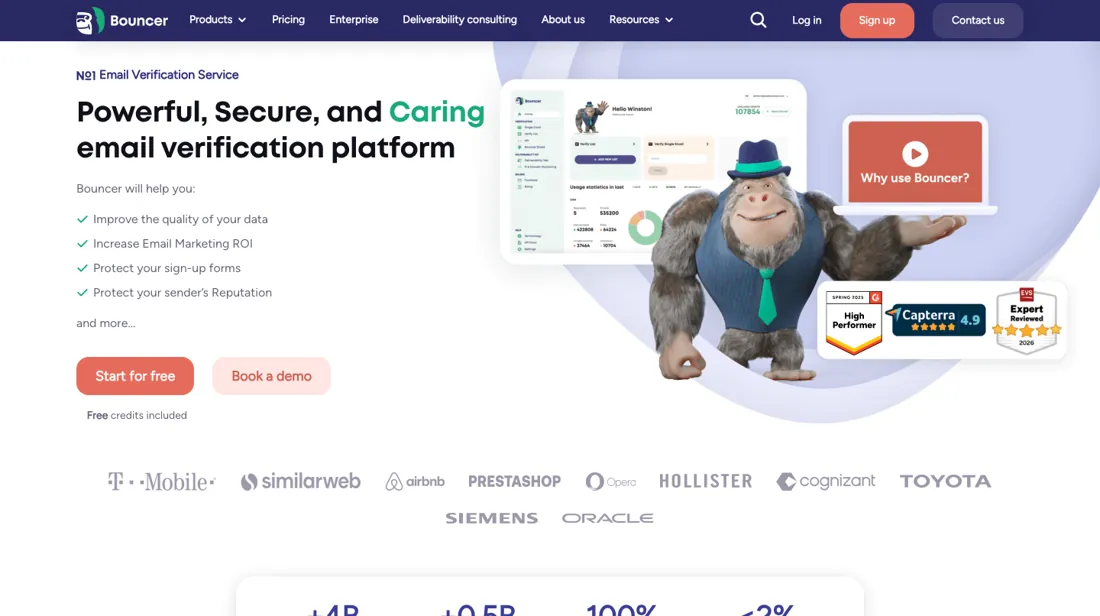
- • 4.8 on G2 across 332 reviews and 4.9 on Capterra across 279 — reviewers name transparent pricing and a clean interface.
- • Pay-as-you-go at $8 per 1,000 with no subscription required, which suits occasional list cleaning.
- • Catch-all domains are the industry's hardest case, Bouncer included: r/coldemail users report bounces on addresses Bouncer marked deliverable. Bouncer says it resolves many catch-all addresses hosted on Google and Microsoft infrastructure and returns risk signals rather than a verdict when it cannot be certain. Either way, treat an accept-all result as a gamble before you trust a large clean list.
- • Reviewers also report false positives and unclear 'risky' verdicts, and ask for more detailed reporting.
- • Individual reviewers put non-urgent support replies at 24-48 hours; Bouncer says it offers premium email and chat support.
- • Costs add up on large lists - $60 for 10,000 credits and $750 for 250,000 on pay-as-you-go (prices re-verified August 2026).
When the paid plan is worth it
Bouncer has no free tier beyond the 100 credits on signup, and verification is sold as credits two ways: one-off pay-as-you-go blocks, or a monthly-subscription mode Bouncer states is discounted against them. The lever is how much volume you commit to, and whether you commit monthly. Pay-as-you-go runs $8 for 1,000 credits — also the minimum purchase — then $35, $60, $250, $400, $750, $1,250 and $2,000 at 5,000, 10,000, 50,000, 100,000, 250,000, 500,000 and 1,000,000.
The per-credit rate improves fastest across the lower and middle tiers and flattens after 250,000, so the largest blocks repay only at sustained volume; credits never expire. Buying a bigger block changes nothing else: it does not raise throughput, which the docs put at 100-200k addresses per hour and adjustable only by asking, nor shorten the 15-minute retry window that makes small and large jobs take comparable time. The $25, $125 and $250 Deliverability Kit tiers are a different product — inbox-placement monitoring — and their allowances make the middle rung the worst buy: they cover 250, 1,000 and 2,500 test emails, so Standard costs $0.125 a test where both neighbours cost $0.10.
Shield, the signup-form product, is cheaper per address than list cleaning: $2 per 1,000 real-time checks against $8 per 1,000 credits.
Our monthly capture read this vendor's pricing page in July 2026 and again in August 2026, and the amounts were the same both times. We keep watching — the registry records what moves.
How to actually use Bouncer
Bouncer's documented route is short. Create an account at app.usebouncer.com, which comes with 100 free credits. From there you either upload your list as a CSV file, the format the FAQ names, or take the API path. For the API, open API in the left-hand menu, press Generate API Key, and pass it as an x-api-key header or as the password in Basic auth. A sandbox lets you test the integration free of charge.
Distilled from This comes from vendor material only - Bouncer's pricing page at usebouncer.com/pricing/ (the verification credit calculator, the Deliverability Kit tiers with their test-email and IP allowances, and the Bouncer Shield check ladder), re-read on 11 September 2026, plus the FAQ and the developer docs (quick start, integration guidelines, and the batch and batch/sync API references) read on 2026-07-29; we found no independent walkthrough worth citing, since the third-party pages that surfaced were comparison or competitor-blog content, and an earlier attempt at the one third-party integration guide (a LeadsHook help article) returned HTTP 403.
Common Bouncer setup mistakes
Where Bouncer setups actually go wrong, and what it costs you when they do. Same sources as the setup notes above — not from a walkthrough we ran ourselves.
The friction sits elsewhere.
- Signing up with a private Gmail or Hotmail address is not accepted unless you email Bouncer first and explain who you are, so a human gate can precede your first verification.
- Results are not instant either: retries run for up to 15 minutes, which is why small and large jobs take a similar time.
- Batches process sequentially, so a 100,000-email batch delays a 1,000-email batch queued behind it.
- Batch/Sync caps a request at 10,000 emails and caches results for 24 hours, after which the same address is charged again.
- The dashboard itself is behind a customer login.
The natural comparison is ZeroBounce or NeverBounce — the verification peer set — accuracy claims are near-identical; compare per-1,000 rates at your volume and the unknown/duplicate billing policy. Weigh it against ZeroBounce on the job you actually need done.
More on Bouncer
Everything we publish about Bouncer links back here — the review stays the honest hub:
The ex-banker filter — the same yardstick on every review (how we review): My ex-banker filter is simple: does Bouncer remove a real cost — time, errors, missed revenue — bigger than what it charges?
Frequently asked questions
What should I weigh before buying Growth & Revenue software?
It depends on whether you have the bottleneck it solves. Small teams get the most out of this category when one clear problem is already costing real hours or revenue; buying ahead of that just adds cost and another login. Price it against the hours or lost deals it removes, not against its feature list, and start on the smallest plan that covers the job.
Is this a hands-on review of Bouncer?
This is a researched assessment, not a hands-on test — where we've used a tool ourselves, we say so explicitly. We name what each tool is genuinely good and bad at, and we earn a commission only if you sign up, at no cost to you.
- Buyer reviews on G2, Capterra, GetApp and Reddit, read August 2026.
- Bouncer’s own published pricing page.
- A dated screenshot of that pricing page, kept on this site as the receipt.
Others in this category
Reviewed growth & revenue tools that share ground with Bouncer — comparable in what they do, not drop-in swaps:
New dossiers, cost-traps we found, and tools that earned a keep — no hype, no sponsored-disguised-as-advice. Unsubscribe anytime.
This is our researched assessment — not a paid placement. The “Visit” links on this page are affiliate links: we may earn a commission if you sign up, at no extra cost to you, and it never changes our take. How we review →