 CallRail Review (2026)
The headline price is a floor, not a ceiling — the included minutes, numbers and SMS are modest, so an active campaign quickly hits metered overages that meaningfully lift the bill.
Visit CallRail → Affiliate link — the rest of this page is the honest version, including who should skip it.
Watch the 2-minute review
Same honest take, in video form — from our YouTube channel.
⚡ Short on time? Watch the 30-second verdict Short.
Pricing (2026)
✓ Pricing re-verified 6 Sep 2026
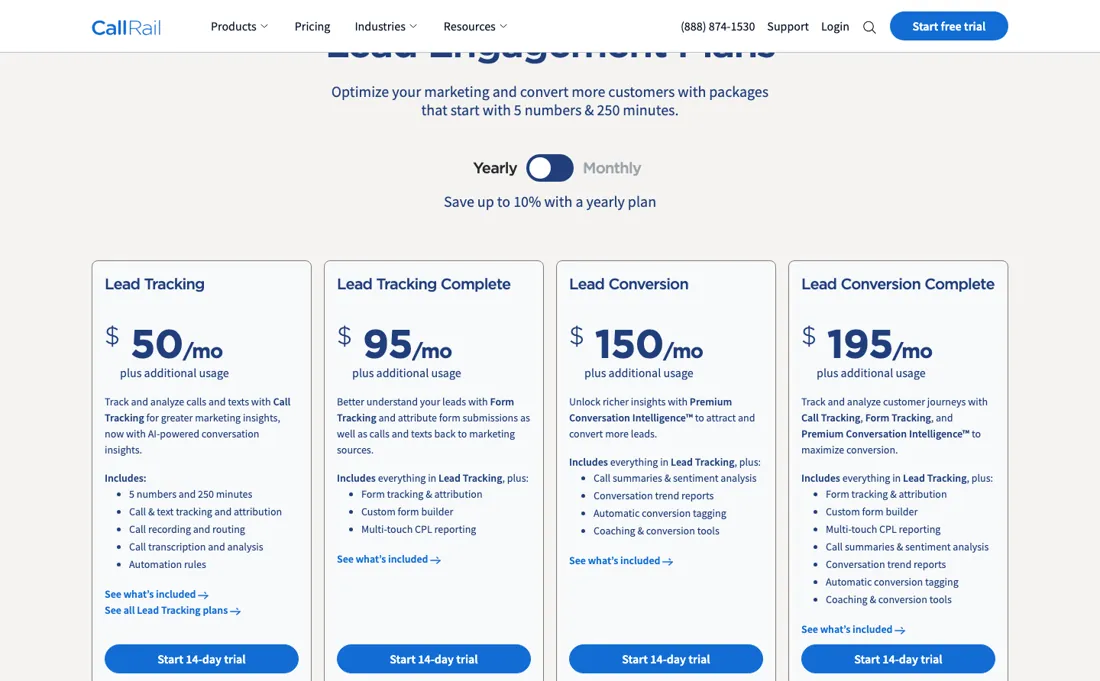
Four plans, read on callrail.com/pricing on 5 September 2026, each 'plus usage': Lead Tracking $55 a month, Lead Tracking Complete $105, Lead Conversion $165 and Lead Conversion Complete $215; on yearly billing the same four read $50, $95, $150 and $195 a month (read 6 September 2026; the page states “Save up to 10% with a yearly plan”). Voice Assist (the AI answering agent) is a separate add-on from $95 a month for 50 calls, then $1 a call.
Usage past the included allowance is metered: extra local numbers $3 each, local minutes $0.06, toll-free numbers $5. Users are unlimited on every plan. 14-day free trial. Plans change — always verify the live price on their site.
Correction after re-checking: (2026) No free plan; a 14-day trial with no credit card required. Four packages, priced per account rather than per user — users are unlimited on every plan. On annual billing: Lead Tracking $50/mo, Lead Tracking Complete $95/mo, Lead Conversion $150/mo, Lead Conversion Complete $195/mo. Month-to-month is higher: $55, $105, $165 and $215. All tiers meter usage on top of the base fee. Entry-level Lead Tracking includes 5 local numbers, 250 local minutes and 25 text messages; overages run $0.06 per local minute, $3.00 per extra local number and $0.03 per text. Higher Lead Tracking tiers buy bigger buckets at cheaper rates: $68/mo for 750 minutes, $85/mo for 10 numbers and 1,000 minutes, $265/mo for 40 numbers and 4,000 minutes. The 25-text allowance does not increase at any tier. Add-ons: White Label $65/mo, Advanced Callflows $15/mo per company, Premium Integrations $80/mo. Voice Assist starts at $95/mo including 50 calls, then $1 per additional call over 15 seconds. (re-verified 31 Jul 2026)
What the pricing page doesn’t say
It's also specifically an attribution tool: it proves which marketing drives calls and leads, but it isn't a phone system or CRM, so you add it alongside those, not instead of them.
What CallRail does
Call tracking and attribution — which campaigns, keywords and ads produce phone calls and form leads. It is an attribution layer, not a phone system or CRM.
What buyers report about CallRail
Recurring themes from the buyer-review sites listed at the foot of this page, read in August 2026. We have not run CallRail ourselves, so this is other buyers' experience rather than ours. We summarise it here because the complaints are usually the part a vendor page leaves out.
- • Call attribution that marketers actually trust, and easy to run — 4.5 on G2 across 1,600+ reviews, with several reviewers saying they would pay more.
- • A 14-day trial on every tier.
- • Per-minute fees apply to answered and unanswered calls alike, with no warning alerts. Reviewers describe a $50 plan becoming a $200 bill. This is the thing to model before you buy.
- • Every base plan caps at 250 local minutes, and spam calls count against them with no refund.
- • Cancellation is reported as very difficult — one Trustpilot reviewer describes an unexpected $500 charge months after believing the account was closed.
- • Two parallel plan lines confuse new buyers, AI features sit on expensive tiers, and per-account billing punishes agencies.
- • Tier-2 support non-responsiveness surfaced independently in separate reviews.
When the paid plan is worth it
CallRail has no free plan, so the real choice is the entry tier versus the intelligence tiers. Lead Tracking is $55 a month plus usage (read 5 September 2026) and includes a small bundle of local numbers, minutes and texts. Users are unlimited, so the bill scales with call volume rather than headcount, and volume is what squeezes first: past the allowance each extra local minute is $0.06, each extra local number $3 and each toll-free number $5.
Upgrade for volume before you upgrade for features. The feature tiers, Lead Tracking Complete at $105, Lead Conversion at $165 for Premium Conversation Intelligence and Lead Conversion Complete at $215 adding form tracking, only repay themselves if someone will actually read the transcripts and act on the attribution.
How to actually use CallRail
Every account starts with a 14-day free trial and no credit card. CallRail documents the first pass as under 10 minutes: create a tracking number, install the JavaScript snippet, set up notifications, place a test call, then open the activity dashboard. Paste the snippet on every page right before the closing </body> tag, then dial your tracking number from a phone other than the destination number — if the destination rings, the routing works.
The snippet is where it goes wrong. Dynamic number insertion only swaps a number that matches your swap target, so span tags splitting the digits, stylised dashes, or a script nested inside an iframe or noscript element will fail silently. Caching plugins such as WP Rocket can strip the snippet altogether. The slower traps are scheduling ones: texting is blocked during the trial and needs A2P 10DLC registration that can take up to 30 days, and porting an existing number in runs 4-6 weeks.
Distilled from CallRail help center: getting-started, JavaScript snippet, swap target formatting, caching plugins, 10DLC registration and number porting articles
CallRail vs WhatConverts, side by side
Both columns come from the same place: each vendor’s own published pricing, read on the date shown in the sources at the foot of this page. We do not average them into a score.
Both names above are affiliate links: we may earn a commission if you sign up, at no extra cost to you. Neither changes what this table says: both columns come straight from the vendors’ own pricing pages.
The natural comparison is WhatConverts or a platform's native tracking — comparable attribution tools — compare on included minutes and how your real call volume meters.
More on CallRail
Everything we publish about CallRail links back here — the review stays the honest hub:
The ex-banker filter — the same yardstick on every review (how we review): My ex-banker filter is simple: does CallRail remove a real cost — time, errors, missed revenue — bigger than what it charges?
Frequently asked questions
What should I weigh before buying Growth & Revenue software?
It depends on whether you have the bottleneck it solves. Small teams get the most out of this category when one clear problem is already costing real hours or revenue; buying ahead of that just adds cost and another login. Price it against the hours or lost deals it removes, not against its feature list, and start on the smallest plan that covers the job.
Is this a hands-on review of CallRail?
This is a researched assessment, not a hands-on test — where we've used a tool ourselves, we say so explicitly. We name what each tool is genuinely good and bad at, and we earn a commission only if you sign up, at no cost to you.
- Buyer reviews on G2, GetApp and Trustpilot, read August 2026.
- CallRail’s own published pricing page.
- A dated screenshot of that pricing page, kept on this site as the receipt.
Others in this category
Reviewed growth & revenue tools that share ground with CallRail — comparable in what they do, not drop-in swaps:
New dossiers, cost-traps we found, and tools that earned a keep — no hype, no sponsored-disguised-as-advice. Unsubscribe anytime.
This is our researched assessment — not a paid placement. The “Visit” links on this page are affiliate links: we may earn a commission if you sign up, at no extra cost to you, and it never changes our take. How we review →