 Birch Review (2026)$49/mo to a $10k Ad-Spend Ceiling
The honest catch is that pricing tracks your ad spend, so a scaling advertiser's bill rises with their budget: Pro alone ladders from $99 to $1,799 a month between a $10,000 and a $500,000 ceiling, and past $500,000 only Enterprise is left.
Visit Birch → Affiliate link — the rest of this page is the honest version, including who should skip it.
Watch the 2-minute review
Same honest take, in video form — from our YouTube channel.
⚡ Short on time? Watch the 30-second verdict Short.
Pricing (2026)
✓ Pricing re-verified 11 Sep 2026
(2026, formerly Revealbot) Essential is $49/mo and Pro $99/mo up to $10K of monthly ad spend, and the price then tracks total spend across all connected accounts. Essential steps to $149 at $30K, $299 at $75K and $499 at $150K, where the tier stops; Pro steps to $249, $499, $799, $1,299 and $1,799 against $30K, $75K, $150K, $300K and $500K. Above $500K only Enterprise remains, priced on request with no spend limit.
Every current tier card reads ‘No overages apply’ — the percentage-of-overspend meter now applies to legacy monthly plans only, and the pricing FAQ’s own ‘About overages’ link 301-redirects to an article titled about-additional-charges-legacy-plans. 14-day free trial, no card required. Annual billing is charged as eleven months ($540 Essential, $1,090 Pro at the $10K tier), though the same FAQ still claims ‘12 months for the price of 10’. Plans change — always verify the live price on their site.
What the pricing page doesn’t say
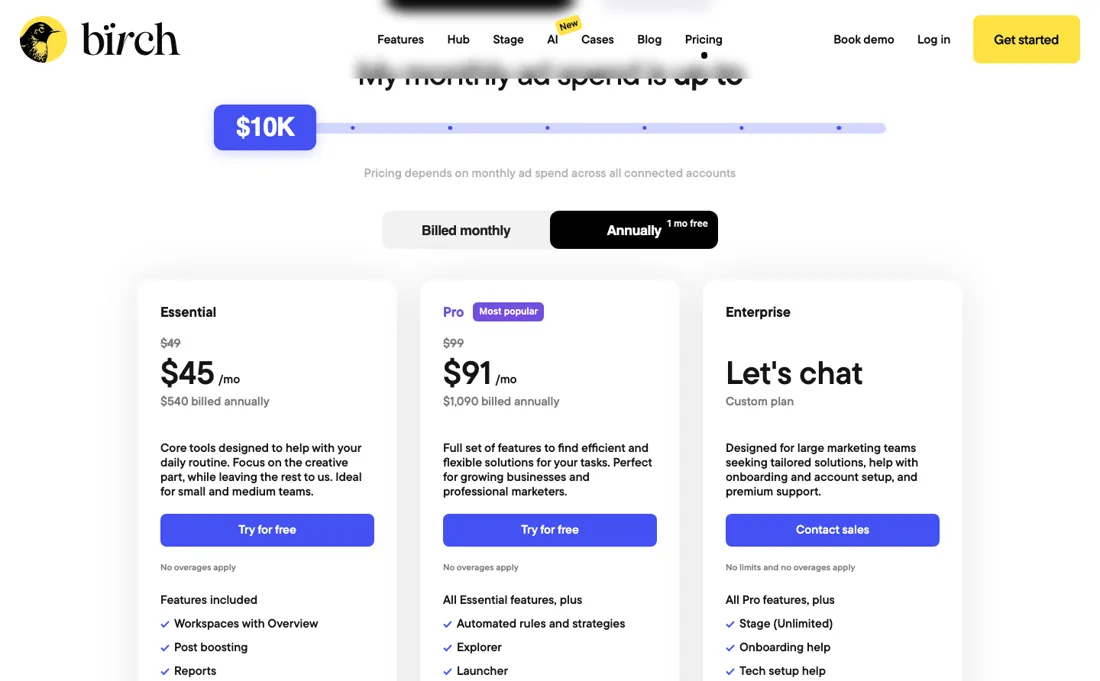
Check the annual arithmetic against their own FAQ, which promises ‘12 months for the price of 10’ while the page charges eleven — $540 for Essential and $1,090 for Pro at the entry tier. It's also a power tool: rule-based automation across Meta, Google, TikTok and Snapchat rewards advertisers who know what to automate, and can amplify mistakes if your rules are wrong. For hands-on performance marketers, it's a serious time-saver.
What Birch does
Ad automation for performance marketers (formerly Revealbot): rule-based optimization, automated scaling and creative insights across Meta, Google, TikTok and Snapchat — run and optimize ad campaigns on autopilot.
What buyers report about Birch
Recurring themes from the buyer-review sites listed at the foot of this page, read in August 2026. We have not run Birch ourselves, so this is other buyers' experience rather than ours. We summarise it here because the complaints are usually the part a vendor page leaves out.
- • Automation rules genuinely stop budget running away, and reviewers say the creative upload plus reporting in one place saves the most time.
- • Every plan includes unlimited team members, API access and Slack reports.
- • Price is the main complaint — $69/month up to $10K ad spend, rising to $299 at $500K. Reviewers say it gets steep fast at real spend, and one calls the structure anti-agency.
- • The interface is not friendly for anyone newer to paid media, and reviewers describe it as time-consuming to learn.
- • You are buying rules-based automation on top of Meta — if you would not write those rules yourself, the tool will not write them for you.
When the paid plan is worth it
Birch's real split is not free versus paid but reporting versus automation. Essential starts at $49 per month at up to $10,000 monthly ad spend and gives you Workspaces, Post boosting, Reports, the Activity page and Slack alerts; automated rules and strategies, Explorer, Launcher, Stage, top audiences and custom metrics all sit on Pro, which starts at $99 per month. If rule-based optimisation is why you are looking at Birch, Essential is not a cheaper version of the product.
Price then tracks spend: Pro runs $99, $249, $499, $799, $1,299 and $1,799 against limits of $10,000, $30,000, $75,000, $150,000, $300,000 and $500,000. Essential stops at $499 and a $150,000 limit, so crossing into the $300,000 band means Pro at $1,299 — an $800 step that buys headroom, not features. What no upgrade fixes is measurement: Hub's server-side tracking is billed separately by event volume on top of any plan, free to 10,000 events a month and $499 at 150 million, and Stage stays on its free version until Enterprise.
Every current tier card now reads ‘No overages apply’ while the FAQ still describes a percentage charge, so pin down which regime your contract is on before you sign.
Our monthly capture read this vendor's pricing page in July 2026 and again in August 2026, and the amounts were the same both times. We keep watching — the registry records what moves.
How to actually use Birch
You sign up with an email, no card required, and get a 14-day trial; then, under Settings and Platforms, you authorise Meta, Google, TikTok or Snapchat and assign each ad account to a Workspace, since only assigned accounts count as connected and are billed. Birch's own course runs to 17 videos across four chapters, with setup a single lesson in the Getting started chapter, and its help center's Getting started collection runs to 32 articles.
Distilled from Vendor pricing page https://bir.ch/pricing (read 2026-09-11 in a live browser; the ad-spend slider was stepped through all seven positions to read the Essential and Pro ladders, and the Hub tab for the event-volume prices); the overages help article linked from that page, https://help.bir.ch/en/articles/6083528-about-additional-charges, which 301-redirects to https://help.bir.ch/en/articles/6083528-about-additional-charges-legacy-plans (read 2026-09-11) and states the charge ‘applies only to monthly plans’ with a worked example on a $199 tier that no longer appears on the pricing page; the pricing-page FAQ on the trial, annual billing and cancellation (read 2026-09-11). Setup details come from Birch's own help center and the transcript of its course, read 2026-08-02.
Common Birch setup mistakes
Where Birch setups actually go wrong, and what it costs you when they do. Same sources as the setup notes above — not from a walkthrough we ran ourselves.
The friction is on the platform side.
- Birch lists only Meta assets where you are an admin of both the Business Manager and the ad account.
- Their troubleshooting article blames missing accounts on permissions, on delays after admin rights are granted, and on Meta glitches — re-authorising or toggling admin rights off and on is the fix.
- A Workspace takes unlimited ad accounts, but each ad account can sit in only one Workspace.
- Unlinking is destructive: rules become drafts, and reports, custom metrics and launch templates are deleted permanently.
- Server-side tracking needs a CNAME to signals.birch.events, with propagation up to 48 hours.
The natural comparison is Madgicx or the native ad managers — comparable ad-automation platforms — Birch's edge is granular rule automation; compare on spend-based pricing at your budget.
More on Birch
Everything we publish about Birch links back here — the review stays the honest hub:
The ex-banker filter — the same yardstick on every review (how we review): My ex-banker filter is simple: does Birch remove a real cost — time, errors, missed revenue — bigger than what it charges?
Frequently asked questions
What should I weigh before buying Growth & Revenue software?
It depends on whether you have the bottleneck it solves. Small teams get the most out of this category when one clear problem is already costing real hours or revenue; buying ahead of that just adds cost and another login. Price it against the hours or lost deals it removes, not against its feature list, and start on the smallest plan that covers the job.
Is this a hands-on review of Birch?
This is a researched assessment, not a hands-on test — where we've used a tool ourselves, we say so explicitly. We name what each tool is genuinely good and bad at, and we earn a commission only if you sign up, at no cost to you.
- Buyer reviews on G2, Capterra and Software Advice, read August 2026.
- Price re-verified 2026-09-11 against the vendor's own pricing page.
- A dated screenshot of that pricing page, kept on this site as the receipt.
Others in this category
The growth & revenue tools closest to Birch that we have also reviewed. They overlap rather than match:
New dossiers, cost-traps we found, and tools that earned a keep — no hype, no sponsored-disguised-as-advice. Unsubscribe anytime.
This is our researched assessment — not a paid placement. The “Visit” links on this page are affiliate links: we may earn a commission if you sign up, at no extra cost to you, and it never changes our take. How we review →