Clay Review (2026)
 By Daan Haket · Tested hands-on · written with an AI assistant · who does what
Two honest catches: a steep learning curve (expect 2–4 weeks, many teams need a dedicated Clay expert), and credits that are hard to forecast at scale. It's an enrichment engine, not a sender — you still need Instantly, Lemlist or Outreach to actually email. Throughout this review we weigh it against ZoomInfo.
Exit test (measured 2026-10-30)
- Export route
- Tools > Export > Download CSV
- Formats
- CSV
- Attachments included
- Not tested
- Re-import tested
- With our own file, not the standard kit (see below)
- Lost on export
- Nothing we checked
Formats describe this export route; offered formats may not have been inspected. Full exit test and scope ↓
modern GTM and ops teams who want best-in-class waterfall enrichment and custom research workflows — and have someone to own it.
you want to sign up and prospect on day one, or you can't dedicate time to learn it — the curve and credit spend frustrate casual users.
Transparency: we earn nothing from Clay; the links to it are plain links. How we make money →
Tested by our team on 30 October 2026 on the free trial: Daan created the account and our AI assistant ran the test in Daan's browser. We imported a two-row test CSV into a new table without running any enrichment, exported it and compared every field.
How we tested
- Imported our two-row test CSV into a new table
- Downloaded the table as CSV and compared every field
- Looked at the import options and the plan checkout
- The account came with 1,000 data credits and 5,000 actions every two weeks, with no card. Setup asks four survey questions and a tool must be picked before you can continue.
- The CSV import has no field mapping step: every column became a text column.
- The CSV export brought back all eleven columns of both rows, including accents, quotes and line breaks. Amounts lost a trailing zero (12.10 became 12.1).
Pricing (2026)
✓ Pricing re-verified 19 Oct 2026
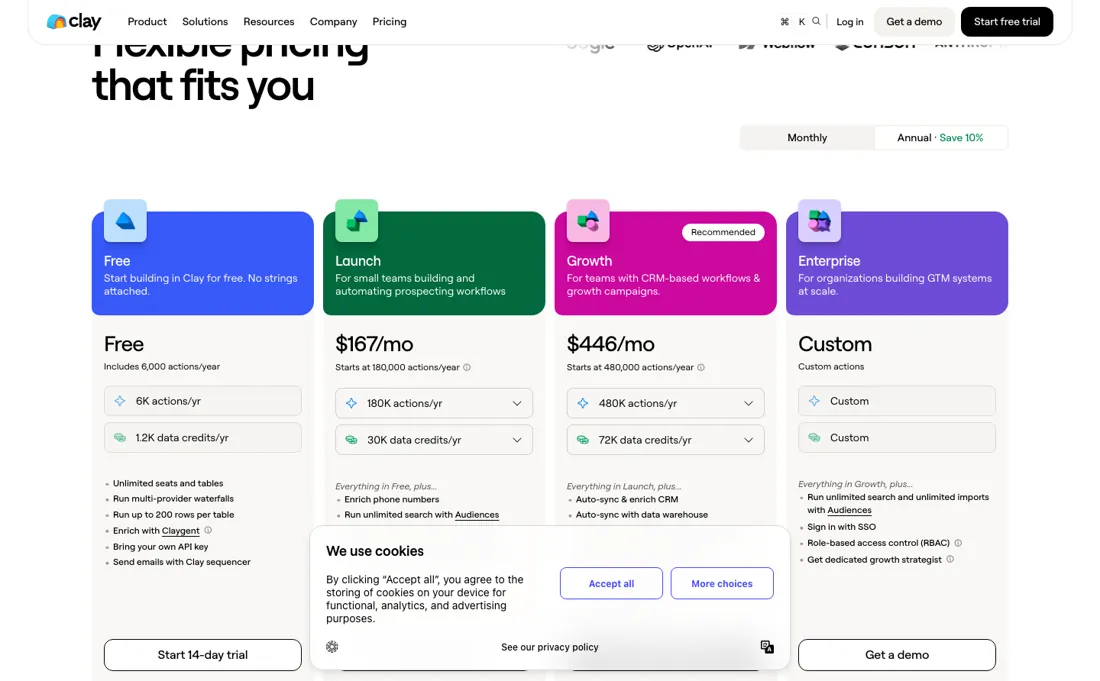
Clay meters two things separately — actions and data credits — and each paid plan is an expandable volume rather than a fixed tier, which is the part most write-ups still get wrong, ours included until the August 2026 update. The free plan is real: 6,000 actions and 1,200 data credits a year, unlimited seats and tables, multi-provider waterfalls and Claygent, capped at 200 rows per table and with no phone enrichment.
Launch is advertised at $167/mo and Growth at $446/mo, and the page's own figures show how those are built: the smallest action step plus the smallest data-credit step on annual billing ($54 + $113 = $167 for Launch, $185 + $261 = $446 for Growth). The plan FAQ's “starting at $185/mo” for Launch and “$495/mo” for Growth are the same pairs billed monthly ($60 + $125 and $205 + $290).
Full pricing notes (3 more paragraphs)
The “Starts at $54/mo” and “$185/mo” lines on the cards price the action meter alone. The served page offers no data-credit step below 30,000 a year on Launch or 72,000 on Growth, and it does not say whether a plan can be bought with actions only. Our earlier reading treated $54 as the Launch floor, and that was wrong. Billed monthly the Launch action ladder runs $60, $150, $200, $290 and $540 for 15K, 40K, 60K, 100K and 200K actions a month; billed annually it runs $54, $135, $180, $261 and $486 a month for 180K, 480K, 720K, 1.2M and 2.4M actions a year.
Growth starts one rung higher: $205, $290, $450 and $850 a month for 40K to 200K monthly actions, or $185 to $765 a month on the annual ladder. Data credits are a separate meter again — monthly from $125 for 2,500 credits up to $2,125 for 50,000, or annually from $113/mo for 30,000 a year up to $1,913/mo for 600,000. Annual billing saves 10%.
Waterfall enrichment spends credits per lookup, so the credit meter rather than the plan is what decides the bill. Actions reset every cycle. Unused data credits on Launch and Growth bank up to twice the monthly amount, and top-ups on those plans cost 30% more than plan credits. Enterprise is quote-only.
Plans change — always verify the live price on their site.
Category context: Growth & Revenue. Across the 85 tools in this category that we researched with a public US-dollar price, the median entry price is about $30 a month (lowest paid plan as listed, per seat where the vendor prices per seat). Compare pricing conditions in the Software Cost Atlas →
What the price did
We read Clay’s own pricing page on a schedule and keep every reading, so this is our record of the page — not a forecast, and not someone else’s summary. A change appears here only after we confirmed the new price on the page itself.
Unchanged. Every price on Clay’s pricing page was identical across our 12 reads from 8 Aug 2026 to 2 Nov 2026 (86 days).
Clay's page looks volatile and is not. Our July and August 2026 captures carry exactly the same two ladders: $54, $135, $180, $261 and $486 a month for annual action volumes, and $60, $150, $200, $290 and $540 for monthly ones, plus the same $167 entry figure. The page returned those same numbers on 17 August 2026. What changed is our understanding of it: the credit-based description we carried before does not match any of the three readings.
Clay’s pricing page, as we read it
Watch the video review
The video version of this review, from our YouTube channel.
What Clay does
Waterfall enrichment and custom research workflows for go-to-market teams. It enriches rather than sends, so you still need a separate email tool.
What buyers report about Clay
Hands-on: tested 2026-10-30Reported by buyers: G2, Trustpilot and a survey of 500 GTM professionals, read August 2026
Themes from the buyer-review sites listed at the foot of this page, read in August 2026. We tested Clay ourselves on 2026-10-30, but one test is a narrow sample, so here is what other buyers report. We summarise it here because the complaints are usually the part a vendor page leaves out.
- • 150+ data providers in one waterfall with AI agents that research prospects — nothing else does this, and that is why reviewers persist through the learning curve. 4.7 on G2 across roughly 189 reviews.
- • The March 2026 pricing overhaul cut credit cost on the most-used enrichments by about half.
- • Credit burn is the most-repeated G2 dislike, and 42% of complaints in a 500-person GTM survey were about uncontrolled credit consumption. Reviewers describe spending $500 just learning the interface.
- • Failed lookups still consume credits, and top-up pricing carries a 30% markup that is not on the pricing page.
- • The learning curve is four to six weeks by reviewers' own accounts. Budget that as onboarding cost, not a weekend.
- • Support is slow, with bugs going unresolved. There is a free tier, and the paid plans are priced by action volume rather than by named tier.
Where the ratings disagree. 4.7 on G2 against 2.2 on Trustpilot — though that Trustpilot figure rests on only 9 reviews, so weigh it lightly. The theme in it is support and credits, which matches the G2 complaints rather than contradicting them.
Pages read (August 2026): Trustpilot
When the paid plan is worth it
Clay's free tier is a demo surface: 100 Data Credits and 500 Actions a month, 200 rows per table, and no phone number enrichment. Launch is priced at $167/mo on the plan card and $185/mo in the plan FAQ, with 2,500 Data Credits and 15,000 Actions a month. That is where it becomes operational: phone numbers, job-change and signal tracking, email campaign integrations and scheduled recurring enrichment runs. Clay's documentation sizes the Launch band, 2,500 to 10,000 Data Credits, at roughly 1,000 records a month; the FAQ's 2,500 is that band's floor.
Growth, $446/mo on the card and $495/mo in the FAQ, brings 6,000 Data Credits and 40,000 Actions. But the real reason to take it is plumbing: CRM auto-sync, HTTP API integrations, webhook automation, web intent signals and warehouse connections, with up to 250k CRM and warehouse imports. Without a CRM to write back to, the step is hard to justify. Seats and tables are unlimited on every plan, so you pay for throughput, not headcount.
Every enrichment costs one Action even with your own provider API key, Actions never roll over, and credit top-ups on Launch and Growth carry a 30% premium.
Our monthly capture read this vendor's pricing page every month from July 2026 to October 2026, and the amounts were the same all 4 times, including $765, $850, $1,913 and $2,125 from the pricing above. We keep watching — the registry records what moves.
What we found running Clay ourselves
The first findings are at the top of this page. The rest:
- The export has no Clay row ID of its own, and the import into an existing table offers no update-on-key option.
- Importing and exporting used none of the credits.
- Launch at $185 a month is preselected on the plan page. The cheapest plan, Flex, came to €46.64 a month at checkout with €0.00 tax shown.
Claim vs. what we measured
We set a claim from Clay's own pages next to what we saw in our test, on the plan named. The status says whether the two describe the same thing and match; it is not a verdict on the product. Confirmations are listed too.
| What the vendor says | What we measured | Status | What it means if you buy |
|---|---|---|---|
| Start 14-day trialSource: clay.com, read 25 Oct 2026 | Measured 2026-10-30: Billing says Plan Trial, Pricing Free, one thousand credits and five thousand actions per two weeks; Growth says Trialing. No explicit trial end date was shown.Our test, 30 Oct 2026; Trial; Pricing Free; Growth labelled Trialing | Not testableClay trial wording is compared with mixed Trial, Free and Trialing labels; the two-week credit interval is not an independently observed trial duration. | A fourteen-day expiry cannot be established from a biweekly zero-payment date. |
| No credit card required.Source: clay.com, read 25 Oct 2026 | Measured 2026-10-30: No card was requested according to source notes, and no payment details were entered in the observed route. Complete signup screens were not counted.Our test, 30 Oct 2026; Trial; Pricing Free; Growth labelled Trialing | ConfirmedClay onboarding and CSV work proceeded without a card; opening Flex checkout did not activate a subscription. | The recorded session proceeded without card entry; this does not promise payment-free access to every feature. |
| $50/moSource: app.clay.com, read 30 Oct 2026 | Measured 2026-10-30: Flex promotional USD 50 versus EUR 46.64 including displayed EUR 0 tax; currency conversion USD/EUR 0.9328 explains the session total. No matching rule.Our test, 30 Oct 2026; Trial; Pricing Free; Growth labelled Trialing | ConfirmedThe introductory Flex monthly selection, rather than default Launch, converts to the displayed EUR total with zero tax in this checkout; no matching cost rule is available. | The selected introductory Flex checkout totals EUR 46.64; do not confuse it with preselected Launch. |
Exit test: can you take your data out?
Imported the two-record kit CSV into a new table and exported the default view without running enrichment or connecting a CRM. Test date: 30 Oct 2026. We describe the friction rather than score it; this is one run with synthetic records, not a verdict on Clay.
| What we checked | What we saw |
|---|---|
| Came along in the export |
|
| Lost in the export | Nothing we could show was lost in this check. |
| Awkward but not lost | Import shows no field mapping or type-selection screen; every column uses a text icon. Date and amount value retention therefore does not prove typed columns. The attachment column contains filenames only; no image bytes were uploaded. Onboarding requires survey answers including at least one tool choice, and Escape does not close the first-use modal. Billing says Trial and Pricing Free with credits and actions replenished every two weeks, while Growth is labelled Trialing; no trial end date was shown. Launch was preselected before Flex was chosen. |
| Export route | Tools > Export > Download CSV. |
| Export format | UTF-8 CSV without BOM, LF endings, two rows and eleven columns in original order. Amounts normalize from 12.10 to 12.1 and from 24.20 to 24.2. |
| Re-importing the export | Export has no Clay row ID, only the supplied test_id. Import from CSV opens an upload box; update matching was not tested and no reimport was performed. |
| Cancelling | Actual cancellation, trial expiry and account deletion were not tested. |
What the exit test does not show:
- Complete signup screen count and human first-result setup time.
- Actual cancellation, expiry, deletion and follow-up mail.
- Kit fields that were not entered.
- Application reimport or restoration.
Kit check counts
Kit databases-tabellen 1.0.0; run clay-2026-10-30; observed 2026-10-30.
- export / AIBM-001: Of 10 checks: 7 kept, 0 changed, 0 lost, 1 not offered, 2 not tested
- export / AIBM-002: Of 10 checks: 7 kept, 0 changed, 0 lost, 1 not offered, 2 not tested
- reimport / AIBM-001: Of 10 checks: 0 kept, 0 changed, 0 lost, 0 not offered, 10 not tested
- reimport / AIBM-002: Of 10 checks: 0 kept, 0 changed, 0 lost, 0 not offered, 10 not tested
Each record and phase uses this kit’s checks. Counts describe this run; they are not a score or a comparison between kits.
Mail in the first 14 days
Measurement running until 2026-11-12T23:00:00Z (last observed 2026-11-02T02:18:01.612935Z).
3 emails in the 14-day window so far; first email after signup: unknown (exact signup time not recorded); 0 with an explicit offer.
Retained inbox and junk only; removed or archived mail is outside this observation. Ambiguous supplier attribution is excluded. Day numbers use elapsed 24-hour periods since the recorded signup date at midnight Europe/Amsterdam; the signup hour is unknown. Offer flags quote literal subject/body text. Replies in our own correspondence (support tickets, our comment requests) are excluded; one-time codes, our own address, our account name and our name are replaced in brackets.
| Day | Time (UTC) | Sender | Literal subject | Folder | Offer evidence |
|---|---|---|---|---|---|
| Day 0 | 2026-10-30 14:29:21 UTC | Clay team / clay.com | Verify your email to get started with Clay 🚨 | inbox | |
| Day 0 | 2026-10-30 14:57:25 UTC | Clay team / clay.com | Your Clay account is ready to go | inbox | |
| Day 2 | 2026-11-01 14:57:43 UTC | Clay team / clay.com | Verified contact details for every person on your list | inbox |
What this test does not show:
- Enrichments and AI research
- Re-importing to update rows
- Connecting a CRM
- Contacting support
Most of our reviews are researched rather than run — how we review explains which is which, and why we do not pretend otherwise.
Questions we are still checking
Facts about Clay that would change a buying decision, and where we stand on each. An unanswered question does not mean the feature is missing; it means we have not confirmed it yet.
- Can a Launch or Growth plan be bought with actions only, without a data-credit step? Still checking
Applies to: the card prices for Launch and Growth add the smallest action step to the smallest data-credit step; the served pricing page shows no data-credit step below 30,000 a year (Launch) or 72,000 (Growth).
Why it matters: decides whether the real Launch floor is $54 a month (actions only, e.g. with your own provider keys) or $167.
Checked: Clay pricing (2026-10-19)
Have a public source that answers one of these? How we review explains how we check and correct.
How to actually use Clay
Nothing happens in Clay until a table has a source: a CSV, a Find People or Find Companies list, a CRM import, or a webhook. Clay's documentation puts CRM, warehouse and webhook imports outside the Action meter, and importing first-party data consumes neither Actions nor Data Credits. Sourcing accounts and contacts costs no Action either, but does spend Data Credits unless you access free data or use your own API keys.
From there the work is a waterfall: pick the data point, order the providers, enter the required inputs, such as email addresses or social profile URLs. A documented stumbling block: adding a Find Company source to an existing table errors unless columns for professional social URLs or company domains already exist. Editing a source's filters after a run does not update existing rows; delete and re-run the step, or duplicate the table.
At the row limit, Clay imports records up to the limit and stops automatically, with no error message displayed. Salesforce Reports cap at 2,000 records (API restriction).
Where this section comes from: our research notes (105 words)
Clay's own pages, read 2026-07-31: the plan FAQ and plan comparison on the pricing page (https://www.clay.com/pricing) for plan contents, prices and top-up terms; the Sources doc (https://university.clay.com/docs/sources) for source types, the required-column error, the non-retroactive source edit, the behaviour at the row limit and the 2,000-record Salesforce Reports cap; the Waterfalls doc (https://university.clay.com/docs/building-a-data-waterfall) for the waterfall build steps and the required data inputs; and the Actions & Data Credits doc (https://university.clay.com/docs/actions-data-credits) for which activities consume Actions, which consume Data Credits, the per-record credit range and the Launch sizing band.
Plan prices, the plan FAQ and the credit rules re-read on https://www.clay.com/pricing on 19 October 2026.
Clay vs ZoomInfo, side by side
Where a vendor publishes a price, its column shows the entry price we read and when; where it does not, the column says so rather than filling in a figure from elsewhere. We do not average them into a score.
The ZoomInfo link above is an affiliate link — we may earn a commission if you sign up, at no extra cost to you — and the other column is a plain link. Neither changes what this table says.
The natural comparison is ZoomInfo or Apollo — the all-in-one data platforms. Weigh it against ZoomInfo on the job you actually need done.
Frequently asked questions
Can you export your data from Clay?
Exit check 2026-10-30; route excerpt: Tools > Export > Download CSV; came along (excerpts): Both rows and all eleven source columns return …; lost (excerpts): none recorded in this test; re-import: not tested.
What does Clay cost?
There is no single answer, because Clay meters actions and data credits separately and each is an expandable volume. Read on clay.com/pricing on 19 October 2026, the Launch headline of $167 a month is the smallest action step ($54) plus the smallest data-credit step ($113) on annual billing. Billed monthly, the same pair costs $60 + $125 = $185, which is the figure the plan FAQ quotes. Growth works the same way: $446 a month on annual billing, $495 billed monthly. From there, actions expand at $60, $150, $200, $290 and $540 a month for 15K to 200K, and data credits run from $125 a month for 2,500 to $2,125 for 50,000. Annual billing takes about 10% off. The page does not say whether a plan can be bought with actions only.
Is there a Clay free trial or discount?
Annual billing is the published discount, at 10% — modest by the standards of this category, where 20% is common. People search for Clay promo codes often; we have found none. The more useful lever is sizing: because both meters expand in steps, buying the step you need rather than the one above it matters more than any code would.
Why do people say Clay burns budget?
Because the plan is not the meter. Waterfall enrichment spends a data credit per lookup per provider, so a single list run through several providers consumes credits far faster than the action count suggests. The two ladders are independent: you can be well inside your action allowance and out of data credits in the same week. Watch the credit balance, not the plan.
Do unused Clay credits roll over, and what does topping up cost?
The two meters behave differently, per the pricing FAQ read on 19 October 2026. Actions reset every billing cycle and never carry over; if you hit the limit, the route is the next action tier. Data credits do carry over: on Launch and Growth, unused credits accumulate up to twice your monthly amount, so a 10,000-credit plan can bank 20,000 in total. Enterprise rolls over up to 15% of the prior year's credits, and only if you renew at an equal or higher commitment. Buying more credits mid-cycle on Launch or Growth costs 30% more than the credits in your plan. Two rules lower the bill: an enrichment that returns no result costs neither credits nor actions, and with your own provider API key you skip data credits and pay only actions.
Is this a hands-on review of Clay?
Yes. We tested Clay ourselves on 2026-10-30; the section above says what we tested, what we found and what we did not test, and where a figure comes from the vendor's own documentation instead. Most of our reviews are researched rather than run; we say which is which. We name what each tool is good and bad at, and we have no affiliate relationship with Clay — we earn nothing whether you sign up or not.
- Buyer reviews on G2, Trustpilot and a survey of 500 GTM professionals, read August 2026.
- Re-verified 2026-10-19 on clay.com/pricing; both billing terms read from the page markup, no figure has moved since our August reading, and our reading of the headline prices was corrected that day.
- A dated screenshot of that pricing page, kept on this site as the receipt.
- Our own hands-on session with Clay (2026-10-30), written up in full further down this page.
Others in this category
Reviewed growth & revenue tools that share ground with Clay — comparable in what they do, not drop-in swaps:
New reviews, price changes we recorded, and the cost conditions we found. No sponsored placements. Unsubscribe anytime.
This is our researched assessment — not a paid placement. How we review →