 Campaigner Review (2026)Automation Starts on the $35 Plan
Two paragraphs of fine print worth reading. Throughout this review we weigh it against Mailchimp.
Visit Campaigner → Affiliate link — the rest of this page is the honest version, including who should skip it.
Watch the 2-minute review
Same honest take, in video form — from our YouTube channel.
⚡ Short on time? Watch the 30-second verdict Short.
Pricing (2026)
✓ Pricing re-verified 5 Sep 2026
Campaigner prices by contact count and bills per account, not per user: a slider sets the tier and there is no separate monthly/annual toggle. Two self-serve plans: Essentials from $14 a month at 1,000 contacts ($38 at 5,000, $158 at 25,000, $409 at 100,000) and Advanced from $35 a month at 1,000 contacts ($70 at 5,000, $258 at 25,000, $649 at 100,000), plus a quote-only Custom tier.
Essentials excludes automation workflows and conversion tracking but includes the REST API, webhooks and SFTP; landing pages, sub-accounts and white-label are Custom only. SMS/MMS is not bundled into any plan: pay-as-you-go from $0.009 per message, sold through sales. Reputation Defender is an add-on at 20% of plan cost. The 30-day trial is full-feature but takes a card and auto-charges when it ends.
History: until July 2026 the page carried a Starter/Essential/Advanced ladder at about $59, $179 and $649 a month; the current ladder starts far lower and moves with the contact count. Plans change — always verify the live price on their site.
Correction after re-checking: (2026) Contact-based and billed per account rather than per user; a contact slider sets the tier and there is no separate monthly/annual toggle. Two self-serve plans: Essentials from $14/mo at 1,000 contacts ($38 at 5,000, $158 at 25,000, $409 at 100,000) and Advanced from $35/mo at 1,000 contacts ($70 at 5,000, $258 at 25,000, $649 at 100,000), plus a quote-only Custom tier. Essentials excludes automation workflows and conversion tracking, but does include the REST API, webhooks and SFTP. Landing pages, sub-accounts and white-label are Custom-tier only. SMS/MMS is not bundled into any plan — it is pay-as-you-go from $0.009 per message and gated behind sales. Reputation Defender costs an extra 20% of whatever your plan costs. The 30-day trial is full-feature but requires a card and auto-charges when it ends. (re-verified 31 Jul 2026)
The honest knock
Automation workflows and conversion tracking only arrive on Advanced (from $35 a month at 1,000 contacts) — Essentials is a sending tool with an API, not a marketing-automation platform — and the trial auto-converts to paid if you do not actively cancel, which tells you something about the retention strategy. Contact-based pricing also means dormant subscribers bill like active ones; prune first.
What Campaigner does
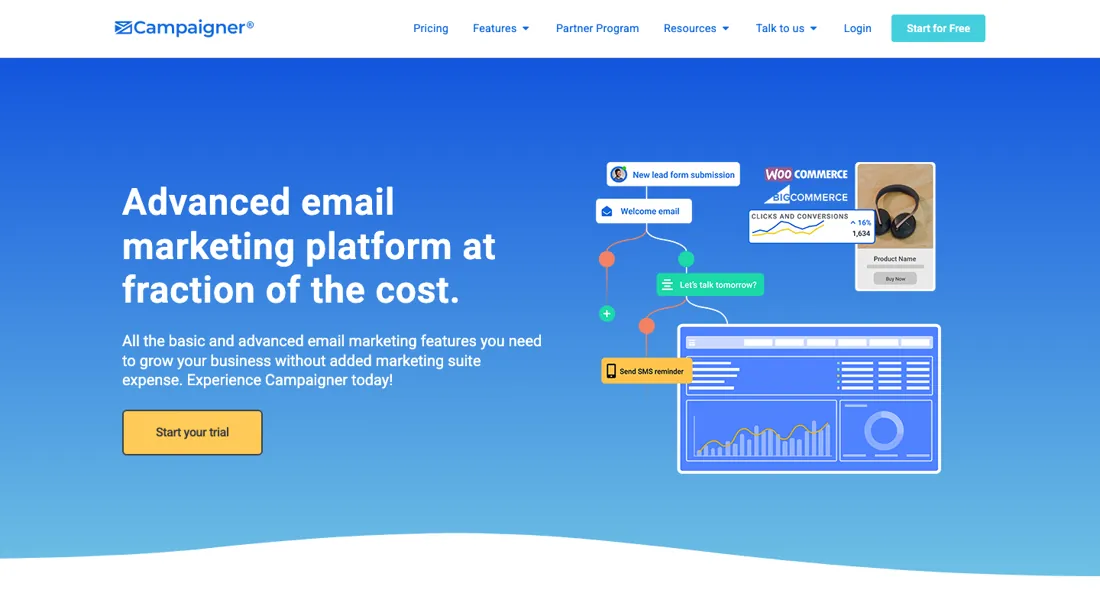
Email and SMS marketing for mid-market senders with larger lists. The useful features start high — automation and API only arrive on Essential at about $179/month, while Starter at $59 is a sending tool rather than an automation platform. Contact-based pricing bills dormant subscribers too.
What buyers report about Campaigner
Recurring themes from the buyer-review sites listed at the foot of this page, read in August 2026. We have not run Campaigner ourselves, so this is other buyers' experience rather than ours. We summarise it here because the complaints are usually the part a vendor page leaves out.
- • Segmentation and automation are deeper than the price suggests, and reviewers running complex campaigns rate the workflow builder.
- • $14/month at 1,000 contacts on Essentials is competitive on paper.
- • Cancellation requires a phone call plus 30 days' notice. Reviewers describe still paying for a month after the service stopped working for them.
- • The 30-day trial takes a card and auto-converts. Reviewers report being charged for over a year on a trial they never used.
- • SMS works only for US and Canadian numbers as of early 2026, and this is not stated prominently at signup. For a European team that is a dealbreaker discovered after paying.
- • No free version, and below 500 contacts reviewers say it is simply the wrong tool.
When the paid plan is worth it
There is no free tier — only a 30-day trial that takes a card. The real decision is Essentials versus Advanced, and pricing scales by contact count, not per user: $14 versus $35 a month at 1,000 contacts, $158 versus $258 at 25,000, $409 versus $649 at 100,000. The limit that bites first is automation. Essentials has no workflows at all — no time-based, rules-based or conditional triggers, no delay nodes — no conversion tracking, and no way to remove the Campaigner footer branding.
Stay on Essentials if you broadcast a scheduled newsletter to one list: you still get the drag-and-drop editor, A/B and multivariate testing, dynamic segments, the REST API, webhooks and SFTP. Advanced pays for itself the moment you want one triggered sequence, or want to attribute revenue to a send. Upgrading does not fix the ceiling above it. Landing pages, sub-accounts, SSO and white-label stay quote-only on the Custom tier. The media library is capped at 50MB on every plan, Reputation Defender adds 20% of plan cost at any tier, and SMS stays pay-as-you-go behind a sales conversation.
Our monthly capture read this vendor's pricing page in July 2026 and again in August 2026, and the amounts were the same both times. We keep watching — the registry records what moves.
How to actually use Campaigner
Start the 30-day trial — full-feature, but it takes a card and charges automatically when the trial ends unless you cancel first. Fix the sending identity before anything else. Campaigner's knowledge base carries separate articles for validating a business From domain instead of a Gmail or Yahoo address, and for SPF, DKIM and DMARC records. Its deliverability page describes authentication as something its team walks through with you. So treat DNS as a task with lead time, not a checkbox. Then run the import wizard, build in the drag-and-drop editor, and schedule.
Distilled from vendor pricing and SMS pricing pages, anti-spam policy and terms & conditions, the deliverability and tutorials pages, and the knowledge-base article index
Common Campaigner setup mistakes
Where Campaigner setups actually go wrong, and what it costs you when they do. Same sources as the setup notes above — not from a walkthrough we ran ourselves.
The trap is the first big send.
- The anti-spam policy states that campaigns are screened automatically and held until a postmaster reviews and clears them.
- The flags it lists include campaign size, the billing plan chosen, and how little time passed between account creation and scheduling — the exact profile of a new account.
- Campaigner's own remedy is to let support help with the first large list upload and to test-send to a few addresses first.
- Purchased or rented lists are refused outright.
Campaigner vs Campaign Monitor, side by side
Both columns come from the same place: each vendor’s own published pricing, read on the date shown in the sources at the foot of this page. We do not average them into a score.
Both names above are affiliate links: we may earn a commission if you sign up, at no extra cost to you. Neither changes what this table says: both columns come straight from the vendors’ own pricing pages.
The natural comparison is Campaign Monitor or ActiveCampaign — Campaign Monitor shares the polish, ActiveCampaign beats it on automation depth — compare at your real list size and feature floor. Weigh it against Mailchimp on the job you actually need done.
More on Campaigner
Everything we publish about Campaigner links back here — the review stays the honest hub:
The ex-banker filter — the same yardstick on every review (how we review): My ex-banker filter is simple: does Campaigner remove a real cost — time, errors, missed revenue — bigger than what it charges?
Frequently asked questions
What should I weigh before buying Growth & Revenue software?
It depends on whether you have the bottleneck it solves. Small teams get the most out of this category when one clear problem is already costing real hours or revenue; buying ahead of that just adds cost and another login. Price it against the hours or lost deals it removes, not against its feature list, and start on the smallest plan that covers the job.
Is this a hands-on review of Campaigner?
This is a researched assessment, not a hands-on test — where we've used a tool ourselves, we say so explicitly. We name what each tool is genuinely good and bad at, and we earn a commission only if you sign up, at no cost to you.
- Buyer reviews on Capterra, TrustRadius and Business.com, read August 2026.
- Re-read 2026-09-05 on campaigner.com/pricing.
Others in this category
Reviewed growth & revenue tools that share ground with Campaigner — comparable in what they do, not drop-in swaps:
New dossiers, cost-traps we found, and tools that earned a keep — no hype, no sponsored-disguised-as-advice. Unsubscribe anytime.
This is our researched assessment — not a paid placement. The “Visit” links on this page are affiliate links: we may earn a commission if you sign up, at no extra cost to you, and it never changes our take. How we review →